

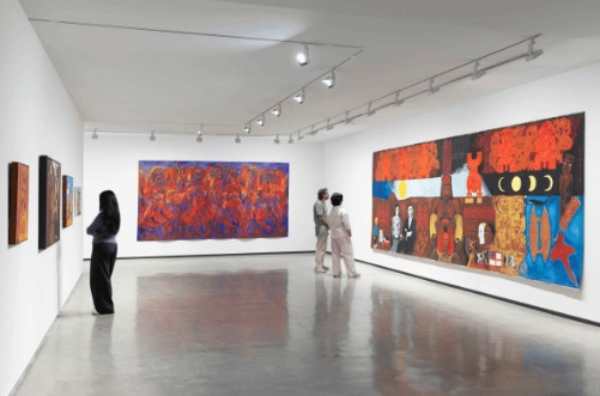
The Museum of Contemporary Art Australia (MCA Australia) presents My Ancestors Are Always With Me, a major exhibition celebrating the life, work and enduring legacy of Māori artist Robyn Kahukiwa (1938–2025).
Developed in partnership with Christchurch Art Gallery Te Puna o Waiwhetū, the exhibition is the first Australian solo exhibition dedicated to the Sydney-born artist, bringing together works spanning more than five decades. Opening at MCA Australia in the wake of Kahukiwa’s passing, the exhibition offers audiences a timely opportunity to encounter the extraordinary vision of an artist whose work transformed representations of Māori identity, culture and political struggle. The exhibition will travel to Aotearoa New Zealand, where it will open at Christchurch Art Gallery Te Puna o Waiwhetū in February 2027.
Born in Sydney in 1938, Kahukiwa (Ngāti Porou, Te Aitanga-a-Hauiti, Ngāti Konohi, Te Whānau-a-Ruataupare) reconnected with her Māori heritage after moving to Aotearoa New Zealand in the late 1950s. There she developed a powerful artistic language grounded in whakapapa (genealogy and ancestry), ancestral knowledge and Māori ways of knowing. Through vivid, emotionally charged paintings, Kahukiwa depicted the enduring impacts of colonisation while affirming the strength, resilience and sovereignty of Māori communities. Her uncompromising works address issues such as land rights, language revitalisation, racism, displacement and social inequality. Her paintings bring historical and contemporary experiences into dialogue, reflecting her belief that art and political struggle were inseparable. She once asked: ‘How can you paint about Māori and not paint about political issues? How can you separate the two?’
Central to Kahukiwa’s practice was a profound commitment to mana wāhine, celebrating Māori women as creators, nurturers, leaders, activists and protectors. Revered by generations of Māori women, Kahukiwa produced iconic images of motherhood, honouring women for their role in sustaining culture, community and future generations.
Through her distinctive visual language, Kahukiwa connected past and present, drawing on ancestral narratives and Māori carving traditions to create works that are both culturally specific and universally resonant. Her art speaks to the experiences of First Nations peoples globally and the ongoing search for identity, belonging and cultural continuity in the face of colonisation, migration and language loss.
The exhibition highlights key themes that defined Kahukiwa’s career, including identity, tino rangatiratanga (self-determination or sovereignty), whakapapa and mana wāhine (inherent strength, power and authority of Māori women). Together, the works reveal an artist deeply committed to her people and culture, whose images remain powerful expressions of resistance, pride and survival.
In her later years, Kahukiwa received increasing international recognition for her contribution to First Nations art history. Following her passing in 2025, her work continues to inspire artists, scholars and communities in Aotearoa New Zealand and beyond.
Exhibition curators Matariki Williams and Chloe Cull said: ‘We are deeply moved by the opportunity to present the first solo exhibition of Robyn Kahukiwa’s work in Australia. For more than five decades, Robyn Kahukiwa was uncompromising in her commitment to portraying Māori life and culture. Her paintings continue to inspire generations of artists and audiences and remain profoundly relevant today.’
Suzanne Cotter, Director, MCA Australia, said: ‘Robyn Kahukiwa’s work stands among the most significant contributions to First Nations art in the Pacific. Her powerful and deeply affecting paintings gave voice to Māori histories, experiences and aspirations that continue to resonate across cultures and generations. We are honoured to present her first major exhibition in Australia and to celebrate the enduring legacy of this remarkable artist.’
Robyn Kahukiwa: My Ancestors Are Always With Me invites audiences to engage with the breadth of an extraordinary artistic career and the enduring relevance of an artist whose vision helped redefine First Nations representation in contemporary art.











