

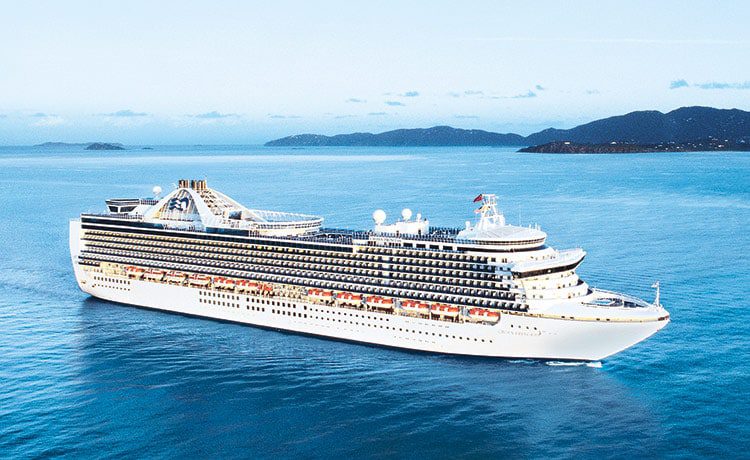
New Zealand’s 2026/27 cruise season is set to cast off in earnest this weekend, with Crown Princess returning to Auckland on Saturday, 3 October, in a timely show of confidence for a sector that has spent the past few years navigating more than just the weather.
The Princess Cruises ship is scheduled to arrive at Auckland’s Queens Wharf early on Saturday before departing that evening for Sydney. Port of Auckland currently lists Crown Princess arriving at 5.30 am and departing at 9.00 pm, after sailing from Moorea.
Her return follows an earlier Auckland visit on 29 August, which effectively gave the season an advance curtain-raiser. This weekend, however, is when the summer programme begins to gather serious momentum.
And momentum is precisely what New Zealand cruise needs.
Celebrity Edge Adds Star Power
Celebrity Edge follows soon afterwards, with Port of Tauranga listing the ship for Tuesday, 13 October, arriving at 6.00 am and departing at 5.15 pm.
From there, the familiar parade of funnels, balconies and increasingly adventurous shore-excursion footwear spreads across the country as Auckland, Tauranga, Wellington, Napier, Picton, Lyttelton, Dunedin and other destinations welcome international ships, passengers and crew.
For New Zealand’s visitor economy, that matters.
Cruise passengers do not simply admire the scenery from a balcony, photograph a fjord and disappear over the horizon. They buy excursions, fill cafés, visit attractions, shop locally and use coaches, taxis, guides and tourism operators.
Cruise lines themselves purchase port, provisioning and operational services. The spending reaches considerably further than the gangway.
According to the New Zealand Cruise Association’s latest season outlook supplied to industry, the 2026/27 programme is expected to comprise about 642 port calls, involving approximately 223,530 guests and 96,911 crew.
Those numbers suggest a season broadly resembling the previous year rather than a dramatic rebound. More importantly, however, signs suggest the prolonged decline in New Zealand cruise deployment may finally be approaching calmer waters.
That does not mean anyone should start firing the victory cannon.

Seeing plateau through 25/26 and 26/27 with positive signals for the 28/29 seasons
New Zealand Still Fighting for Ships
New Zealand remains in a fierce international competition for cruise ships, and deployment decisions are made years before a vessel appears beneath the Auckland Harbour Bridge.
A destination can offer magnificent scenery, warm welcomes and world-class shore experiences, but cruise-line boardrooms also weigh costs, regulatory settings, port infrastructure, biosecurity requirements and the ease — or difficulty of doing business.
In other words, Fiordland may sell the brochure, but certainty helps secure the ship.
NZCA’s Cruise Aotearoa New Zealand 2040 strategy says New Zealand cruise visitation has fallen about 40 per cent in a globally expanding cruise sector, underlining the scale of the recovery task.
Yet there are genuine reasons for encouragement.
Princess Cruises has announced plans to double its New Zealand port calls from the 2028/29 season, expanding its presence across nine ports and destinations. NZCA says the additional activity is expected to generate more than NZ$100 million in economic value.
That is significant because cruise deployment is decided well ahead of sailing dates. A commitment for 2028/29 is therefore not merely a cheerful press-release flourish; it is a commercial decision involving ships, schedules, capacity and substantial capital.
Celebrity Cruises is also maintaining a strong regional presence, with Celebrity Edge and Celebrity Solstice featuring prominently across current New Zealand port schedules.
For destinations that have endured a milder winter, particularly communities dependent on seasonal and domestic tourism, those visitors can provide a particularly welcome injection of business.
Government and Industry Pulling Together
New Zealand Tourism and Hospitality Minister Louise Upston has also placed cruise more prominently within the country’s tourism agenda.
When Crown Princess visited Auckland on 29 August, the Government said close to 200,000 cruise passengers were expected during the season and described cruise as an important contributor to regional tourism, employment, businesses and communities.
That government estimate and NZCA’s subsequently supplied industry figures are not identical, so they should not be treated as interchangeable measures. Both make clear the economic importance of rebuilding the sector.
The third Cross-Government Cruise Forum has subsequently brought together NZCA, Cruise Lines International Association, cruise operators, ports, tourism organisations and senior government agencies to discuss operational readiness, regulatory certainty and the settings influencing future deployment.
Upston chaired the forum, and NZCA says discussions centred on cross-government coordination, regulatory certainty, trans-Tasman cooperation and attracting more turnaround and homeport activity.
The subject may sound bureaucratic, but its commercial consequences certainly are not.
A cruise itinerary can be planned, priced and marketed years before departure. Sudden changes to charges, rules or operating requirements can therefore create substantial problems for cruise companies that have already sold cabins to thousands of passengers.
New Zealand’s 2026 Tourism Policy Statement acknowledges that issue. It commits the Government to continued cross-agency engagement with the cruise sector and greater transparency over the timing and cost implications of fee and levy reviews.
That is exactly the sort of long-range certainty the industry has been requesting.
The Tasman Is Not a Moat
NZCA has also been taking its message to regional destinations through pre-season meetings, while strengthening ties with Australian cruise organisations.
That trans-Tasman relationship deserves attention.
Cruise companies do not assess New Zealand in splendid isolation. They look at the commercial strength of the wider Oceania region and compare it with deployment opportunities in Asia, Alaska, Europe, the Caribbean and elsewhere.
Strong Australian gateways, attractive New Zealand itineraries and sensible cooperation across the Tasman make the entire region more commercially appealing.
A ship attracted to Sydney can become a ship visiting Auckland, Tauranga, Wellington and Dunedin. In cruise tourism, the Tasman Sea is less a moat than part of the product.
Every Port Call Must Count
For New Zealand businesses, meanwhile, the message is refreshingly practical: be ready.
NZCA maintains industry resources covering cruise-line alcohol policies, common myths about cruising and guidance for tourism operators wanting to sell products to cruise passengers.
That matters because a cruise passenger is not simply another independent international traveller.
Their time ashore is finite. Transport must work. Tours must run to schedule. Retailers need to understand passenger patterns. Attractions must deliver efficiently and, above all, everybody needs to remember one fairly important detail: the ship does not wait because the souvenir shop had a queue.
The immediate challenge, therefore, is making every call count.
New Zealand’s natural assets hardly require an advertising agency. The harder task is ensuring that the welcome on the wharf, the coach transfer, excursion, café stop, attraction and return to the vessel operate with the same polished efficiency as the view from the lookout.
Get that right consistently, and the country strengthens its case for more ships, longer stays and greater regional dispersal.
Dunedin Takes the Conference Helm
The industry is already looking further ahead.
The New Zealand Cruise Association has confirmed Dunedin as the host city for its 2027 conference, taking the industry gathering south after the 2026 conference in Auckland.
The supplied NZCA save-the-date lists Thursday, 12 August 2027 at the Dunedin Centre, with registration information still to come.
By then, attention will inevitably have shifted to the deployment decisions that will determine whether today’s encouraging signals translate into a sustained recovery.
For now, however, attention turns to Auckland.
On Saturday, Crown Princess will arrive, the lines will be secured, passengers will stream ashore and New Zealand’s 2026/27 cruise season will be properly under way.
After several difficult years, nobody in the industry should mistake a promising beginning for a completed recovery.
But there is something reassuring about seeing the ships return and, more importantly, seeing government, ports, destinations and cruise companies increasingly pulling in the same direction.
Full steam ahead may still be slightly premature.
Steady ahead, however, looks entirely appropriate.
By: Sandra Jones – © 2026.
Read Time: 5 minutes.
Author Bio:
 Sandra has spent a working lifetime quietly rescuing journeys, one itinerary, one anxious caller, one impossible connection at a time. Years in Australia’s finest travel agencies taught her the art of calm, how to find a flight in a fog of cancellations, how to soothe a traveller when luggage wanders, how to turn nine frantic days in Europe into something resembling sense. Qualified, seasoned, endlessly patient, she learned that good travel advice is part logistics, part listening.
But the storyteller in her was always waiting its turn. Writing offered a new map, a way to turn experience into reflection, detail into delight. At EGT Media, Sandra now writes the truths only insiders know: the mishaps, the laughter, the grace found between gates and goodbyes. She reminds us that travel, for all its fuss, is still one of life’s better ideas.











