

In 2026, both American Express and Airbnb have pointed towards a trend for Lore Tripping – or seeking out holidays that prioritise under-the-radar destinations with an interesting backstory. While the Setouchi region is best-known for its natural landscapes – varied coastlines and awe-inspiring mountain ranges – there is far more to it than grand scenery. Its towns tell captivating stories of enterprise and resilience that have evolved into living culture.
Takehara City: A Taste of Traditional Craftsmanship – At the port town of Takehara on the Seto Inland Sea visitors can walk through streets lined with townhouses preserved from the mid-Edo period through to the Meiji era (1700 – 1912). Having flourished as a transportation hub since the Muromachi period (1330-1570), Takehara has ensured that its architectural heritage remains a strong theme in its modern-day story. Historic structures like former banks, inns and sake breweries have now been repurposed as guest accommodation. One of Takehara’s most memorable experiences is a visit to the Fujii Shuzo Sake Brewery which provides a walk through traditional sake heritage culminating in a tasting.
Udatsu Town: The Secrets of ‘Japan Blue’ – Udatsu Townscape has preserved not only its traditional housing but also the art of ‘Japan Blue’, with workshops offering indigo-dyeing experiences. Japan Blue, or Awa-ai, was an indigo hue so precious that its recipe was closely guarded and its distribution controlled. Visitors to Udatsu can uncover these secrets while surrounded by the splendour of the town’s historic architecture. Udatsu refers to the fireproof walls that adorn the townhouses of this tranquil town and the structures were once a symbol of great wealth. Now designated as an ‘Important Preservation District for Groups of Traditional Buildings’ this historic cluster of houses has stood tall for generations, with some dating back to the Edo period.
Kurashiki Bikan Historical Quarter: Marrying the Past and the Present – Along the Kurashiki River lie the white-walled facades of the Kurashiki Bikan Historical Quarter. During the 1600s, as a territory directly administered by the shogunate, it became a hub for the distribution of goods and influential merchants rose to prominence. This strong connection to commercial enterprise is reflected in the preserved kurayashiki, warehouses used to store rice and produce. These buildings stand as monuments to Kurashiki’s past, while today blending with more modern Japanese architecture to create a striking contrast. Visitors can learn about the town’s rich history through the Discover Kurashiki Bikan Historical Quarter Walking Tour which not only explores its heritage and architecture, but also explains how past and present coexist within Kurashiki. Guides share stories passed down by their own ancestors – one such guide is Hiroyuki Hara, a descendant of a merchant family with a 400-year history in Kurashiki. He shares little-known stories by weaving together tales passed down from his grandparents with historical facts.
Ozu Castle Town Regeneration: Telling Stories of Generations Past – Ozu is a castle town being brought back to life by residents who’ve initiated community-led projects to revive the historic townscape. Visitors are guided by local residents through whose eyes they learn about a rich past, a hard-fought present, and the hopes for future generations in preserving this cultural gem. So far over thirty historic buildings have been restored and repurposed to create new shops and cultural hubs such as Kominka Café Hiiragi, HITOSHIMA Hirata Residence & Art Space, Claire Shokai (a bookstore) and AFTER WARD (vintage clothing). Throughout the year events take place including OZU ARTS and CRAFTS each October, showcasing contemporary art and traditional crafts against the backdrop of historic streetscapes and buildings, and MACHIBITO, an immersive market event which takes place the last weekend of November and this year will be themed around ‘A trip back in time to the glamorous Ozu of 100 years ago’. Ozu’s story is one of groundswell cultural regeneration with once-vacant buildings repurposed primarily as accommodations and new thriving businesses.
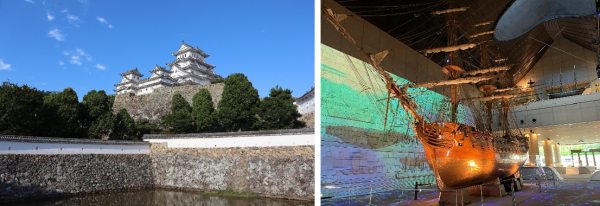
Kobe: A Diverse and Historic Port City – After the opening of the Port of Kobe in 1868 it quickly became one of the largest international trading ports in Japan and a symbol for foreign diversity and global culture. Chief among these was the culinary arts, with Western-style dishes being served alongside local delicacies like Kobe Beef. Artistic influences soon followed – jazz, rock and the birthplace of the first karaoke machine in 1971. The Kobe Maritime Museum charts the city’s evolution from trading hub to cultural cornerstone. Numerous artifacts, models, videos, graphics and hands-on exhibits include Ninja motorcycles and jet skis, as well as riding simulations.
Himeji Castle: A Standing Monument to Political History – Himeji Castle stands as a monument to the history of Japanese political dynasties and was designated as UNESCO World Heritage Site in 1993. Remarkably well preserved, the ‘White Heron Castle’ rises as a five-storey, seven-tiered architectural masterpiece. The vast majority of Japan’s castles were destroyed following the establishment of the Meiji era in 1868, and those that we can see today are mainly reconstructed from concrete. Only twelve Japanese castles have preserved their original keep, five of which are located in the Setouchi region – Hameji Castle is said to have been protected from fire due to its iconic white plaster. It has become one of the traditional symbols of Japan, along with Mount Fuji, and is particularly beautiful at sunrise and sunset when the golden light illuminates the white walls. Visitors can check out the events schedule for daily English-language guided tours, nighttime illuminations and events such as cherry blossom viewings and the May festival. The town surrounding Himeji Castle became a hub for trade and transport, excelling in the production of staples like soy sauce and mirin, and takes pride in its local cuisine. Visitors are encouraged to try delicacies such as Himeji oden and conger eel. The town also features a stunning nine-garden park, Koko-en, with Himeji Castle providing a stunning photo backdrop.
Hagi Castle Town: Immersing into Centuries-old History – Following defeat at the Battle of Sekigahara in 1600, Mori Terumoto built Hagi Castle on Mount Shizuki (1604). Although the castle itself was demolished, the castle grounds have become a popular tourist destination in spring, when approximately 600 Somei-Yoshino cherry trees produce an astoundingly beautiful pink bloom, making it one of the best places to see cherry blossom in the Seto Inland Sea region.Steeped in history, the surrounding area features traditional pathways lined with striking white-walled streetscapes where visitors can enjoy a scenic rickshaw ride past the historic homes of Shinsaku Takasugi and Takayoshi Kido. As prominent late-19th-century activists, these influential figures helped orchestrate the Meiji Restoration, ultimately toppling the Tokugawa shogunate and paving the way for a modern Japan. Afterwards, guests can take part in traditional tea ceremonies at places like the Kikuya Family Residence while dressed in an elegant kimono.











