

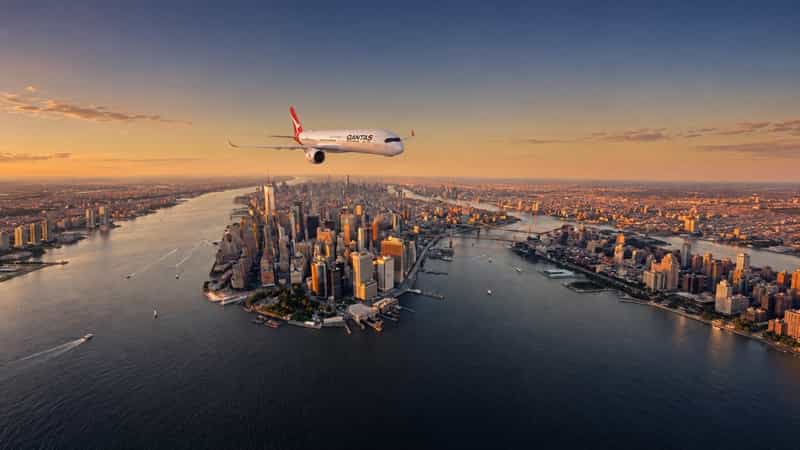
Australia’s long battle with geography is about to lose another round.
Qantas has confirmed non-stop flights between Sydney and New York from mid-2028. It will be the first commercial service to link Australia and the Big Apple without a stop. The route is the second confirmed service under Project Sunrise. Sydney–London is due to begin first, in October 2027.
Tickets for Sydney–New York are expected to go on sale from August 2027. The timing remains subject to regulatory approval and aircraft certification. Qantas says the flight will save more than three hours against today’s fastest one-stop journey.
For Australian travellers, this is more than an aviation novelty. It changes how the east coast can connect with one of the world’s key business, tourism and entertainment markets.
And, happily, it removes that familiar mid-journey question: “Which airport are we changing planes in this time?”
From island hops to one giant leap
Qantas first reached New York in 1958. The city formed part of its first round-the-world service from Sydney, which travelled via Fiji, Honolulu and San Francisco. Today, Qantas serves New York daily from Sydney via Auckland.
Project Sunrise will remove that final stop.
Qantas expects Sydney–New York to take about 18 hours. Actual times will vary with winds, routing and operating conditions. Passengers will board in Sydney and stay on the same aircraft until New York’s John F. Kennedy International Airport.
That is aviation’s version of removing the intermission.
The aircraft making it possible is the Airbus A350-1000ULR. Qantas has ordered 12 for Project Sunrise. Each aircraft has an extra rear-centre fuel tank for ultra-long-range flying. Airbus says the modified aircraft is designed for flights of up to 22 hours.
The Qantas cabin will carry only 238 passengers across four classes. That is a very low seat count for an A350-1000. It is also quite deliberate.
The cabin will include six First suites, 52 Business suites, 40 Premium Economy seats, and 140 Economy seats. More than 40 per cent of the aircraft is devoted to premium cabins.
All passengers will also have access to a dedicated Wellbeing Zone. It is designed for stretching, movement and hydration during very long flights. Qantas has also worked with the University of Sydney’s Charles Perkins Centre on cabin lighting and other measures to support sleep and body-clock adjustment.
Project Sunrise, then, is not simply about keeping an aircraft aloft for longer. The tougher challenge is helping 238 people arrive looking as though they have not spent most of a day inside an aluminium tube.
A350 testing pushes the limits
Airbus has already shown how far the new aircraft can travel.
In July 2026, the first A350-1000ULR test aircraft flew non-stop from Melbourne to Toulouse. The development flight lasted an extraordinary 24 hours and 24 minutes and covered 12,460 nautical miles. Airbus says it was the aircraft’s longest point-to-point flight to date.
The test aircraft carries special equipment for the certification program. Engineers are checking the systems needed for ultra-long-range work, including the added fuel system.
Qantas says its first customer aircraft is due in April 2027. Airbus independently confirms that delivery timing.
The airline is also preparing crews. Pilots have started training on Australia’s first A350 simulator in Sydney. Qantas expects to train more than 360 pilots and 1,200 cabin crew for Project Sunrise by the time all 12 aircraft have arrived.
Hudson: “That changes what’s possible”
Qantas Group chief executive Vanessa Hudson described New York as a defining step for Australia-US travel.
“Conquering the tyranny of distance has been part of who Qantas is from the very beginning. Reaching New York non-stop completes a vision we set out many years ago, and it’s a moment of enormous pride for the thousands of our people who have been working hard to make Project Sunrise a reality.
“New York has always captured the imagination, and for generations, reaching it from Australia has meant breaking up the journey somewhere along the way. From 2028, our customers will be able to board in Sydney and arrive in New York around 18 hours later without stopping once, cutting around three hours off the current fastest travel time. That changes what’s possible for travel between our two countries.
“Flying these distances is only worth doing if our customers arrive feeling their best, and that belief has shaped everything we’ve built. Over the past decade, working alongside experts, we’ve designed the aircraft and the onboard experience around the science of ultra long-haul travel, from the lighting to the meals to a world-first Wellbeing Zone. This is a fundamentally different way to fly.”
A trans-Pacific market with room to grow
The headline has solid commercial logic.
Australian Bureau of Statistics data show 755,500 short-term visitors arrived from the United States in 2025–26. That compares with 714,770 a year earlier. The rise was about 5.7 per cent. The US was Australia’s third-largest source market for visitors.
Qantas says demand to and from New York on its network has nearly doubled since 2023. Its commissioned research also found growing interest in ultra-long-haul non-stop flying. Stated intent to book rose from 58 per cent to 70 per cent from February to May 2026. Qantas says the figure reached 80 per cent among premium travellers.
Those numbers are important. Project Sunrise has a premium-heavy cabin. Its business case depends, in part, on travellers paying for saved time and less hassle.
Qantas says nearly two million passengers have used its existing non-stop long-haul routes since 2018. Those services include Perth–London, Perth–Rome, Perth–Paris, Melbourne–Dallas and Auckland–New York. The airline says these routes have also produced its highest international customer-satisfaction scores.
What it means for travel advisors
For Australian travel advisors, Sydney–New York non-stop will be an easy product to explain. It should strongly appeal to corporate travellers, premium leisure clients, and anyone who dislikes connections.
It will not make New York close to Sydney. Eighteen hours is still eighteen hours, no matter how clever the lighting. But removing a stop can make the whole journey easier.
That will matter for passengers starting outside Sydney, too. Many will still need a domestic connection. Even so, removing an overseas transit point simplifies the long part of the trip.
Advisors should watch four things when sales open: fares, schedules, frequent-flyer seats and domestic connections. Premium cabins will attract particular attention because that is where the new aircraft differs most.
Project Sunrise has spent years somewhere between an engineering project and aviation folklore. It is now becoming a timetable.
Sydney–London is scheduled for October 2027. Sydney–New York follows from mid-2028.
For Australians who have spent decades changing aircraft somewhere between home and Manhattan, the pitch is wonderfully simple: board once, settle in and stay there.
New York remains a very long way away. Qantas is simply taking out the intermission.
By: May Marclay – © 2026.
Read Time: 5 minutes.
Author Bio:
 May Marclay’s career hasn’t followed a straight line, and she’s better for it. She began in real estate, then moved into hospitality, finding her rhythm with Centara in the Maldives. There, she worked the Asian markets the old-fashioned way: building trust, closing deals, and turning conversations into lasting business.
The UAE sharpened its focus. At IHG, supporting an Area General Manager, she saw the machinery of a major travel hub from the inside, no gloss, just how things actually get done.
Now, with her sights set on healthcare, May brings a broader lens than most. She speaks three languages, reads widely, travels with intent, and writes with the calm assurance of someone who understands both the detail and the bigger picture without needing to say so too loudly.











