

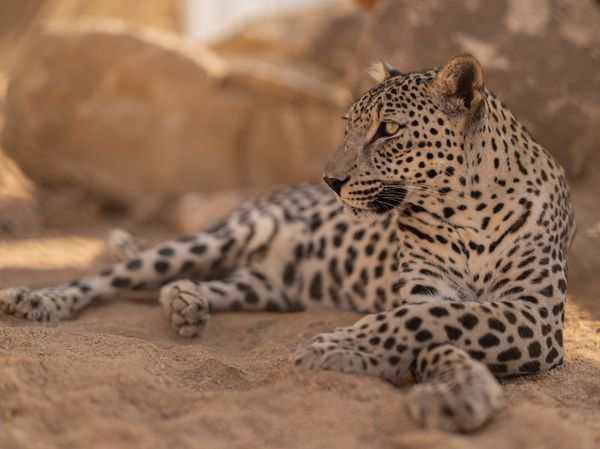
Marking a major milestone in a global effort to safeguard the critically endangered Arabian Leopard, the Royal Commission for AlUla (RCU) and the Smithsonian’s National Zoo and Conservation Biology Institute (NZCBI) broke ground on a dedicated habitat in Washington, D.C.
With fewer than 120 Arabian Leopards (Panthera pardus nimr) remaining in the wild, the partnership established a vital platform for cross-border scientific collaboration. It brings together scientists and animal-care specialists from RCU and Smithsonian to advance global research on the species survival. Together, the institutions will support the continued development of a coordinated ex situ assurance population, while strengthening scientific exchange and management of the species’ genetic diversity to support long-term resilience and recovery.
The groundbreaking event at NZCBI’s historic campus marks a significant chapter in RCU’s broader landscape-scale recovery and public awareness strategy. This comprehensive effort integrates conservation breeding, ecosystem restoration across protected areas, capability-building for Saudi scientists and international advocacy – including the UN-recognised International Arabian Leopard Day on 10 February.
The Arabian Leopard is a cultural icon and the flagship apex predator of the Arabian Peninsula, its deep connection to AlUla’s natural landscape captured in ancient rock-art. To bridge this legacy with modern recovery efforts, the Smithsonian was presented with a hand-carved stone replica of an ancient Arabian Leopard petroglyph sourced from AlUla. The selected rock-art panel depicts a leopard beneath a horse-drawn chariot alongside Dadanitic script and has been broadly dated to between 800 BCE and 400 CE. Sculpted from natural sandstone, the gift will form a permanent part of the future exhibit experience.
“Protecting the critically endangered Arabian Leopard is long-term work. It means restoring the landscapes it needs, strengthening the science behind its recovery, and developing the Saudi conservation talent who will help carry this mission forward.” Said Abeer Al Akel, CEO of the Royal Commission for AlUla. “Through our partnership with Smithsonian, RCU is connecting AlUla’s natural legacy with global conservation expertise — building the knowledge, capability and long-term conditions needed to support the species’ recovery.”
The groundbreaking ceremony welcomed HRH Ambassador Reema Bandar Al- Saud, Ambassador of the Kingdom of Saudi Arabia to the United States; Abeer AlAkel, Chief Executive Officer, RCU; Smithsonian Secretary Lonnie G. Bunch III; Dr. Ellen Stofan, Undersecretary for Science and Research, Smithsonian Institution; Dr. Brandie Smith, John and Adrienne Mars Director, NZCBI; and Dr. Peter Leimgruber, Director of Conservation Science, NZCBI.
The breeding pair of Arabian Leopards are expected to eventually travel from the conservation breeding programme in Saudi Arabia to the U.S., subject to final technical evaluations and regulatory approvals, including welfare, genetic suitability and readiness. The new D.C. exhibit will introduce an international audience to a species few people outside the Arabian Peninsula will ever encounter, giving millions of visitors a front-row seat to the ecological challenges facing the species and the conservation progress underway in AlUla.
“Extinction is not inevitable,” said Brandie Smith, the John and Adrienne Mars Director of NZCBI. “When we bring together exceptional animal care, cutting-edge science, sustained investment and partners committed for the long term, we can change the future for wildlife. This exhibit will connect millions of people with one of the rarest cats on Earth and with the science and collaboration working to save it.”
To secure the species’ long-term survival, RCU operates an EAZA-accredited conservation breeding programme in Taif. The managed Arabian Leopard population has more than doubled since RCU assumed responsibility for the programme, reflecting sustained progress in conservation breeding, specialist animal care and genetic diversity management.
The collaboration is also expected to strengthen Saudi conservation capability by building on existing RCU and Arabian Leopard Fund efforts to create a broader long-term platform for knowledge exchange, scientific collaboration and conservation talent development.
As an early activation of this wider platform, the planned Summer 2027 professional exchange programme at the Smithsonian-Mason School of Conservation (SMSC) in Virginia is expected to provide selected Saudi and AlUla students with applied conservation training and professional exposure. Over time, this platform can support capability development across conservation breeding, animal care, ecosystem restoration, field monitoring and protected area management.
“Reintroducing an apex predator to the wild is a complex, long-term scientific endeavour. It requires far more than releasing a leopard into its natural habitat; it requires restoring the ecosystem needed to support its long-term survival,” said Naif AlMalik, Vice President of Wildlife & Natural Heritage at RCU. “Through habitat restoration, rewilding and global partnerships such as the one strengthened today with the Smithsonian, we are creating the conditions for the species to thrive in the wild once again.”
To support the eventual return the critically endangered species to the wild, RCU is executing a robust conditions-led restoration strategy developed with IUCN across protected areas – which now cover more than half of AlUla land. Rather than fixed timeline-based targets, progress is governed by key milestones, such as habitat readiness, prey-base recovery, animal welfare, genetic suitability and long-term monitoring.
As part of these efforts, the AlUla Native Plant Nursery and Seed Bank has produced one million native plant seedlings, of which over 650,000 have been delivered across more than 70 RCU projects. More than 74,400 hectares have been rehabilitated in the IUCN-recognised Sharaan National Park alone, where vegetation cover has increased from around 6% in 2018 to 50% by mid-2026.
In addition, more than 1,700 animals have been released as part of the wildlife restoration programme with successful breeding recorded in reserves, supported by more than 320 RCU Rangers conducting over 50,000 kilometres of monthly patrols across six RCU-managed nature reserves.
These reintroductions are important not simply for the recovery of individual species. They are helping rebuild functioning natural systems, including the prey populations that must be sufficiently established before an apex predator such as the Arabian Leopard could eventually survive independently within the landscape.











