

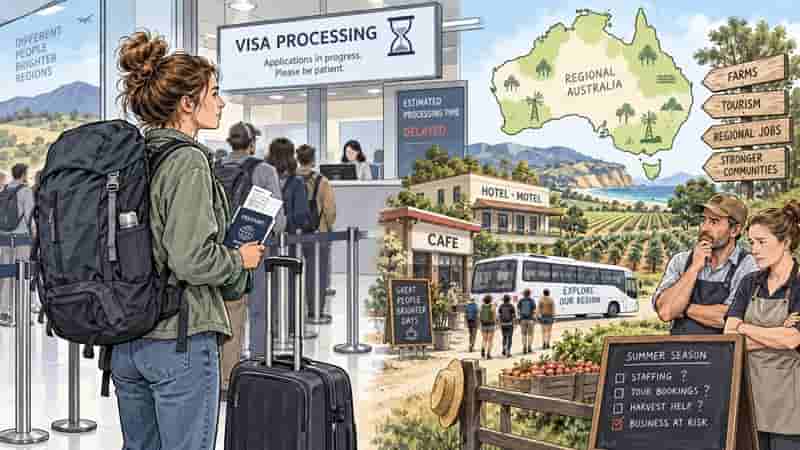
Australia’s regional visitor economy is heading towards the summer peak with an uncomfortable question hanging over it: will enough Working Holiday Makers arrive in time to help tourism, hospitality and agricultural businesses meet seasonal demand?
The concern is not a collapse in interest. Australia currently has a record number of Working Holiday Makers, according to the Department of Home Affairs. The complication is processing. Home Affairs says it is prioritising onshore Working Holiday Maker applications and that some offshore applications may take several months to finalise.
That qualification matters because the department’s published median processing time for Working Holiday Maker visas is five days. Home Affairs stresses that this figure reflects recently finalised applications and may not represent every applicant’s experience. It also recommends that applicants do not book flights or make travel, work or study commitments until their visa has been granted.
For regional tourism businesses preparing rooms, rosters and summer programs months ahead, that uncertainty is hardly an insignificant footnote.
Backpackers are tourists first and valuable ones
The term “backpacker” can make this market sound more modest than it is.
Tourism & Transport Forum Australia says Working Holiday Makers spent about $4.4 billion in Australia during 2025: approximately $3.3 billion in capital cities and $1.1 billion in regional Australia. TTF says the regional component represented 20 per cent of all international visitor expenditure in regional Australia.
That matters because Working Holiday Makers do considerably more than fill short-term jobs. They stay in hotels and hostels, hire vehicles, eat in cafes and restaurants, join tours, attend events and often travel far beyond Australia’s capital-city gateways.
TTF chief executive Margy Osmond described them as “high-value, long-stay international visitors who work, travel and spend across Australia”.
For many regional businesses, therefore, the same traveller can be both a customer and a worker during different stages of the trip.
Summer rosters are becoming the concern
On 10 September, the Tourism & Transport Forum, National Farmers’ Federation, Accommodation Australia and Australian Chamber of Commerce and Industry jointly called for greater certainty around Working Holiday Maker settings.
The organisations said slower subclass 417 processing and interruptions affecting first Work and Holiday subclass 462 applications were putting businesses and regional economies under pressure ahead of peak summer.
Accommodation Australia chief executive James Goodwin said:
“When you take those workers out of the system, something has to give.”
His organisation said reduced access to Working Holiday Makers could put greater pressure on existing employees, limit what accommodation businesses can offer and make it harder to respond when visitor demand is strongest.
That wording is important. It is more precise than suggesting specific hotels will necessarily close restaurants or remove rooms from inventory. The industry’s concern is workforce pressure, operating flexibility, and capacity.
And that is a more immediate issue than the migration statistics might suggest.
Tourism and hospitality capacity is not determined only by how many people want to travel. Businesses also need enough people to clean rooms, prepare meals, serve customers, run tours and keep venues operating when demand surges.
Queensland Tourism Industry Council says 323,077 Working Holiday Maker visas were granted during 2025–26, including 127,895 second or third visas, close to two in five of the total.
QTIC says those repeat visas matter because regional-work incentives and specified-work rules have historically encouraged many Working Holiday Makers to spend time outside the major capital cities.
For regional tourism, that dispersal is worth considerably more than a line on a visa spreadsheet.
The current subclass 462 picture
The Work and Holiday subclass 462 program is particularly important because first visas for a number of partner countries are subject to annual caps.
Home Affairs says it can pause country caps to spread applications through the program year, manage demand when a cap is close to being filled, or support the government’s migration settings while keeping the program sustainable.
As of 16 September 2026, the Home Affairs country-cap table lists 23 partner countries as paused for first subclass 462 applications.
San Marino and Türkiye remain open.
China, India and Vietnam are managed through a ballot process. Indonesia is also moving to a ballot for first subclass 462 visas, with registrations expected to open later in 2026.
That Indonesian change is important because earlier descriptions of the ballot system referring only to China, India and Vietnam are no longer complete.
Home Affairs says Indonesian passport holders seeking their first Work and Holiday visa will be managed through a ballot, although the registration opening date had not been confirmed as of 16 September.
There is another important distinction.
A paused country cap does not necessarily mean that country’s annual visa allocation has been exhausted.
Home Affairs says a paused cap may reopen later in the same program year. A closed cap, by contrast, will not reopen until the following program year because all available places have been filled.
There are also no annual country caps for second- or third-subclass 462 visas.
For repeat visas, eligible applicants generally need to complete specified subclass 462 work in eligible industries and locations.
That is the technically safer description than simply referring to “work in a designated region”, because eligibility depends on the type of work, location and visa circumstances.
Those requirements have long helped send some young travellers into regional and remote Australia, where seasonal labour demand can be intense.
The farm gate meets the front desk
The tourism and agricultural workforce debate often converges in regional communities.
Queensland Fruit & Vegetable Growers says the state’s horticulture industry produced an estimated $4.61 billion in farm-gate value during 2024–25 and supported 44,846 jobs across the supply chain.
QFVG chief executive Scott Kompo-Harms captured the timing problem neatly:
“You can’t put a crop on hold while you wait for a workforce to arrive.”
QFVG says Queensland horticulture can require up to 16,860 additional temporary full-time-equivalent jobs each month during peak harvesting periods, showing how rapidly regional labour needs can change.
The same calendar problem exists, in a different form, across tourism.
Christmas bookings do not move because a visa is still being assessed. Neither do school holidays, major events, harvests or the summer road-trip season.
For operators in smaller destinations, where the permanent local labour pool may be limited, mobile temporary workers can provide an important buffer when seasonal demand peaks.
Why travel advisors should be watching
Travel advisors also face a clear practical issue when handling Working Holiday Maker clients.
Home Affairs specifically recommends that applicants wait until their visa is granted before booking flights or making travel, work or study commitments.
That makes flexibility important.
Advisors should ensure clients understand airline change conditions, cancellation rules, insurance limitations, and the financial risks of committing substantial money before a visa decision.
It would be particularly unwise to interpret the published five-day median as a promise that an individual offshore application will be completed within five days.
Home Affairs is making precisely the opposite point: recently finalised applications produce the published median, while individual offshore cases may take substantially longer.
This is also not merely an immigration-administration issue.
Working Holiday Makers buy international airfares, domestic transport, travel insurance, accommodation, tours and experiences, often over a much longer stay than the conventional holiday visitor.
France offers a useful illustration.
Tourism Australia says more than 25,000 French subclass 417 applications were made in 2024–25, with the French Working Holiday Maker segment contributing more than $660 million to the Australian visitor economy.
French visitors also show strong regional dispersal, with Tourism Australia reporting that 38 per cent travel into regional areas.
Italy tells a similar story.
Tourism Australia says the Italian Working Holiday Maker segment recorded more than 10,000 subclass 417 visa grants in 2024–25 and contributed more than $240 million to the Australian visitor economy.
These are meaningful tourism markets.
And young travellers considering a year abroad have choices about where to spend both their money and their time.
Australia may possess beaches, sunshine, extraordinary wildlife and enough open road to keep a campervan busy for months, but international travellers are not obliged to wait indefinitely at the visa gate.
Migration policy adds another layer
The Working Holiday Maker debate is unfolding as the Federal Government prepares to outline broader migration policy.
Australian Bureau of Statistics data show that net overseas migration was 301,000 in the year ending December 2025, down 8.9 per cent from the previous year.
It is important to use that figure correctly.
The ABS describes net overseas migration as Australia’s official measure of population change resulting from overseas migration and warns against substituting international arrivals-and-departures statistics as a proxy.
Home Affairs Minister Tony Burke is scheduled to address the National Press Club on Thursday, 17 September 2026, with a speech titled The work of managing the migration program: Who arrives, who stays, who leaves.
The government has indicated that further visa-system changes are intended to help manage net overseas migration.
Tourism, horticulture and business groups, meanwhile, have been arguing that Working Holiday Makers should also be recognised for their role as visitors, consumers and seasonal workers.
Those are separate policy considerations, and the government’s 17 September announcement may clarify whether current Working Holiday Maker arrangements are temporary measures or part of broader changes.
Regional tourism needs certainty
For regional tourism, the immediate issue is less ideological than operational.
Businesses need to know whether seasonal workers are likely to arrive, when they can arrive and whether the rules governing repeat Working Holiday Maker visas will remain sufficiently predictable for workforce planning.
At the same time, Australia has an established policy interest in maintaining an orderly visa system and managing the size and composition of its migration program.
Working Holiday Makers sit unusually across both areas.
They are temporary migrants for visa and migration-statistics purposes, but they are also international visitors who travel extensively, spend heavily and frequently work in the destinations they visit.
That makes the present processing slowdown more than an administrative curiosity.
For regional accommodation providers, attractions, restaurants, farms and tourism businesses heading into summer, the question is becoming increasingly practical:
How many Working Holiday Makers will actually make it through the visa gate in time?
Summer, as ever, has little interest in paperwork.
By: Stephen Peters – © 2026.
Read Time: 6 minutes.
Author Bio:
 Stephen Peters has spent much of his career proving that the straight-and-narrow path is considerably overrated. Armed with a Bachelor’s degree in Technology from the University of Queensland and a Master’s in Management, he first ventured into hospitality, working in and helping open several five-star hotels across Sydney and Asia.
After deciding he had experienced quite enough of five-star hospitality from the operational side of the desk, Stephen returned to technology, working with major US tech companies while based between Australia and Asia.
Then came the ultimate change of scenery. Stephen built his own yacht and, with his family aboard, sailed from Florida through the United States and its Great Lakes before crossing the Pacific to Asia. Several memorable years followed, exploring Indonesian waters before the Peters family eventually returned to Australia with considerably more sea miles, stories and perspective than when they left.











