

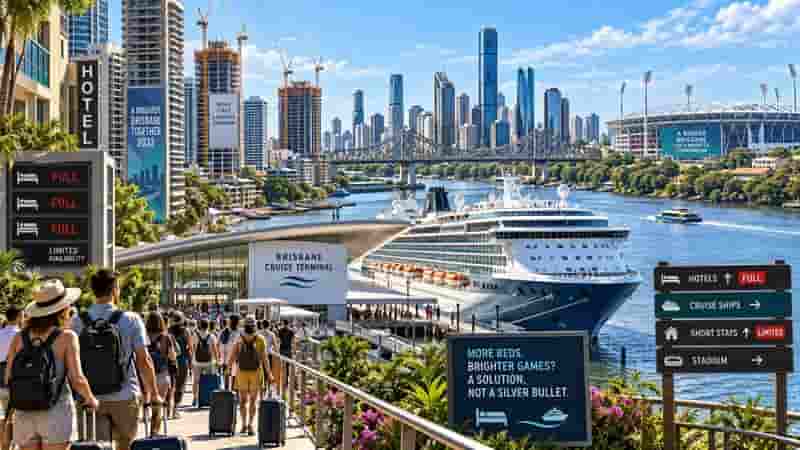
Queensland did not suddenly discover that Brisbane 2032 would need somewhere to put the world. Accommodation was on the planning table years before the Olympic rings were secured.
That, if anything, makes the present situation rather more uncomfortable.
The latest Property Council of Australia and CBRE Hotels Research outlook says Queensland is off track to meet the accommodation supply it expects to need by 2032. The Queensland Government’s Destination 2045 strategy includes an interim requirement for 14,700 additional hotel rooms by the Games. On current probability-adjusted projections, only about 24 per cent of those rooms are expected to be delivered, leaving Queensland close to 12,000 rooms short. In South East Queensland, where much of the Olympic-related demand will fall, the projected gap is about 7,400 rooms.
Those figures deserve one important clarification. This is not simply a case of “Brisbane being 10,000 beds short for the Olympics”. It is a broader hotel-supply shortfall against Queensland’s 2032 tourism accommodation target, and it extends well beyond the fortnight of Olympic competition.
The Olympic Games will run from 23 July to 8 August 2032, followed by the Paralympic Games from 24 August to 5 September. The Olympics will therefore land in the middle of the Australian winter rather than during Australia’s traditional summer cruise peak.
So how did Queensland end up here when the warning lights were flashing years ago?
The Shortage Was Known Before Brisbane Won
A 2019 South East Queensland Olympic and Paralympic Games feasibility study estimated that around 81,000 rooms would be required across Olympic family, workforce and visitor groups. Importantly, that study was undertaken more than two years before Brisbane was officially awarded the Games in July 2021.
It also examined a range of alternative accommodation sources, including student housing, homestays, tourist parks and yes cruise ships.
In other words, accommodation was not forgotten. The much sharper question is why a recognised structural challenge remains so pronounced with fewer than six years before the opening ceremony.
The answer is not especially mysterious.
Hotel development has become difficult and expensive. Property Council research says Brisbane has averaged fewer than 100 new hotel rooms a year since 2019, compared with more than 1,000 annually during the previous major development cycle. Construction costs have climbed sharply, financing conditions remain difficult, and, as every developer knows, a development approval does not magically turn into a hotel key.
That is the problem Queensland needs to solve, preferably with accommodation that continues earning its keep long after the Olympic flame has gone out.
Enter the Floating Hotel
With hotel development lagging, cruise ships have reentered the conversation.
The Queensland Tourism Industry Council (QTIC) has said temporary floating accommodation, including cruise ships, should be properly explored as part of the wider accommodation mix. Crucially, QTIC also says permanent hotel investment must remain the priority.
And the suggestion is hardly something scribbled on the back of a cocktail napkin.
Brisbane’s own 2019 feasibility work considered cruise ships as an Olympic accommodation option. That study identified the possibility of using several large ships to supplement room capacity and noted that cruise ships had been used as accommodation at previous Games.
So the concept is not ridiculous.
But a sizeable stretch of water separates “worth exploring” from “easy solution”.
The same 2019 study warned that cruise-ship lease and service costs can be high, with Games operating budgets sometimes required to subsidise accommodation to achieve an acceptable room rate.
That warning deserves considerably more attention.
A cruise ship diverted to Brisbane is not simply a hotel that happens to float. It is a major revenue-producing asset normally operating a carefully planned itinerary.
Any serious 2032 proposal would have to account for vessel availability, charter costs, repositioning, crewing, food and beverage operations, security, port charges, passenger transport and potentially the revenue a cruise line sacrifices by withdrawing a vessel from its normal commercial program.
And in July and August, many internationally deployed ships are ordinarily committed to lucrative Northern Hemisphere summer programs.
Nobody can reliably predict today precisely where suitable vessels will be deployed in 2032. But assuming several large cruise ships will simply be bobbing about waiting for Brisbane to telephone would be optimistic planning indeed.
Then There’s the Small Matter of Parking Them
Brisbane certainly has an impressive purpose-built cruise facility, but geography and capacity cannot be wished away.
The Brisbane International Cruise Terminal is at Luggage Point, Pinkenba, not Fisherman Islands. It is approximately 21 kilometres by road from Brisbane’s CBD, or about a 30-minute drive under normal conditions.
Its infrastructure includes a 208-metre wharf and 450-metre berth pocket, built to accommodate large cruise ships.
For regular cruise operations, it is an important and substantial asset.
Accommodating several large vessels simultaneously for an Olympic-sized floating-hotel operation, however, is an altogether different proposition.
Alternative berths, temporary facilities, passenger transfers, screening, security, baggage operations and high-volume transport between ships and Olympic venues would all require detailed planning.
None of that makes the cruise-ship proposal impossible.
It does, however, make it considerably more complicated than tying up four ships, hanging out the “vacancy” sign and handing over the room keys.
Build for 2032 and 2042
A much bigger question remains: where spectators will sleep for 17 Olympic days.
The Property Council argues that Queensland’s accommodation problem is structural rather than cyclical. The Games will amplify demand, but Brisbane’s expanding events calendar, international aviation growth and broader visitor economy are expected to keep generating accommodation demand long after 2032.
Indeed, that is the great prize Brisbane 2032 offers.
A successful Games should not merely produce full hotels for three weeks. It should leave Queensland with stronger tourism infrastructure, greater international visibility and the ability to capitalise on visitor demand for years afterwards.
Cruise ships, should they eventually form part of the Games accommodation solution, therefore make far more sense as supplementary capacity than as a substitute for getting permanent hotels built.
Queensland still has time, but hotels do not appear merely because somebody waves an Olympic flag over a vacant block.
Planning, financing, construction, staffing and opening a substantial hotel can take years.
The debate should therefore not descend into “hotels versus cruise ships”.
It should be about delivering enough permanent hotel accommodation while retaining credible temporary solutions for the exceptional peak created by the world’s biggest sporting event.
Cruise ships may yet have a role.
They could even prove to be an ingenious part of the answer.
But declaring them the answer before the charter costs, fleet availability, berth capacity, security and transport logistics are nailed down would be premature.
Brisbane 2032 has promised Queensland a once-in-a-generation tourism opportunity.
The state now needs to make certain that when the world turns up, there is somewhere sensible to put everyone, preferably without discovering at the eleventh hour that the spare bedroom is floating somewhere out in Moreton Bay.
By: John Alwyn-Jones – © 2026.
Read Time: 5 minutes.
Author Bio:
 John Alwyn-Jones is one of those rare figures who can make the business of travel sound positively adventurous.
A lifelong communicator with the polish of a broadcaster and the curiosity of a journalist, he’s spent decades shaping stories and strategies across tourism, aviation, and the cruise world. He’s led from the front as CEO, director, mentor, and advisor, and still brings warmth and wit to every boardroom and microphone.
Known for his sharp insight into global cruise lines and destinations, John has an old-school belief in professionalism, tempered with the sparkle of someone who’s genuinely seen the world. He’s not just in the business of travel; he’s made it an art form.











