

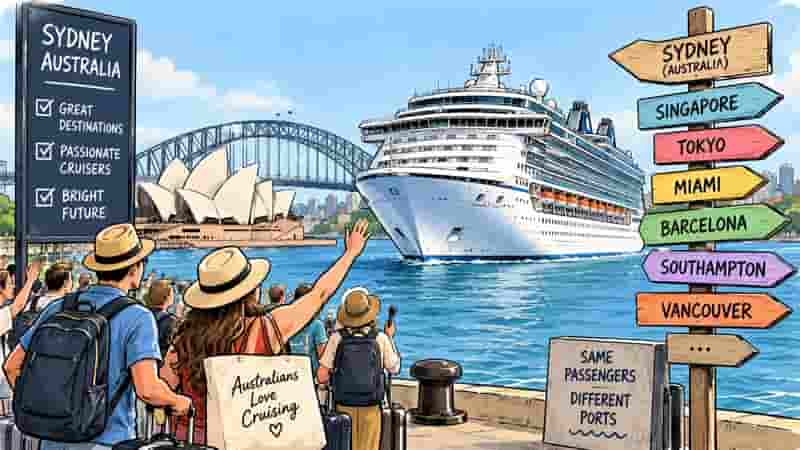
Australia has rarely been more in love with cruising.
A record 1.45 million Australians took an ocean cruise in 2025, up 9.5 per cent from 1.32 million the previous year and eclipsing the former record of 1.35 million set in 2018.
Australia remains the world’s fourth-largest cruise source market, behind only the United States, Germany and the United Kingdom. More than one in 20 Australians took a cruise last year.
Yet beneath those impressive numbers lies a rather uncomfortable contradiction.
Australians are cruising in record numbers, but Australia is attracting fewer ships, less capacity and fewer of the lucrative turnaround visits that pour money into hotels, restaurants, transport operators, tour companies and local businesses.
Put simply, Australia isn’t losing its cruisers. It risks losing their ships.
A $1 billion warning shot
The numbers should command attention in Canberra and every state capital with a stake in the visitor economy.
Cruise tourism generated an estimated $7.32 billion in Australian economic output during 2024–25. That is undeniably substantial, but it was down 13.2 per cent from the previous year’s $8.4 billion record.
Employment supported by cruise tourism also fell, from 26,370 full-time-equivalent positions to 22,720, while the number of cruise ships operating in Australian waters declined 9.3 per cent, from 75 to 68 ships.
Passenger capacity fell by 8,174 to 80,280, while total ship visits dropped 3.8 per cent. Most significantly, turnaround visits fell by 87, while transit visits rose by 24.
That distinction matters.
A turnaround port is where a cruise begins or ends. Passengers may arrive a day or two early, book accommodation, eat in restaurants, catch taxis, buy supplies and perhaps stay after their voyage. Ships also require provisioning, fuel, services and crew support.
Consequently, losing a turnaround call can hurt considerably more than losing another photograph of a cruise ship sailing past the Opera House.
The Australian Cruise Association and Cruise Lines International Association say the decline is not being driven by a shortage of passengers. Instead, they point to reduced ship deployments and capacity amid higher operating costs, regulatory uncertainty and increasingly fierce global competition.
Australians are increasingly boarding elsewhere
Australian cruise passengers certainly haven’t packed away their deck shoes.
CLIA’s 2025 figures show 1.16 million Australians cruised within Australia, New Zealand and the South Pacific, up 8 per cent.
But another statistic deserves considerably more attention.
Some 286,000 Australians cruised outside the local region during 2025, an increase of 17 per cent. The proportion choosing long-haul cruise destinations rose from 18.5 per cent in 2024 to 19.7 per cent in 2025.
The Mediterranean, Asia, Alaska, Caribbean and Northern Europe are all competing for Australian cruise dollars.
There is nothing inherently wrong with Australians cruising overseas far from it. International cruising is part of a healthy global travel market.
But from Australia’s tourism perspective, the question is whether a growing proportion of Australian cruise expenditure is being exported because cruise companies see stronger opportunities for their ships elsewhere.
Carnival delivers the clearest warning yet
The argument became less theoretical in February.
Carnival Cruise Line announced on 26 February 2026 that Carnival Adventure would become a seasonal Australian ship from April 2028, relocating to North America during the northern hemisphere summer.
Carnival said it had made the deployment decision because of “more favorable market conditions elsewhere” and uncertainty surrounding the regulatory environment in Australia and New Zealand.
The American spelling of “favorable” is Carnival’s own wording.
Carnival Country Manager Peter Little said the company was seeing stronger momentum and local government support in other major tourism markets and was adjusting its deployment to pursue greater opportunities elsewhere.
That is an unusually clear message from a major cruise company.
But it is equally important not to exaggerate it.
Carnival is not abandoning Australia.
Indeed, the company says it will operate from more Australian and New Zealand homeports during 2027–28 than previously, with Carnival Adventure scheduled to operate from Sydney, Melbourne, Adelaide and Auckland. Carnival Splendor is also scheduled to continue year-round operations from Sydney and Carnival Encounter from Brisbane.
The warning is therefore subtler and arguably more important.
Cruise lines do not need to abandon Australia for Australia to lose economically. They need only allocate incremental ships, add capacity, and extend deployment periods elsewhere.
The world’s cruise ports are fighting for ships
Modern cruise ships are enormously valuable mobile assets.
A cruise line considering where to deploy a ship must weigh passenger demand against port charges, fuel and provisioning costs, regulatory requirements, taxation, infrastructure, itinerary opportunities and the commercial returns available in competing regions.
Australia has magnificent destinations. Sydney Harbour remains one of cruising’s great arrivals. Queensland offers the Great Barrier Reef and South Pacific access, while Tasmania, Western Australia, South Australia, Victoria and the Northern Territory offer compelling itineraries.
But beautiful scenery alone doesn’t balance the books.
That message came through forcefully at the Australian Cruise Association’s 2026 annual conference in Brisbane.
CLIA Global President and CEO Charles “Bud” Darr warned that regulatory uncertainty and high costs had damaged Australia’s ability to attract cruise ships, even while Australian consumer demand remained strong.
Darr noted that cruise tourism generated more than $7 billion for Australia in the previous financial year but had fallen by roughly $1 billion as fewer ships visited the region.
Australian Cruise Association Chairman Brendan Connell delivered an equally pointed warning.
While cruise companies are investing in new vessels, expanding fleets and responding to growing global demand, Australia must compete against destinations actively seeking that investment.
His prescription was refreshingly uncomplicated: Australia needs to be “competitive, predictable and easy to do business with.”
For an industry that plans itineraries and deployments years in advance, predictability isn’t bureaucratic window dressing. It is commercially valuable.
Australia cannot compete on scenery alone
The competitive threat matters because global cruising is booming.
A record 37.2 million passengers cruised worldwide in 2025, up 7.5 per cent from 34.6 million in 2024. CLIA forecasts global passenger numbers will reach 38.3 million in 2026 and 42.1 million by 2029.
The pie is getting bigger.
Australia’s challenge is ensuring its slice doesn’t get smaller.
Cruise companies may achieve more attractive deployment economics in markets offering lower costs, stronger government support, greater infrastructure capacity or more predictable regulation.
Geography also presents Australia with an unavoidable disadvantage. Ships deployed here operate a long way from many of the world’s biggest cruise markets and major fleet-support centres.
Australia cannot move itself closer to Miami, Singapore or the Mediterranean.
It can, however, influence the cost, regulatory and infrastructure environment confronting cruise companies.
Sydney illustrates the infrastructure challenge
Sydney remains Australia’s cruise powerhouse and one of the country’s greatest tourism calling cards.
But a physical problem no amount of marketing can make disappear.
The largest modern cruise vessels cannot pass beneath the Sydney Harbour Bridge, meaning they require suitable berthing east of the bridge. This places greater pressure on available infrastructure as the global fleet increasingly shifts towards larger vessels.
That does not mean Sydney is suddenly losing its appeal. Demand remains strong.
Rather, it demonstrates why Australia needs a long-term infrastructure strategy capable of accommodating the ships cruise companies are building for the decades ahead.
Ports are not constructed overnight, and neither are cruise deployment decisions.
Melbourne provided another warning
Port costs can also influence deployment.
A 15 per cent increase in Victorian cruise port charges became a flashpoint after Carnival Australia linked the increase to changes in cruise deployment.
Princess Cruises ceased homeporting in Melbourne for the 2025–26 season, while Cunard removed Melbourne from its programme.
Again, the lesson is not that cruise companies have permanently deserted Victoria. Carnival has subsequently announced Carnival Adventure seasons from Melbourne.
It does, however, demonstrate how sensitive deployment decisions can be to costs.
When ships can move between countries and continents, Australia’s competitors are not merely Brisbane competing against Sydney or Melbourne competing against Adelaide.
They are Singapore, Tokyo, Miami, Barcelona, Southampton, Vancouver, Los Angeles and scores of other ports around the world.
An extraordinary Australian contradiction
And so Australia enters the 2026–27 summer cruise season in an extraordinary position.
Crown Princess sailed into Sydney Harbour in early September to launch the season after completing a 114-night world cruise, carrying 2,720 guests and 1,130 crew.
It was precisely the sort of magnificent arrival that reminds Australians why cruising matters.
Yet almost simultaneously, senior cruise-industry leaders were warning that Australia’s competitive position needs attention.
Therein lies the story.
Australian cruising is strong. Australia’s competitive position for attracting cruise-ship deployment is considerably less secure.
Those are not contradictory statements.
Australia generated $7.32 billion in cruise economic activity during 2024–25 and supported more than 22,000 full-time-equivalent jobs. Australians are taking cruises in unprecedented numbers.
This is emphatically not an industry in collapse.
It is an industry with enormous demand, enviable destinations and substantial economic value that nevertheless faces intensifying international competition for the ships producing that value.
The danger, therefore, is not that Australians suddenly stop cruising.
It is that Australians continue cruising enthusiastically but increasingly board their ships in Singapore, Tokyo, Barcelona, Southampton, Miami or Vancouver instead.
For Australian tourism, that would be the cruellest irony of all.
We have the passengers.
We have the destinations.
Now Australia needs to make certain it keeps the ships.
By: Jason Smith – © 2026.
Read Time: 6 minutes.
Author Bio:
 Jason Smith didn’t learn travel from textbooks. He learned it in airports, taxis and hotel lobbies, watching the business unfold long before he played his own part. Half American, half Asian, he grew up around the quiet workings of tourism, where people come and go, and stories rarely stand still.
Bangkok came first, then formal study, then a career that carried him through Singapore, Malaysia and Vietnam. Each place left something behind. In the end, Thailand felt like home, along with a senior role in hotel sales.
Then everything stopped. Borders shut, planes grounded, and Jason found himself back in America with time to reflect.
Now at Global Travel Media, he writes travel as it really is, not polished, not perfect, but human, and all the better for it.











