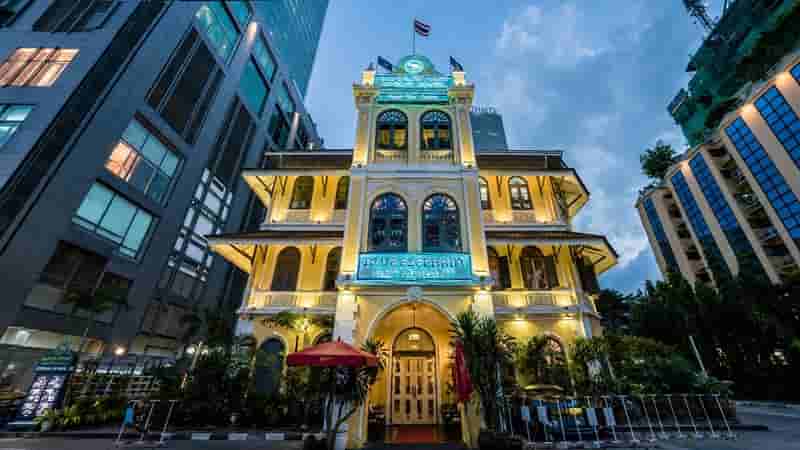
May Marclay discovers a century-old Bangkok mansion where Master Chef Nooror Somany Steppe keeps Thai culinary history very much alive and very difficult to leave hungry.
Bangkok can make choosing dinner feel like a competitive sport. Street stalls perfume whole sois, rooftop dining rooms float above the traffic, and enough fashionable tasting menus keep a determined gourmand busy for months.
Yet some restaurants possess something newer arrivals simply cannot manufacture: history.
Blue Elephant Bangkok Sathorn Cooking School & Restaurant has plenty.
Opposite BTS Surasak on South Sathorn Road, the restaurant occupies a century-old colonial-style mansion which Blue Elephant says is listed by Thailand’s Fine Arts Department. It is an arresting old beauty, especially against Bangkok’s surrounding towers: elegant arches, polished timber, handsome proportions and the sort of staircase that makes you instinctively straighten your shoulders.
Inside, the mood is grand without becoming stiff. There is ceremony here, certainly, but not the hushed solemnity that can occasionally make fine dining feel like a visit to the bank manager.
And at the heart of it all is Master Chef Nooror Somany Steppe.
Blue Elephant’s story began not in Bangkok, but Brussels. Nooror met Belgian businessman and art dealer Karel Steppe while studying in Belgium, and in 1980 they opened the first Blue Elephant restaurant there with Thai partners. Born in Chachoengsao province, Nooror traces much of her culinary grounding to childhood and, particularly, to her mother’s fragrant curries and heirloom Massaman paste.
More than four decades later, that family thread remains very visible in the food.
Pretty Enough to Frame
I began with the Chaowang Chor Muang, four butterfly-shaped shiitake dumplings from the Royal Kitchen tradition, finished with a restrained hint of truffle. Blue Elephant itself lists the dish among Sathorn’s signatures.
They arrived looking almost too lovely to disturb.
Almost.
The dumplings were delicate rather than dainty, carrying enough earthy mushroom character to prevent the truffle from becoming a European gatecrasher at a distinctly Thai party. The result was graceful, fragrant and beautifully controlled.
Then came the Crab Maprao Orn Coconut Soup, made with blue swimmer crab, coconut milk, organic galangal and straw mushrooms.
This was a bowl to slow down for.
The crab brought sweetness, the coconut rounded the edges, and the galangal supplied that clean aromatic lift that prevents richness becoming heaviness.
Thai cooking is so often described through its balance of sweet, sour, salty, spicy and aromatic notes that the phrase risks becoming cliché.
Here, the balance wasn’t something to describe.
It was something to taste.
The Massaman That Stops Conversation
Then came the dish I had been waiting for: Master Chef Nooror’s Bespoken Massaman Lamb.
Blue Elephant describes it as Nooror’s signature curry, inspired by a celebrated culinary poem associated with King Rama II. The Bangkok menu builds it around lamb, the restaurant’s Massaman curry paste, coconut milk, tamarind juice, palm sugar, Thai sweet potatoes and roasted nuts.
It is not a shy curry.
The sauce is deep, fragrant and layered, with sweetness arriving alongside spice rather than sitting on top of it. The lamb gives way willingly, while the nuts provide texture just when the coconut-rich sauce threatens to become too comfortable.
With roti nearby, restraint becomes an administrative inconvenience.
I did consider ordering more.
I also considered licking the plate.
Decorum won.
Although not by much.
What impressed me most was that Blue Elephant treats heritage as a living thing. There are historical references, royal-kitchen influences and family recipes, but the food does not arrive embalmed beneath a glass dome of reverence.
It is allowed to be generous, colourful, contemporary and, most importantly, delicious.
Service With Grace, Not Fuss
The service matched the room: polished, attentive and warm.
The staff explained each dish enough to make it interesting without turning dinner into an evening lecture. Plates arrived with sensible rhythm, allowing flavours to settle before the next course appeared, while the room retained that easy Thai hospitality that can make even a formal restaurant feel welcoming.
That balance matters.
Bangkok has no shortage of restaurant theatre. Smoke, projections, tweezers and dishes assembled with the precision of a minor civil-engineering project all have their place.
Blue Elephant has chosen a different kind of spectacle: a beautiful old building, confident service and food that carries its story on the plate.
The restaurant’s cooking school reinforces that purpose. Blue Elephant Sathorn teaches Thai heritage cuisine in the same historic setting, extending the restaurant beyond a place to eat into a place where recipes and techniques are passed from one generation to another.
And recognition has followed.
Three Stars – Thai Style
In late 2025, Blue Elephant’s Bangkok, Phuket and Sukhumvit restaurants were reported to have received Thai SELECT 3-Star certification, the highest tier in that year’s Thai SELECT programme, presented under Thailand’s Ministry of Commerce. Only 12 restaurants were reported to have received the three-star level that year.
That matters because Thai SELECT is designed to recognise restaurants representing authentic Thai cuisine, ingredients, presentation and service rather than simply rewarding fashionable dining rooms.
But 2026 brought even more impressive news.
Blue Spice Co., Ltd., associated with Blue Elephant’s packaged food and international brand operation, collected two Prime Minister’s Export Awards 2026.
Thailand’s Ministry of Commerce officially lists Blue Spice Co., Ltd. as a Best Exporter winner, while also naming the company and its BLUE ELEPHANT brand among the Best Thai Brand recipients.
That distinction is worth getting right.
These are corporate and brand honours, not awards that should be attributed personally to Chef Nooror.
And, frankly, they say something significant about the wider Blue Elephant story. What began with a Thai chef in Brussels more than four decades ago has become not merely a restaurant business, but an international vehicle for taking Thai flavours, ingredients and culinary culture abroad.
That is quite an elephant-sized footprint.
An Elephant With Staying Power
Is Blue Elephant cheap?
No.
Nor does it pretend to be.
This is special-occasion territory: a business dinner that needs to impress, an anniversary meal, or a polished introduction to Thai heritage cuisine for visitors who want something more substantial than another fashionable dining-room concept.
The surroundings, service, ingredients, technique, and history all factor into the price.
As at 1 September 2026, its current business listing showed Blue Elephant Bangkok Sathorn at 4.5 out of five from 3,164 reviews. Restaurant ratings move constantly, of course, but the figure suggests the restaurant’s longevity doesn’t depend on nostalgia alone.
That may be Blue Elephant’s greatest achievement.
Restaurants built around heritage can easily become trapped by it. They start preserving yesterday so carefully that today never gets invited to dinner.
Chef Nooror has largely avoided that.
Her cooking draws on royal traditions, regional Thai food and family recipes, yet the restaurant still feels engaged with contemporary Bangkok.
The past is respected.
It isn’t embalmed.
And that is perhaps why the old elephant continues to stride confidently through one of the world’s most competitive dining cities.
I left Sathorn thinking not about whether Blue Elephant was traditional or modern, but about how unnecessary that distinction suddenly seemed.
When heritage is handled with confidence, it does not need to be frozen in time.
It simply needs to taste good.
At Blue Elephant, it very much does.
May’s Verdict
Blue Elephant Bangkok Sathorn combines one of the city’s most memorable historic settings with assured Thai heritage cooking and the unmistakable culinary identity of Master Chef Nooror Somany Steppe.
Come for the mansion.
Stay for the Massaman.
And leave enough room for the roti.
Rating: 9/10 – Highly Recommended
BLUE ELEPHANT BANGKOK FACT SHEET
| Detail | Verified information |
|---|---|
| Full name | Blue Elephant Bangkok Sathorn Cooking School & Restaurant |
| Cuisine | Thai Heritage Cuisine |
| Master Chef | Master Chef Nooror Somany Steppe |
| Address | 41 South Sathorn Road, BTS Surasak, Bangkok 10120, Thailand |
| Nearest BTS | Surasak |
| Telephone | +66 (0)2 673 9353–8 |
| [email protected] | |
| Lunch | Monday–Sunday, 11.30 am–2.30 pm, last order |
| Dinner | Monday–Sunday, 5.30 pm–10.00 pm, last order |
| Cooking school | Yes |
| Blue Elephant established | First restaurant opened in Brussels in 1980 |
| Bangkok operation | Restaurant and cooking school opened in 2002 |
| Building | Century-old colonial-style mansion; Blue Elephant says it is listed by Thailand’s Fine Arts Department |
| Thai SELECT | Reported 3-Star certification, 2025 |
| Current business rating | 4.5/5 from 3,164 reviews, checked 1 September 2026 |
| 2026 award recognition | Blue Spice: Best Exporter; BLUE ELEPHANT: Best Thai Brand |
The address, telephone number, email and service periods above are currently published by Blue Elephant itself.
Blue Elephant Bangkok official website.
MASTER CHEF NOOROR SOMANY STEPPE – FACT FILE
Born: Chachoengsao Province, Thailand
Culinary influence: Her mother and family cooking, particularly curries and Massaman paste
Blue Elephant beginnings: Brussels, Belgium, 1980
Co-founder: Karel Steppe, with Thai business partners
Experience: More than four decades promoting Thai cuisine internationally
Culinary focus: Thai Heritage Cuisine, regional traditions, palace recipes and Thai ingredients
Academic honour: Blue Elephant’s official biography records an honorary Master of Arts degree from Kasetsart University.
A useful editorial distinction should remain in the published piece: the 2026 Best Exporter and Best Thai Brand awards belong to Blue Spice/Blue Elephant and should not be represented as Chef Nooror’s personal awards. Thailand’s Ministry of Commerce clearly identifies the recipients.