

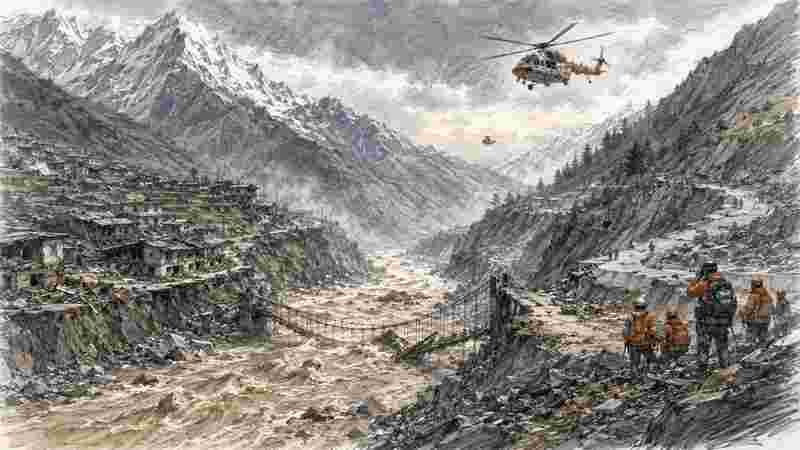
At least 160 people have died across Nepal and Tibet, while 34 Australians are among hundreds reported missing after a catastrophic Himalayan flood.
At least 160 people 157 in Nepal and three in Tibet have been reported dead after catastrophic flooding tore through communities along the Nepal–Tibet border.
Hundreds more remain unaccounted for, including 34 Australians. Rescue teams are confronting destroyed bridges, blocked roads, severed communications and some of the most unforgiving terrain on Earth.
The figures remain provisional and must be treated with caution. The Nepal Tourism Board reported 403 people missing in Nepal, including 341 foreign nationals. Separate figures were being compiled on the Tibetan side, where Chinese authorities reported hundreds more missing.
The combined cross-border total could therefore be considerably higher. It may also change as communications are restored and authorities reconcile passenger manifests, local reports and information supplied by tour operators.
Prime Minister Anthony Albanese confirmed on Thursday, 27 August, that 34 Australians had been reported missing. Australian officials were working with authorities and travel companies to establish their whereabouts and welfare.
The disaster has transformed a remote national emergency into an international travel tragedy. Visitors from Australia, India, the United States, Britain, Canada, Malaysia and other countries were believed to have been travelling through the region on organised tours, pilgrimages and trekking itineraries.
Fifteen Australians unaccounted for
Fifteen Australians travelling with US-based operator Himalayan Glacier Adventures were among those unaccounted for.
The group reportedly included nine men and six women. Two boys, aged 11 and 14, were among its youngest members, while the oldest Australian traveller was a 64-year-old woman, according to the ABC’s coverage of the Nepal disaster.
The operator said it had been unable to contact the travelling party. A loss of communication does not, by itself, confirm that group members were physically caught in the flood.
Mobile services, power supplies and roads have failed across parts of the affected region. Travellers who are safe may therefore remain beyond contact. Nevertheless, the continuing silence has left families in Australia facing an agonising wait for reliable information.
Authorities had not released a complete public list of names at the time of publication.
Australian Government seeks answers
Albanese said obtaining information from Nepal was “difficult” and confirmed that Australian officials were liaising with local authorities and tour operators.
Foreign Minister Penny Wong described the loss of life and destruction in Nepal and China as devastating. She said Department of Foreign Affairs and Trade officials were urgently trying to confirm the welfare of Australians believed to have been in the area.
The Embassy of Nepal in Canberra has also sought financial and technical assistance from Australia as search, rescue and relief operations continue.
Families unable to contact an Australian traveller in Nepal should call DFAT’s 24-hour Consular Emergency Centre on:
- 1300 555 135 from Australia
- +61 2 6261 3305 from overseas
You can contact the Australian Embassy in Kathmandu on +977 1 437 1678.
Australia’s Smartraveller advice for Nepal was updated on 27 August. It warns that the flood and mudslide caused significant damage to roads, transport services and other infrastructure.
Australians have been advised to avoid flood-affected areas, monitor local reporting and follow the instructions of authorities. Travellers should contact their airline, transport provider, travel agent or tour operator before attempting to move through the country.
The overall advice remains to exercise a high degree of caution in Nepal because of the risks posed by natural disasters and road accidents.
Himalayan communities swept away
The flooding began in the Lhende-Bhote Koshi river system on Wednesday morning before surging through northern Nepal.
Rasuwa was among the worst-affected districts, with severe damage extending into Nuwakot and Dhading. Water, mud, ice, rock and debris swept through narrow valleys, destroying homes, bridges, roads, market areas and power infrastructure.
Communities in Timure, Rasuwagadhi and Syabrubesi were among those devastated. Extensive destruction was also reported along the Trishuli River corridor.
The International Red Cross reported that entire villages and markets had disappeared. Helicopters were conducting rescue operations, but damaged roads and collapsed bridges prevented ground teams from reaching several communities.
Electricity and internet services were also cut in parts of the disaster zone, making it harder to determine who was safe, missing, or in urgent need of assistance.
The flood damaged an important commercial route between Nepal and China. Beyond the appalling human toll, the destruction threatens families and small businesses that depend on tourism, trade and transport for their livelihoods.
Nepal’s mountains have always demanded respect. Their beauty draws trekkers, climbers and pilgrims from around the world, but the same steep valleys can channel water and debris with devastating speed.
Authorities urged people living near the Bhote Koshi River to move to higher ground. Authorities also monitored an upstream blockage amid concerns, at the time of publication, that another sudden release of water could produce a second surge.
Earthquake explanation ruled out
Initial reports suggested that a magnitude-4.4 earthquake had triggered a landslide, blocking the river before accumulated water broke through.
Further analysis subsequently challenged that explanation.
The United States Geological Survey said seismic records and satellite imagery indicated no earthquake had occurred. Its preliminary assessment instead identified a glacial collapse and debris flow.
Nepali disaster authorities described a snow-and-rock landslide, while the International Centre for Integrated Mountain Development assessed that a rock-and-ice avalanche blocked the Lhende River. Water building behind that blockage may then have broken through, producing the destructive cascade.
The exact sequence remains under investigation. It is therefore premature to attribute the event conclusively to one cause.
What is clear is that steep valleys, unstable slopes, glacial movement and extreme Himalayan conditions can combine to create floods of extraordinary speed and force. In such remote terrain, warning, evacuation and rescue operations are exceptionally difficult.
G Adventures confirms travellers safe
G Adventures confirmed that all its travellers and staff in the affected area were safe and well.
The operator provided Global Travel Media with the following statement on 27 August 2026:
“Following reports of severe flash flooding in the Nepal-Tibet border region, G Adventures can confirm that all of our travellers and staff in the affected area are safe and well.
“We currently have one traveller group in Tibet, whose itinerary is being adjusted to accommodate changes to the border crossing. All other G Adventures itineraries in the region remain unchanged at this time. Our local operations teams are monitoring the situation closely and are in regular contact with our travellers and local partners, with further adjustments to itineraries to be made if required.
“Our thoughts are with the local communities who have been impacted by the flooding.”
World Expeditions separately confirmed that its travellers were safe and accounted for.
The company noted that Rasuwa, near the Tibetan border, is not on the standard Everest trekking route. However, it warned that damaged infrastructure could have broader consequences for roads, bridges, communications and access elsewhere in Nepal.
Intrepid launches Nepal flood appeal
Intrepid Travel has launched an emergency fundraising appeal through its not-for-profit arm, The Intrepid Foundation, to support communities affected by the floods.
The company will match donations dollar for dollar up to AUD100,000, giving the appeal some much-needed financial muscle at a time when emergency agencies are racing to provide shelter, clean water and medical assistance.
The Nepal Flood Appeal is being conducted in partnership with Australian Red Cross, which is supporting relief efforts on the ground.
All money raised will support affected communities. This includes emergency shelter, water, sanitation and hygiene services, first aid and health support.
Intrepid has a substantial presence in Nepal. It operates 26 itineraries in the country and has 76 local team members.
The company confirmed that no Intrepid customers or employees were in the affected regions when the floods struck. All its travellers in Nepal were accounted for and safe.
Yalamber Rai, Intrepid Travel’s General Manager for Nepal, said:
“The scale of this disaster is devastating. Communities across the region are grieving the loss of loved ones while also facing significant challenges in the weeks and months ahead. Support will be critical to recovery efforts, and we are encouraging anyone who is able to donate to the appeal or help spread the word. Together, we can help ensure affected communities receive the support they need during this incredibly difficult time.”
The appeal gives the travel industry and the travelling public a direct way to support the immediate humanitarian response.
It also reflects an uncomfortable truth about disasters in tourism-dependent destinations: once the television cameras move on, local communities remain to rebuild homes, roads, businesses and lives.
ATIA supports agents and tour operators
The Australian Travel Industry Association has moved to support travel agents and tour operators as the flooding emergency unfolds in Nepal and China.
ATIA said it had worked directly with DFAT throughout 27 August, helping to distribute current government advice and practical guidance across the Australian travel industry.
ATIA sent tailored communications toolkits to members of the Council of Australian Tour Operators and its wider membership. The resources were designed to support existing emergency protocols and help businesses communicate clearly with affected travellers and their families.
The toolkits include customer email templates and access to the latest DFAT information. They are intended to reduce the administrative load on agents already working through passenger lists, disrupted itineraries and anxious calls from customers.
ATIA Director of CATO and Education Mira Yates said:
“This is a terrible tragedy and our hearts go out to all those who are impacted. It’s also a difficult time for many of our members, who may be affected by the flooding in Nepal and China. We’ve moved quickly to put practical tools in their hands, from customer email templates to the latest DFAT advice, so they can focus on supporting their travellers.
“We’re in constant contact with DFAT and will keep members updated as the situation develops. Right now, our priority is making sure no one in the industry is dealing with this on their own.”
The initiative is timely. Travel agents are often the first people called when disasters strike, even when official information remains incomplete or communications fail.
Their job extends well beyond rearranging a flight or finding a replacement hotel. Agents may need to trace customers, contact relatives, work with insurers, negotiate with suppliers and provide calm guidance while events remain uncertain.
It is crisis management without the luxury of complete information, a particularly stern examination of an industry usually associated with sunnier departures.
A critical test for travel operators
The disaster has placed tour operators, travel agents and local ground handlers under enormous pressure.
Companies with customers in Nepal or Tibet should immediately reconcile passenger manifests with their local partners. They should confirm the last known location of every traveller and document each attempt to make contact.
Scheduled itineraries cannot be treated as proof of a traveller’s location. Customers may have changed routes, booked independent excursions or moved across a border earlier or later than expected.
Accurate records are essential. In an emergency, knowing who is travelling, where they were last seen and how to reach their next of kin is fundamental to responsible tour operations.
Travel companies should provide families with verified information and clearly distinguish between confirmed facts, preliminary reports and reasonable assumptions. Do not repeat unverified names, casualty figures, or rescue claims from social media.
Advice for travellers in Nepal and China
The worst destruction has been reported in the northern Nepalese border region and adjoining areas of Tibet. This does not mean every established visitor destination or trekking route has been directly affected.
However, transport disruption can spread well beyond the immediate disaster zone. A damaged bridge, closed border crossing or blocked highway may alter journeys hundreds of kilometres away.
Travellers should consult the official Smartraveller advice for Nepal and advice for China before changing their arrangements.
Travellers in the region should:
- Avoid Rasuwa and other flood-affected districts.
- Stay away from rivers, unstable slopes and damaged roads.
- Confirm flights, road transfers and accommodation before departure.
- Maintain regular contact with their tour operator or travel agent.
- Keep passports, medicines, water and communications equipment accessible.
- Follow local evacuation instructions without delay.
- Check that travel insurance covers disruption, natural disasters and emergency evacuation.
- Avoid entering damaged communities to observe or photograph rescue operations.
Entering disaster zones without authorisation can obstruct emergency crews and place additional pressure on already limited local resources.
Nepal faces a long recovery
This disaster is not principally a story about interrupted itineraries. It is a human catastrophe for Nepali and Tibetan communities whose homes, businesses and livelihoods stood directly in the flood’s path.
Tourism will eventually have an important role in Nepal’s recovery. Visitor spending supports guides, porters, family-run accommodation, drivers, restaurants and countless small enterprises.
Responsible fundraising will also matter. Intrepid’s matching commitment means donations made through its appeal can have twice the impact until the company’s AUD100,000 limit is reached.
That support will be needed long after the immediate search-and-rescue operation concludes. Rebuilding roads, sanitation, health services and homes in mountainous districts will be neither quick nor inexpensive.
For now, the priorities remain finding those reported missing, protecting communities from further danger, caring for survivors and restoring access to places suddenly cut off from the world.
For families awaiting news of the 34 Australians, hope rests with rescuers, local communities and the gradual return of communications. In a disaster marked by uncertainty, confirmed information remains both precious and painfully scarce.
This report reflects information available on 27 August 2026. Death and missing-person figures may change as authorities complete rescue operations and reconcile reports from Nepal and Tibet.
How to help
Donations can be made through The Intrepid Foundation’s Nepal Flood Appeal. Intrepid Travel will match donations up to a combined maximum of AUD100,000.
For emergency consular assistance, contact:
- 1300 555 135 from within Australia
- +61 2 6261 3305 from overseas
- +977 1 437 1678 for the Australian Embassy in Kathmandu












