

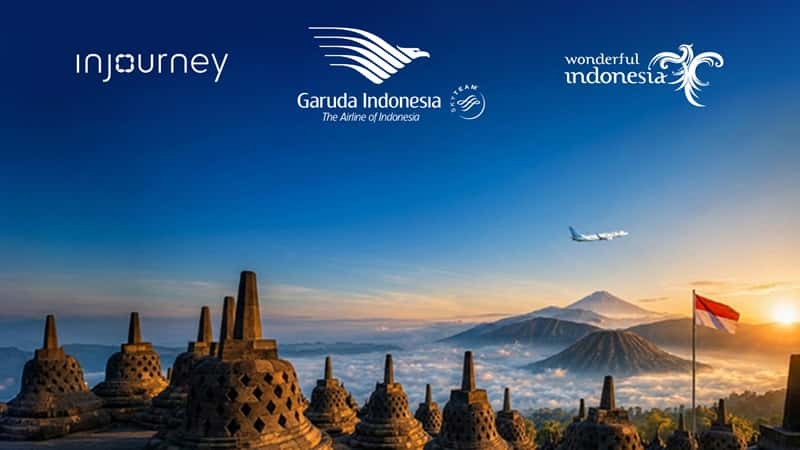
Indonesia is backing its invitation to “discover more” with a persuasive boarding pass. Garuda Indonesia has released 170,845 complimentary domestic flight seats for eligible international passengers, giving travellers a chance to venture beyond Jakarta or Bali without paying an additional domestic airfare.
The Free Domestic Flight program applies to eligible Garuda Indonesia international return journeys during the travel period from 1 August to 30 November 2026. Seats remain subject to the airline’s eligibility rules, participating routes, booking classes, and availability. In other words, this is a substantial promotion, not aviation’s answer to an unattended lolly jar.
Under the #DiscoverMoreIndonesia banner, the airline is linking its international services with its domestic network. The principle is refreshingly straightforward: an overseas visitor who flies into Indonesia can add an eligible domestic sector and see considerably more of the archipelago.
That matters in a nation where geography has never been shy. Indonesia stretches across thousands of islands and offers a formidable range of cultures, cuisines, landscapes and local experiences. Jakarta and Denpasar are major gateways, but they are the opening chapter rather than the entire book.
More than a visitor incentive
The offer is also relevant to members of the Indonesian diaspora, Indonesian migrant workers and citizens returning home. Eligible passengers may gain a simpler onward connection to family, hometowns or other destinations after arriving on an international service.
Garuda Indonesia Marketing Group Head Prina Eka Putri said the initiative was designed to make travel to the country more convenient, connected and valuable.
“Indonesia boasts a wealth of diverse destinations, and we see a significant opportunity to make every trip to Indonesia a more enriching experience. Through this program, we aim to provide a stronger incentive for international travelers not only to visit but also to stay longer, explore more destinations, and discover unique experiences across various regions of Indonesia,” said Prina.
The commercial thinking is sound. A visitor who adds another destination is likely to add more accommodation nights, restaurant meals, transfers, tours and local purchases. Instead of tourism expenditure gathering almost exclusively around the best-known gateways, it can travel with the passenger into regional economies.
“Indonesia is too vast to be enjoyed from just one destination. That’s why we want to make it easier to continue your journey within Indonesia. The idea is simple: come to Indonesia, then discover more of Indonesia,” Prina continued.
For travel advisers, the proposition creates an obvious opportunity to build a richer itinerary without automatically adding another domestic airfare. A conventional Jakarta business stop might become a broader leisure journey. A Bali holiday could acquire a second destination and a fresh reason for the client to stay longer.
Travel agents should check the small print
The practical details, however, deserve close attention. Reports on the launch say eligible travellers use the promotional code “INDO” when arranging the complimentary domestic component.
Bookings may be available through Garuda Indonesia’s website and app, travel agents, ticket offices, call centre and WhatsApp service. Travellers should confirm the applicable international itinerary, permitted domestic route, fare class, booking deadline and any taxes or charges before paying.
Garuda Indonesia Southeast Asia Branch Manager and Free Domestic Flight Project Management Office head Agny Gallus Pratama said the allocation was intended to do more than make travel easier.
“The challenge is not just how to attract more travellers to Indonesia, yet how to ensure that a single arrival can open access to more regions. When the travellers stay longer and visit more destinations, economic activity also expands, ranging from hotels, local transportation, restaurants, and culinary MSMEs, to various tourism activities in the region,” said Gallus.
MSMEs micro, small and medium enterprises are particularly important to the argument. Tourism’s value is not measured only at the airport gate or hotel reception desk. It also appears at the family restaurant, the independent guide’s office, the dive operator, the market stall and the transport business. A better-spread itinerary gives those enterprises a better chance of sharing in an international arrival.
“We want every international arrival to have a greater multiplier effect not only by bringing travelers to Indonesia, but also by creating opportunities for more destinations and tourism ecosystems across various regions to benefit from those trips,” Gallus continued.
A competitive weapon for Garuda
The program gives Garuda Indonesia a useful point of difference in Southeast Asia’s fiercely competitive visitor market. Airlines commonly compete on fare, frequency and service. Here, Garuda is also competing on the breadth of the holiday itself: fly to Indonesia, then use the flag carrier’s network to turn one arrival into a more ambitious journey.
The interests align neatly. Travellers get more holiday for their airfare; agents gain a stronger itinerary-building tool; Garuda can feed passengers into its domestic network; and regional destinations can capture a larger share of visitor spending.
The promotion should not be read as an automatic free flight for every international booking. The 170,845 figure refers to the number of allocated return domestic seats, and access depends on the published conditions and remaining inventory. Prospective passengers should consult the official Garuda Indonesia promotion page and confirm every sector before making non-refundable arrangements.
Subject to those conditions, the offer is a confident piece of destination marketing. Indonesia is not merely asking visitors to stay longer and range farther. It is putting seats behind the suggestion and, in tourism, that is considerably more useful than another glossy slogan.
By: Octavia Koo – © 2026.
Read Time: 4 minutes.
Author Bio:
 Octavia Koo arrived in Australia in the early eighties with little fuss and a good eye. Sydney suited her. At UNSW, she studied Arts, then found her footing in graphic design before drifting, quite naturally, into the digital side of things, building websites and shaping words that made people want to stay.
Singapore followed, and with it, the fast pace of tourism platforms and ITB Asia. Long before SEO became a buzzword, Octavia understood how stories travelled online. That’s where she met Stephen, and the seed for something more was planted.
A few years later, she joined Global Travel Media.
Today, Octavia works with quiet assurance, blending art, instinct and experience to produce stories that don’t shout; they simply work and linger.











