

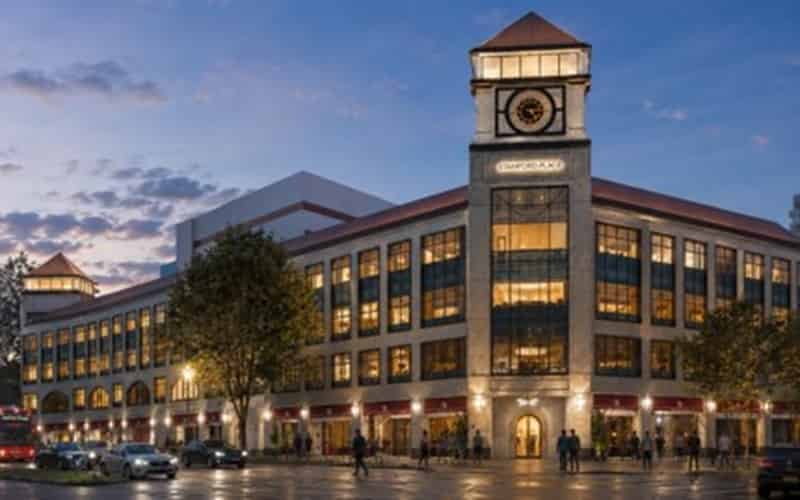
Singapore’s Civic District is preparing to reset one of its most familiar clocks.
Stamford Place, the reimagined former Stamford Court at 61 Stamford Road, is counting down to a September 2026 opening, bringing serviced apartments, flexible offices, restaurants, retail and cultural activity into one compact city-centre address.
And this is rather more ambitious than simply polishing the brass and giving the old clock tower a fresh coat of paint.
Stamford Place sits at the junction of Stamford Road and Hill Street, on a site with a long civic history. Its official website traces the building’s story to Eu Court, a 1920s Art Deco property commissioned by philanthropist Eu Tong Sen. The site later became Stamford Court and earned recognition for its distinctive clock tower.
Following an 18-month restoration, that tower is preparing to resume its place in City Hall life. This time, however, the building will do considerably more than tell Singaporeans they are late for lunch.
Old landmark, very modern ambitions
PGIM Real Estate and Singapore-based Elevate Capital Group acquired Stamford Court in October 2024 for S$132 million, with plans to turn the commercial property into a new mixed-use destination centred on living, working and lifestyle experiences.
That strategy is now taking visible form.
At street level, Stamford Place is being shaped as a neighbourhood hub rather than another sealed corporate address.
Eight food, beverage and retail spaces are planned. The emerging line-up includes Blue Label Tavern, Yoruya and Cold Storage On The Go, all now featured in Stamford Place’s official tenant directory.
Blue Label Tavern will bring its stone-fired pizzas, wine and classic-rock spirit to Stamford Road, alongside cold beer and dry-rubbed rotisserie chicken.
Yoruya takes a different path. The Japanese concept will move with the clock, serving ramen and rice dishes during the day before turning into a relaxed izakaya at night.
Then there is Cold Storage On The Go, supplying the useful but decidedly less theatrical ingredient every successful urban precinct needs: somewhere to grab breakfast, lunch or the forgotten carton of milk without mounting a small expedition.
Stamford Social takes centre stage
The headline dining act will be Stamford Social, an all-day café, bistro and bar inspired by relaxed European café culture.
The concept is designed to flow naturally through the day: coffee in the morning, business lunches, afternoon meetings, drinks after work, and dinner once the laptops have finally been closed.
Stamford Place describes Stamford Social as the development’s social heartbeat, with a focus on seasonal food, approachable wines and straightforward hospitality.
It is scheduled to welcome its first guests in October, following the September opening of Stamford Place and its serviced apartment component.
APT. targets the new urban traveller
Upstairs comes APT., a new-generation serviced apartment brand with 66 design-led apartments.
The proposition reflects a travel market in which the old dividing line between hotel and home has become increasingly blurred.
APT. targets travellers who may be staying for several nights, several weeks, or considerably longer. Its interiors combine residential comfort, technology and hotel-style service, with Frasers Hospitality supporting the guest experience.
Stamford Place’s own description is telling: APT is designed for travellers who move freely between cities but do not necessarily wish to compromise on how they live. Its accommodation will range from serviced studios to premium two-bedroom suites.
Guests will also have access to a gym and laundry facilities.
For corporate travellers, another major attraction is downstairs.
Levels Two and Three will feature The Great Room by Industrious, a hospitality-led flexible workplace offering desks, offices and meeting facilities. Stamford Place says the concept has been designed for organisations ranging from start-ups to Fortune 500 companies.
Put the pieces together, and the commercial thinking becomes clear.
A guest can sleep upstairs, work downstairs, entertain a client over lunch, pick up groceries and meet friends for dinner all without changing postcode or, for that matter, having to hail a taxi.
Why the travel trade should take notice
For travel advisors, corporate travel managers and long-stay accommodation specialists, Stamford Place is worth watching.
Singapore attracts regional executives, project teams, entrepreneurs and business travellers whose trips do not always fit neatly into the traditional hotel model.
A serviced apartment set within a larger dining, workplace and cultural precinct offers visitors something different: a more residential rhythm while retaining managed hospitality and a highly central location.
The property also sits within easy reach of Singapore’s Central Business District, Orchard Road, Raffles City, Funan and Clarke Quay. PGIM highlighted its strong transport links at acquisition, noting that five MRT stations were within a 10-minute walk.
That is difficult real estate to argue with.
Heritage provides the point of difference
The adaptive-reuse story also gives Stamford Place character that a freshly poured glass-and-concrete tower may struggle to manufacture.
Singapore-based Ministry of Design, working with Zaha Hadid Architects, has reinterpreted the building’s architectural character while drawing inspiration from its clock tower.
The geometry and measured rhythms of horology run through the design language, linking the landmark’s past to its new commercial life.
Art will add another layer through a partnership with design and art consultancy The Artling.
The idea is to make Stamford Place feel part of the Civic District rather than simply a property sitting inside it.
Indeed, the building is already engaging with neighbourhood life before its formal opening. Stamford Place is one of the locations in the Light Together Bras Basah. Bugis 2026 programme, running from 1 August to 5 September and using light and digital installations to animate historic spaces across the precinct.
Owners put community at the heart of revival
For the investors, that local connection has been central to the transformation.
“Since acquiring the property, our commitment has been to transform this well- located landmark into a destination that meets the evolving needs of our community, while preserving the character and heritage that make the building so distinctive. As the newly rejuvenated Stamford Place opens its doors, we are pleased to see this vision come to life,” said Su Lin Wee, Head of Asset Management for Southeast Asia, Greater China and South Korea, Real Estate, PGIM.
For Ashish Manchharam, Founder and Managing Partner of Elevate Capital Group, the redevelopment carries an especially personal connection.
“Stamford Place feels deeply personal. I walked past it every day as a child on my way to school, so returning to shape its next chapter feels like coming full circle. Through this refurbishment, our ambition is to make it a place that belongs to the neighbourhood, while giving people a reason to seek it out to stay, work, dine and connect,” said Manchharam.
That may prove to be Stamford Place’s strongest idea.
Singapore hardly lacks polished buildings, sophisticated restaurants or stylish offices. The trick is creating somewhere people choose to return to when they do not strictly need to.
Stamford Place is trying to solve that old urban puzzle with a thoroughly modern mix of hospitality, workplace, dining and adaptive reuse.
If the formula works, its famous clock tower will not simply mark the hour.
It may mark a rather significant new chapter for City Hall.
Stamford Place and APT are scheduled to open in September 2026, with Stamford Social following in October.
For further information, visit the official Stamford Place website.
By: Sandra Jones – © 2026.
Read Time: 4 minutes.
Author Bio:
 Sandra has spent a working lifetime quietly rescuing journeys, one itinerary, one anxious caller, one impossible connection at a time. Years in Australia’s finest travel agencies taught her the art of calm, how to find a flight in a fog of cancellations, how to soothe a traveller when luggage wanders, how to turn nine frantic days in Europe into something resembling sense. Qualified, seasoned, endlessly patient, she learned that good travel advice is part logistics, part listening.
But the storyteller in her was always waiting its turn. Writing offered a new map, a way to turn experience into reflection, detail into delight. At Global Travel Media, Sandra now writes the truths only insiders know: the mishaps, the laughter, the grace found between gates and goodbyes. She reminds us that travel, for all its fuss, is still one of life’s better ideas.











