

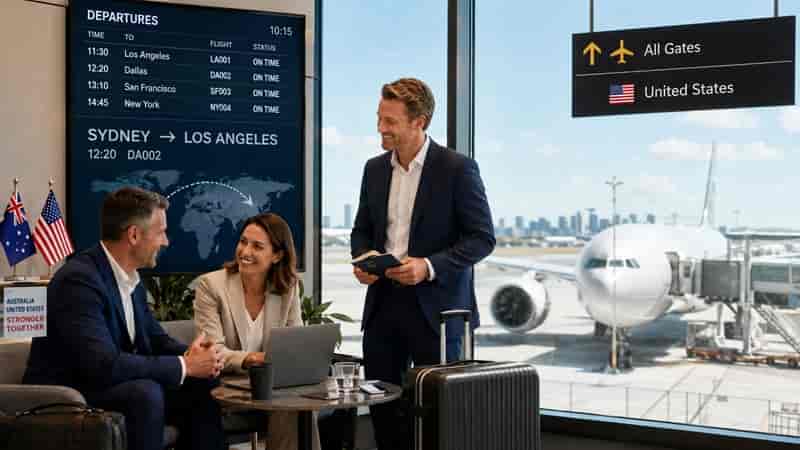
Australian SMEs are proving remarkably hard to ground.
Business travel between Australia and the United States rose 9 per cent among small and medium enterprises in the first six months of 2026, compared with the same period last year. The figure comes from Corporate Traveller customer data supplied for this report.
That is a strong result in a year that has tested both nerves and travel budgets.
In February, the US Supreme Court rejected the legal basis used for an earlier tariff regime. The White House then ended those duties and introduced a separate 10 per cent temporary import surcharge. It took effect on 24 February and applied to most imports, with a range of exemptions. Australia’s Department of Foreign Affairs and Trade says most Australian goods sent to the US were caught by the global surcharge.
Days later, the world became more unsettled. Hostilities between the United States and Iran began on 28 February. Commercial flights across parts of the Middle East were badly disrupted. Shipping through the Strait of Hormuz also fell sharply, while oil and jet-fuel markets came under severe pressure. The US Energy Information Administration reported Brent crude finishing the first quarter at US$118 a barrel, up from US$61 at the start of the year.
For Australian SMEs, however, the boarding gate stayed busy.
“Nine per cent growth in a year like this tells you everything about how Australian SMEs operate – they don’t wait for the noise to settle, they get on the plane and get the deal done,” said Tom Walley, Global Managing Director, Corporate Traveller.
That line has a certain Australian ring to it. When the meeting matters, apparently the passport does too.
America remains serious business
The United States remains a major market for Australian business.
DFAT says the US was Australia’s second-largest two-way trading partner in 2025, with two-way trade worth A$98.6 billion. Australia exported more than A$48.5 billion in goods and services to the US during the year. The United States was also Australia’s largest source of foreign investment, with investment in Australia reaching A$1.36 trillion.
Small business is just as important at home.
The Australian Small Business and Family Enterprise Ombudsman says around 98 per cent of Australian businesses are small businesses under its turnover definition. Federal Treasury says small businesses contribute almost one-third of national GDP and employ about 5.4 million people.
In other words, this is hardly a niche travel market. It is a sizeable piece of Australia’s commercial engine room.
More seats across the Pacific
Airlines have also given business travellers more choice across the Pacific.
Delta Air Lines began nonstop Los Angeles–Melbourne services in December 2025, adding Melbourne as its third nonstop Australian destination.
United Airlines launched the first nonstop link between the United States and Adelaide, with its San Francisco–Adelaide service starting in December 2025.
Then came Qantas, putting the Airbus A380 onto daily Sydney–Dallas Fort Worth services from January 2026. The change delivered more premium seats in First, Business and Premium Economy on one of the carrier’s key US routes.
And there is more to come.
Qantas will launch its first Sydney–Las Vegas scheduled service on 29 December 2026. The seasonal Boeing 787 Dreamliner service will operate three times weekly through to 12 March 2027.
More seats will not make tariffs or conflict disappear. They do, however, give firms more ways to build a workable trip. That matters when time is tight, and a missed meeting can cost considerably more than the airfare.
SME travel is growing up
Corporate Traveller’s wider FY26 data points in the same direction.
The company says SME travel programs have become far more complex. Multi-stop itineraries and international routes, once more common among large corporations, are now routine for smaller businesses with lean teams and often no dedicated travel manager.
Travel and expense management was a top priority for 76 per cent of Corporate Traveller customers in FY26, the company said.
That creates an intriguing picture.
The travel program can look like something from the top end of town. The person running it may also be handling finance, people, sales and wondering who finished the office coffee before lunch.
“SME travel to the US now looks like a big corporate program – multi-city itineraries, higher stakes, less room for error – except most of our customers are running it without a dedicated travel manager. That’s the exact gap we close,” said Walley.
Trade ties add another reason to travel
The broader Australia–US business relationship is also deepening in strategically important sectors.
In October 2025, Prime Minister Anthony Albanese and US President Donald Trump signed a bilateral framework covering critical minerals and rare earths. Each country committed at least US$1 billion towards an identified US$8.5 billion pipeline of priority projects across Australia and the United States.
That agreement matters to business travel because commerce has always followed opportunity.
New projects create meetings. Meetings create trips. And large, complicated deals still have an uncanny habit of working better when the decision-makers are actually sitting in the same room.
The 9 per cent rise should not be read as proof that SMEs ignore risk. Far from it. Smaller firms feel higher fares, currency swings and broken schedules very quickly. They simply appear prepared to manage those risks when the commercial case is strong.
For the travel industry, that is encouraging.
SME travellers now expect competitive fares, sound advice, flexible booking rules and support when plans go sideways. They are also asking more of every journey. Travel is not simply another line on the expense sheet. Every trip increasingly has to earn its keep.
The first half of 2026 therefore delivers a refreshingly old-fashioned lesson.
Technology may manage the diary. Video calls may fill the gaps. Artificial intelligence may even write the meeting notes before everyone has found the biscuits.
But when the deal is serious, people still want to meet people.
And Australian SMEs, it seems, remain more than willing to cross the Pacific to shake on it.
By: Bridget Gomez – © 2026.
Read Time: 4 minutes.
Author Bio:
 Bridget has never been built for stillness. Of Portuguese heritage, she began as a nurse, tending veterans at the Repatriation Hospital, listening to stories as colourful as the life she was yet to live. It was worthy, steady work, but wanderlust, as always, proved louder than routine.
So, she traded starch for a backpack and disappeared for a year, chasing trains, sunsets and the occasional regrettable glass of wine. She wrote everything down: the dust, the laughter, the missteps, the magic. Those notebooks became a travel blog, then a habit, then a calling.
Eventually she found Global Travel Media, or perhaps it found her.
Today Bridget writes with heart, humour and a dash of mischief, still travelling, just now with words.











