

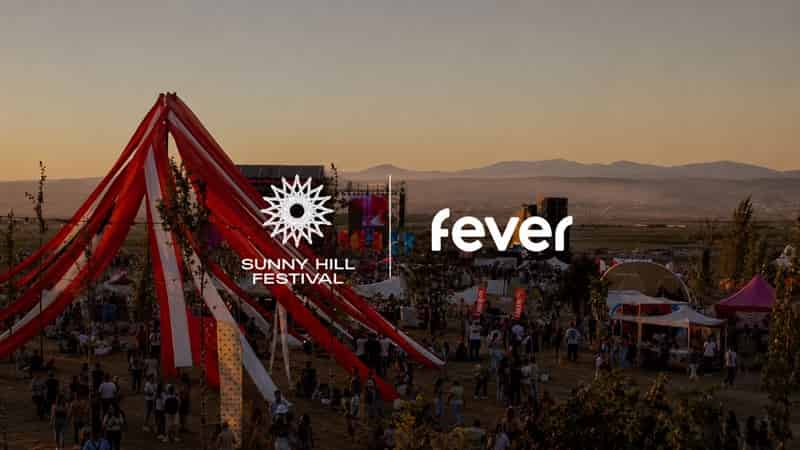
Sunny Hill Festival has long been in the business of turning up the volume in Kosovo. Now, with global live-entertainment platform Fever appointed as its Official International Ticketing Partner for 2026, the festival has also been turning up the volume on Kosovo itself.
The partnership, announced ahead of this year’s three-day event at Sunny Hill Festival Park in Bërnica, Prishtina, was designed to make the festival easier for overseas fans to discover and book. Fever’s international reach was combined with DICE, the fan-first ticketing platform it acquired in June 2025, giving Sunny Hill another route into international markets and, crucially for Kosovo’s visitor economy, another reason for travellers to put Prishtina on the itinerary.
The timing was hardly shy.
Sunny Hill’s 2026 edition ran from 31 July to 2 August, with Katy Perry, Martin Garrix, Lewis Capaldi, Dhurata Dora, Adam Port and Rampa of Keinemusik, PAWSA, Seth Troxler, Carlita, Ledri Vula, MC Kresha and other international and regional artists spread across the program. The final night sold out, capping another high-profile weekend in a city increasingly accustomed to finding itself on the global music map.
For the travel trade, however, the more interesting story is not simply who was on stage.
It is what happens beyond the stage when tens of thousands of people require hotel rooms, restaurant tables, airport transfers, taxis, coffee, late-night food and, one assumes, industrial quantities of bottled water.
Ticketing deal targets the international traveller
Fever says its discovery platform reached more than 300 million people across more than 40 countries in the preceding year. Under the Sunny Hill agreement, the festival was cross-listed across Fever and DICE, broadening international distribution and reducing friction for fans booking from abroad.
That matters because festivals are increasingly destination products rather than mere entertainment products.
A ticket can be the first item in a much larger travel basket: flights, accommodation, ground transport, meals and extra nights before or after the event.
In Sunny Hill’s case, the commercial ambition is particularly clear. The festival is selling music, certainly, but Kosovo is also receiving a rather impressive three-day global shop window.
“Sunny Hill was always about more than music. For a few days every summer, we bring the world to Kosovo and the whole country feels it,” said Dukagjin “Dugi” Lipa, founder of Sunny Hill Festival. “The attention the festival brings is exposure no tourism campaign could ever buy, and the value it creates stays at home: in our visitor economy, in our cultural sector, and in the opportunities we open for young people. Fever’s reach and technology will make it easier for fans everywhere to discover Sunny Hill, secure their tickets and make the journey to Prishtina.”
Fever Senior Vice President Mariano Otero struck much the same commercial chord.
“Sunny Hill is that rare event where a great festival is also a growth engine for an entire country,” Otero said. “Our role is to make it simple for fans anywhere in the world to discover the festival, book their tickets and travel to Prishtina so that more people come, and more of the value stays in Kosovo.”
Three festival days, one sizeable economic tail
The numbers explain why tourism operators should be paying attention.
According to figures cited by Fever and attributed to the Kosovo Chamber of Hotels and Tourism, Sunny Hill’s 2025 edition generated approximately €22 million in direct economic impact across accommodation, restaurants, transport, retail and other local businesses.
The festival subsequently received the Kosovo Chamber of Commerce Economic Impact Award 2025.
Organisers estimate the broader visitor footprint can approach €50 million per edition when expenditure by accompanying friends and family, international visitors and members of Kosovo’s diaspora is included.
That figure should be understood as an organiser estimate rather than treated as a measure comparable to the €22 million direct-impact figure. Nevertheless, the tourism logic behind it is straightforward: festival visitors do not abruptly stop spending when they leave the gate.
The accommodation picture was equally striking.
Organisers reported hotel occupancy in Prishtina of 99–100 per cent during the 2025 festival, with occupancy across the rest of Kosovo at about 96 per cent.
For hoteliers, restaurateurs and transport operators, that is not background noise.
It is the sound of demand arriving with luggage.
Sunny Hill says more than 100,000 festival-goers from more than 60 countries attended in 2025. The European Festivals Association’s FestivalFinder also describes Sunny Hill as an annual international music and culture festival and records more than 35,000 attendees per day for its 2025 edition.
Kosovo’s increasingly powerful cultural calling card
Founded in 2018 by Dukagjin Lipa and promoted internationally by his daughter, three-time Grammy Award winner Dua Lipa, Sunny Hill has assembled a past guest list that would make many longer-established festivals glance rather nervously at their booking sheets.
Previous editions have featured Dua Lipa, Miley Cyrus, Calvin Harris, J Balvin, Shawn Mendes, Stormzy, Burna Boy, Bebe Rexha, DJ Snake, Black Coffee, Peggy Gou, Anyma and Hardwell.
Industry recognition has followed.
Sunny Hill was nominated in two categories at the 2022 European Festival Awards: Best New Festival for its Tirana edition and Best Medium-Sized Festival for its Prishtina edition.
It returned to the Best Medium-Sized Festival conversation in subsequent awards cycles, with the official 2025 European Festival Awards nominee list placing Sunny Hill alongside established European events, including Pohoda, OpenAir St Gallen, and Orange Warsaw Festival.
The importance of such recognition stretches beyond bragging rights.
Successful festivals give destinations something conventional advertising campaigns can struggle to manufacture: cultural relevance.
And there is a wider nation-branding story at work.
Dua Lipa’s connection with Kosovo has given Sunny Hill unusual visibility far beyond traditional festival media. During the 2025 festival period, Kosovo President Vjosa Osmani granted Lipa Kosovo citizenship, a moment that was subsequently reported internationally and that again linked contemporary pop culture with the country’s international identity.
That sort of visibility is notoriously difficult to buy through destination advertising alone.
A headline artist posting from Prishtina to tens of millions of followers can achieve in seconds what tourism marketers have traditionally spent years trying to do: put a destination squarely in the global cultural conversation.
More than a very large weekend party
Sunny Hill also operates in support of the Sunny Hill Foundation, which works across arts, culture and education in Kosovo.
Festival and partner materials say the Foundation supports STEM scholarships for young women and programs that connect young Kosovar songwriters, producers, and artists with international peers and professional networks.
There is a bricks-and-mortar legacy too.
Sunny Hill is associated with a planned €7 million investment in the Bërnica site, aimed at transforming the festival area into public parkland available to citizens outside festival periods.
The investment plans have been discussed publicly since the development of the permanent site was proposed, including landscaping, tree planting, infrastructure, and public use, beyond the few days when the amplifiers are doing their best to rearrange the local geology.
That distinction matters.
For tourism destinations chasing major events, the best festivals do more than fill beds for a weekend. They build infrastructure, create employment, develop creative industries, and give younger generations reasons to participate in, rather than simply observe, a growing visitor economy.
Fever deal carries lessons beyond Kosovo
For the international tourism industry, the message from the Fever partnership goes beyond ticketing.
Digital distribution can turn cultural events into travel triggers, particularly for destinations still building familiarity in major overseas markets.
Lowering booking barriers is part of that equation. So is placing a festival before an audience that might never previously have considered travelling to Kosovo.
Fever brings distribution technology and international consumer reach. Sunny Hill brings a recognisable cultural brand, major artists and an established audience.
Kosovo, meanwhile, receives something increasingly valuable in an exceptionally crowded tourism market: a compelling reason to travel that cannot simply be copied and pasted into somebody else’s brochure.
The 2026 stages may now be quiet, but Sunny Hill’s larger proposition is anything but.
For three days each summer, Prishtina becomes a music capital. The real tourism opportunity is ensuring that visitors remain curious and, preferably, stay in Kosovo a little longer after the final encore.
For an event founded with ambitions far beyond the stage, that may ultimately prove to be Sunny Hill’s greatest headline act.
Official sources and further information:
-
Sunny Hill Festival
-
Sunny Hill Festival official information and tickets
-
Fever Newsroom – Sunny Hill partnership
-
European Festival Awards
By: Bridget Gomez – © 2026.
Read Time: 6 minutes.
Author Bio:
 Bridget has never been built for stillness. Of Portuguese heritage, she began as a nurse, tending veterans at the Repatriation Hospital, listening to stories as colourful as the life she was yet to live. It was worthy, steady work, but wanderlust, as always, proved louder than routine.
So, she traded starch for a backpack and disappeared for a year, chasing trains, sunsets and the occasional regrettable glass of wine. She wrote everything down: the dust, the laughter, the missteps, the magic. Those notebooks became a travel blog, then a habit, then a calling.
Eventually she found Global Travel Media, or perhaps it found her.
Today Bridget writes with heart, humour and a dash of mischief, still travelling, just now with words.











