

A quiet Monday morning at Sydney Airport produced the sort of event aviation works hard to prevent.
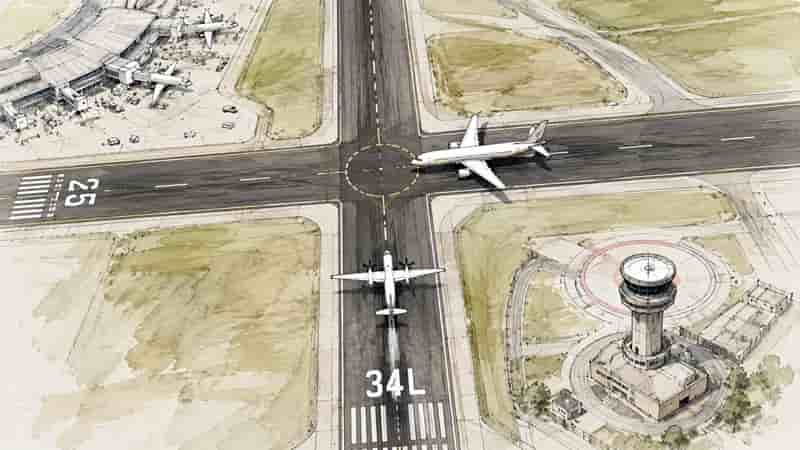
At 8.14 am on 27 July 2026, a QantasLink Bombardier DHC-8-402 from Canberra was still rolling along runway 34L after landing. At the same time, air traffic control cleared a Qantas Boeing 737-838 from Queenstown to move along runway 25 and cross runway 34L.
Air traffic control saw the conflict and warned both crews. The Boeing stopped after passing the holding point. Neither aircraft was damaged. No one was injured.
The Australian Transport Safety Bureau has classed the event as a serious incident. Its listed categories include a breakdown of coordination, an information or procedural error and a runway incursion.
That language is calm by design. Safety reports rarely arrive with a brass band. Even so, “serious incident” is not a decorative label. A runway incursion is not the aviation version of taking the wrong turn near the car park.
The inquiry matters beyond the two aircraft. Sydney is Australia’s main international gateway. It has heavy domestic and overseas traffic, intersecting runways and little room for loose procedure. More than 42.5 million passengers passed through the airport during 2025.
What happened on the airfield
The aircraft were QantasLink flight QLK424D from Canberra and Qantas flight QFA124 from Queenstown.
The QantasLink aircraft, registration VH-QOC, was operated by Sunstate Airlines. It landed on runway 34L. The Qantas Boeing 737, registration VH-XZG, had arrived from New Zealand. It was moving on runway 25 under an air traffic control clearance to cross the main north–south runway.
Sydney Airport has three runways. Runway 16R/34L is the 3,962-metre main north–south runway. Runway 07/25 is the 2,530-metre east–west runway. The two surfaces cross.
The ATSB says the DHC-8 was still in its landing roll when the crossing clearance was issued. Air traffic control then found the conflict and spoke to both crews. The 737 stopped after the holding point.
That last detail matters. The public record does not say how close the aircraft came. It does not say that a crash was only seconds away. It does not yet explain why the clearance was given. No distance has been released by the ATSB.
“Near miss” is a phrase many readers will understand. The formal description is safer and more exact: a serious runway-incursion incident that remains under investigation.
Why runway incursions matter
The ATSB defines a runway incursion as the incorrect presence of an aircraft, vehicle or person within the protected area of a surface set aside for aircraft landing and take-off. Runway incursions remain a major aviation-safety concern because they can create a collision hazard or lead to a loss of separation.
The danger is plain. Aircraft use runways during fast and demanding parts of a flight. A landing aircraft may still be moving at speed. Another aircraft crossing its path can create a threat before either crew has much time to act.
Australia’s safety system is built to find such events, report them and learn why the normal defences did not work as planned. Runway incursions where a collision is narrowly avoided can meet Australia’s reporting threshold for a serious aircraft incident.
Sydney Airport says every taxiway entry to a runway has red stop-bar lights. They add another layer of protection against an aircraft or vehicle entering a runway at the wrong time. The airport also uses marked holding points, air traffic control clearances and formal movement-area rules.
Those systems existed on 27 July. That does not tell us which one was involved, or whether any of them failed.
The ATSB has not said that a light, sign, pilot action, controller action, staff level or computer system caused the incident. Its published information remains preliminary.
That distinction must remain clear. An inquiry is a way to find causes. It is not an invitation for the rest of us to invent them before lunch.
What investigators will examine
The ATSB investigation is active and is in its evidence-gathering phase.
The bureau says it will interview those involved, collect relevant information and review recorded data. The work is intended to establish the sequence of clearances, aircraft movements, warnings and responses.
The inquiry has been set at the short investigation level. A final report is expected during the fourth quarter of 2026.
The ATSB says it will alert relevant parties at once if it finds a critical safety issue before the final report is ready, allowing safety action to be considered without waiting for the investigation to end.
That is how a sound safety system should work. The first aim is not to find a public villain. It is to find the chain of events.
Serious incidents often involve several small factors lining up at the wrong moment. There may be a message, a missed check, a heavy workload, an assumption or a prompt that did not work as intended.
No one can yet say whether any of those factors applied in Sydney.
Staffing questions need evidence
The event has renewed debate about air traffic control staffing and workload. Those are fair topics for a separate investigation.
They are not yet proven causes of this incident.
The ATSB’s present summary identifies a breakdown of coordination. It does not link that breakdown to staff shortages, fatigue, training, technology, or a single person’s mistake.
Airservices Australia manages air traffic through airport towers, terminal units and major air traffic service centres. Its controllers manage aircraft through each phase of flight, while its systems and procedures are intended to reduce collision risks and maintain an orderly flow of traffic.
The relevant instructions, procedures, and control actions will therefore be subject to close study as the inquiry continues. The actions and responses of both flight crews will also form part of the wider evidence.
The review should be firm. It must also be fair.
Aviation safety is best served when investigators can follow the facts without a public verdict racing ahead of them down the runway.
Why Sydney makes the story bigger
Sydney Airport handled more than 42.54 million passengers in 2025. That included a record 17.17 million international passengers. The airport also records more than 300,000 aircraft movements in a typical year.
Its layout adds pressure. The main runway and east–west runway cross. International, domestic, regional and freight flights must all be moved through a tight coastal site.
Busy does not mean unsafe. It does mean every instruction must be clear and every procedure must be followed.
Air traffic control language is brief for a reason. There is little room for waffle when one aircraft is landing, and another is near an active runway.
The system depends on clear instructions, correct replies and a shared view of what is happening on the ground.
The ATSB says the system experienced a breakdown in coordination on 27 July. It must now determine how the breakdown occurred and whether the event points to a broader weakness.
What passengers should take from it?
Passengers have every right to be concerned by a serious runway incident. They are not helped by claims that go beyond the known facts.
Both aircraft came to a safe stop. No one was hurt. No damage was reported. Air traffic control saw the conflict and acted.
Those facts do not make the event minor. They show that one safety layer worked after another part of the operation had gone wrong.
Modern aviation uses many layers of protection. Rules, lights, training, technology, communication, and human judgement are meant to prevent a single error from becoming an accident.
When one layer becomes weak, the others matter greatly.
The key question is not just whether everyone arrived safely. They did.
The key question is why a late warning became necessary and what will stop the same thing happening again.
The answer must come from evidence.
The travel trade has a stake
Sydney Airport is more than runways and terminals. It supports airlines, hotels, events, tours, cruise connections and the wider visitor economy. The airport describes itself as Australia’s primary international gateway and recorded its busiest year for international travel during 2025.
Trust in its operation matters to passengers and to the businesses selling Australia to the world.
Travel advisers should not alarm customers or claim that normal flights through Sydney are unsafe. The published evidence does not support that conclusion.
The industry should not dismiss the event either. A serious incident deserves serious review, even when it ends without injury or damage.
One reason flying remains safe is that incidents and procedural failures must be reported and examined. Confidence is not built by claiming that nothing ever goes wrong. It is built by finding problems and fixing them.
The ATSB report will deserve close attention when it appears. It may identify human, technical, procedural or organisational factors. It may call for action, or record changes already made by the parties involved.
Until then, certainty should remain parked at the gate.
Safety begins with hard questions
The Sydney Airport runway incursion did not become an accident. That is the welcome part of the story.
The troubling part is clear. A Boeing 737 was cleared to cross an intersecting runway while a QantasLink aircraft was still completing its landing roll.
Air traffic control found the conflict. The 737 stopped. The system caught the danger before the situation worsened.
Now the less visible work begins. Investigators must establish what happened, why it happened and whether the same chain could form again.
Passengers do not need theatre. They need open review, careful reporting and action based on proof.
Aviation has no shortage of rules, lights, checklists and acronyms. Their real worth is tested when a busy morning produces a clearance that should not be repeated.
For Sydney Airport, Qantas, QantasLink and Airservices Australia, the next step is accountability.
The ATSB will decide where it leads.
By: Jill Walsh – © 2026.
Read Time: 7 minutes.
Author Bio:
 Jill Walsh has always kept a pen close and a suitcase closer. She started out on media releases, then learned the trade properly by escorting press trips around the world, discovering which stories travel well and which need a sharper edit.
Before long, she wasn’t just promoting destinations; she was representing them, translating civic ambition and local pride into words people actually wanted to read. These days, semi-retired and happily so, Jill has traded departure boards for deadlines, joining old friend and colleague Stephen at Global Travel Media on a casual basis.
Her patch is the business end of wanderlust: balance sheets, route maps, tender wins and the numbers that quietly decide where travellers go. She writes with dry humour, clean prose and an old-school respect for facts a steady voice when the market starts shouting.











