

By the winter of 1932, a small tin‑roofed hall in Kiltoghert, County LeitrimOpens in new window, had become the unlikely flashpoint for one of Ireland’s most divisive cultural battles. Built by local volunteers for Jimmy Gralton, the hall pulsed with the music, dance and radical ideas he had brought home from his travels in 1920s America.
Inside its corrugated‑iron walls, traditional Irish musicians began blending reels and sets with saxophones and jazz rhythms. Young dancers tried foxtrots and quicksteps alongside familiar steps from home. For many, it was a thrilling glimpse of a modern, outward‑looking Ireland.
But not everyone welcomed the change. To some members of the local clergy, the hall represented a direct challenge to the social order of the time. Jazz, dancing and outside influences were viewed with deep suspicion, with warnings that “the devil” had arrived in the parish. On Christmas Eve 1932, the hall was burned to the ground.
Reclaiming the space with a vibrant act of rebellion
Ninety-four years later, Leitrim dancer, choreographer and folklorist Edwina Guckian is bringing its spirit back to life with her immersive touring show, The Devil’s in the Dance HallOpens in new window.
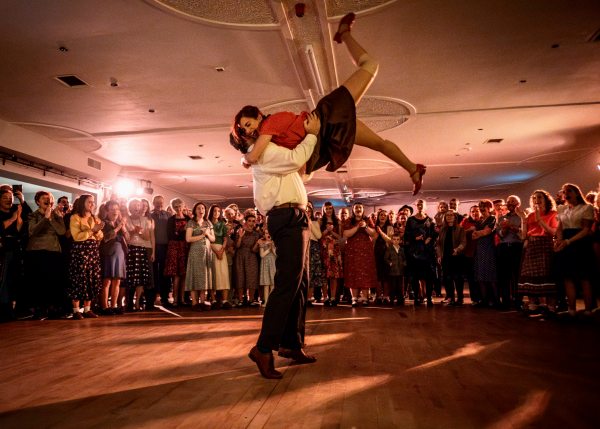
Drawing on oral histories, archival research and family memories, Guckian has spent years piecing together the forgotten social world of Ireland’s dance halls for the production. Now she invites audiences to step directly into it. Guests are encouraged to arrive in 1930s‑style dress, the band strikes up, and Guckian leads the room through the dances that once electrified rural communities. Vintage suits and tea dresses swirl across the floor as village halls and community centres transform into living, breathing dancehalls of another era.
“We’re trying to reclaim the joy in the dancehall,” Guckian says. “These halls were built for dancing, but over the years they’ve become spaces that only hold bingo. We wanted to take that space back. It’s a rebellious act in a tongue-in-cheek kind of way. This is our space, and if we want to dance, we’re going to dance.”
Rediscovering the joy of the dance floor
For an island celebrated for music and dance, Guckian believes Ireland has become increasingly self-conscious about movement and social dancing.
“I blame the 1980s and the techno sound,” she says with a laugh. “Suddenly, the lights went down, the volume went up, and nobody could be seen. Everyone became too busy worrying about themselves.”
Before that shift, dancing was woven into everyday Irish life.
“That’s how you socialised, how you escaped the isolation of rural life, and how most people met their partners,” she says. “It was a form of pure joy. If you’re feeling low and you have a good dance, you feel pretty good afterwards.”
At each performance, audiences do not sit passively watching from rows of seats. Instead, they step directly onto the dance floor. Guckian encourages strangers to dance together, particularly across generations.
“One of the biggest successes of the whole project is hearing people say, ‘I had a great night with people of all ages, and I didn’t have a single drink,’” she says. “It’s about finding that freedom in dancing again.”
Music designed to get you moving
The production is driven by The Gralton Big Band, a nine-piece ensemble inspired by the kind of music that once filled Gralton’s hall. Led by musical director Stephen Doherty on accordion and flute, the group blends traditional Irish music with swing and jazz influences from America during the 1920s and 1930s. Vocalist Cathy Jordan joins fiddlers David Doocey and Conor Caldwell, banjo player Brona Graham, pianist Ryan Molloy, and percussionist Jim Higgins, with trumpet layered over the top.
“It’s music that makes you want to dance,” Guckian says. “There’s plenty of Irish music in it too, so it swings both ways.”
A place rooted in community history
For Guckian, the story is also deeply personal. Her grandparents were teenagers when Gralton’s hall was in operation.
“My grandparents lived just a short stroll on either side of the hall,” she says. “My grandfather had vivid memories of the priest telling people from the altar to go down and throw stones at the dancers. Even as a young lad, he thought it was ridiculous. But the pressure was real.”
Family stories passed down through generations tell of local businesses connected to the hall that were boycotted, and communities became divided over Gralton and his supporters.
The hall itself became far more than a place for dancing. Adults gathered there to learn to read and write, political meetings were held and local farmers organised around land disputes and evictions. For many, it represented a rare independent community space outside the influence of both church and state.
That history gives The Devil’s in the Dance Hall an emotional depth that reaches beyond nostalgia. While works such as the 1982 television film The Ballroom of Romance captured the loneliness sometimes associated with rural dance culture, Guckian’s production leans firmly into joy, connection and community
The power of shared experiences
The revival arrives at a time when audiences are increasingly drawn to shared cultural experiences rooted in Irish history and storytelling. Later this year, another immersive Irish classic returns as the celebrated staging of James Joyce’s The DeadOpens in new window Opens in new windowcomes back to the Museum of Literature IrelandOpens in new window (MOLI). Meanwhile, the Dublin Literary Pub CrawlOpens in new window keeps drawing crowds with its spirited mix of live performance, humour and literary lore.
As Guckian prepares for the second half of her island-wide tour, taking the big band through Cork, Kerry, Clare, Galway, Roscommon and Dublin, she believes the ultimate appeal lies in something very simple.
“People keep asking me when the next dance is going to be,” she says. “And I always tell them the same thing. You don’t need to wait for the next event. Just go home, put on some good music and have a dance in the kitchen with your friends.”
For international visitors, The Devil’s in the DancehallOpens in new window offers something genuinely special — a real taste of Irish cultural heritage delivered in a fresh, immersive format.
The production continues its tour with upcoming performances in The Seamus Ennis Arts CentreOpens in new window in Dublin on Saturday 13 June and in Moore Community Hall,Opens in new window Athlone, Co. Roscommon on Saturday 25 July. Additional tour dates across Ireland will be released shortly.











