

For decades, Australians have debated one question: which city reigns supreme, Melbourne or Sydney? The rivalry has played out in opinion columns, dinner party arguments and interstate bragging rights. To finally settle the score, global eSIM leader Holafly has created The Holafly Rivalry Index 2026, a comprehensive data-driven comparison of Australia’s greatest city rivalry.
Produced by Holafly, the index compares Melbourne and Sydney across eight dimensions of urban life: coffee, nightlife, dining, dating, outdoor spaces, fitness facilities, hotels and live events. Holafly analysed citywide data including venue density, trading hours, dating activity, beaches and green space, fitness facilities and trails, hotel inventory and event activity, with each category weighted and combined to produce an overall score out of 100.
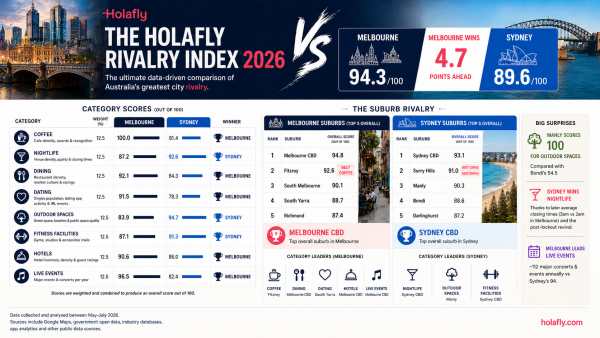
Melbourne came out on top with a score of 94.3, compared with Sydney’s 89.6, winning five of the eight categories and finishing 4.7 points ahead overall.
“The data shows there isn’t one clear winner across every category,” said Nadia Cintra, International Expansion Manager at Holafly. “Melbourne leads overall, but Sydney comes out on top for nightlife, outdoor spaces and fitness. It gives travellers a clearer picture of what each city does best.”
Melbourne leads across coffee, dining, dating, hotels and live events
When it comes to who makes the best coffee, where to catch a live event or even where to score a date, Melbourne wins by a clear margin.
Scoring maximum points on both cafe density and award and recognition measures, Melbourne ranked first in the coffee category. The inner city suburb of Fitzroy recorded the highest density of internationally recognised specialty roasters per square kilometre, while the Brunswick Street and Smith Street precinct achieved an average Google Maps rating of 4.62, representing the most concentrated specialty coffee precinct in Australia.
Melbourne also ranked first for live events, with its year-round sporting calendar providing a significant advantage. The Australian Open, Formula 1 Australian Grand Prix, Boxing Day Test and AFL season produce a density of world-class sporting events that no other Australian city approaches. The city also hosts approximately 112 major concerts and music events annually, compared with Sydney’s 94.
The city also led the dating category, supported by a larger single population, a higher concentration of active dating app users per square kilometre and a greater number of IRL dating events during the 90-day measurement period, creating natural conditions for a more active dating economy.
Finally, Melbourne ranked first for both hotels and dining. Melbourne recorded 412 hotels compared with Sydney’s 394, alongside a higher hotel density and marginally stronger average guest ratings.
The city’s dining result was supported by the strength of its established food market culture, including Queen Victoria Market and South Melbourne Market.
Sydney wins in nightlife, outdoor spaces and fitness facilities
In the most surprising outcome of the Holafly Rivalry Index, Sydney ranked first for nightlife. While Melbourne leads on both venue density and quality recognition, Sydney’s later average closing times tip the overall score in its favour. Standard licensed venues in Sydney recorded an average closing time of 3am, compared with 2am in Melbourne.
The result reflects a city in the midst of a nightlife resurgence, following the NSW Government’s removal of the final remaining lockout-era restrictions in January 2026. Oxford Street and the Darlinghurst corridor extending into the CBD represent the beating heart of Sydney’s post-lockout revival.
The harbourside city also ranked first for the quantity and quality of its public outdoor spaces, with the city’s beach count the decisive variable. The oceanside suburb of Manly achieved the highest outdoor space score in Sydney’s suburb ranking, with its 215 hectares of public land, combined with dual harbour and ocean frontage. Both Sydney and Melbourne exceeded the World Health Organization’s minimum green space benchmark of nine square metres per person by more than 200 per cent.
Sydney also led the rankings for fitness facilities, supported by 620 kilometres of accessible hiking trails. Sydney’s harbour inlets, Lane Cove National Park, and coastal reserves produce significant trail kilometrage within the 30km radius of the CBD that Melbourne’s terrain cannot match at an equivalent distance.
The suburb rivalry
The index also assessed 13 suburbs in each city. Melbourne CBD ranked first among the Melbourne suburbs assessed, while Sydney CBD topped Sydney’s separate suburb ranking. Fitzroy and Surry Hills claimed their respective cities’ coffee crowns, while Surry Hills also outranked Sydney CBD for dining. In one of the index’s biggest surprises, Manly scored 100 for outdoor spaces, compared with Bondi’s 54.5, while South Melbourne ranked as Melbourne’s third-best suburb overall.











