

If you’ve ever spent half your European summer holiday standing in a queue behind 400 people taking exactly the same photo, Southern Africa may have the answer.
While much of Europe prepares for another season of packed airports, inflated hotel rates and tourists shoulder-to-shoulder from Barcelona to Venice, South Africa and Zimbabwe are quietly entering what many safari veterans consider their finest time of year.
No crowds.
No heatwaves.
No fighting for a restaurant booking six months in advance.
Just lions, elephants, whales and horizons that stretch further than most airline baggage queues.
For travel advisors looking for alternatives to Europe’s increasingly congested summer season, Southern Africa is becoming a far easier sell than it was even five years ago.
Traveller priorities have shifted.
The post-pandemic traveller is increasingly chasing experiences rather than checklists. They want wildlife instead of waiting in lines. Nature instead of noise. Space instead of stress.
And right now, Southern Africa has plenty of all three.
The region’s winter season, running from June through August, delivers conditions that safari operators spend the rest of the year talking about.
The bush thins out. Water sources shrink. Animals become easier to find.
In safari terms, Mother Nature effectively turns up the contrast setting.
Suddenly, elephants appear where dense vegetation once hid them. Predators linger around waterholes. Game drives become less about luck and more about where to point the camera.
That is particularly true across South Africa’s major wildlife regions and Zimbabwe’s Zambezi corridor, where dry-season conditions traditionally produce some of the strongest viewing opportunities of the year.
But the appeal extends well beyond the safari vehicle.
In South Africa’s vast Karoo, the historic town of Graaff-Reinet offers a reminder that not every memorable African experience comes with a lion attached.
The beautifully restored Drostdy Hotel has become a favourite among travellers wanting something slower, richer and more connected to local culture.
This is a part of South Africa where history still feels alive, where Cape Dutch architecture stands proudly against enormous landscapes, and where conversations tend to last longer than the average social media video.
A few hundred kilometres away, another trend is gathering momentum.
Private-use travel.
Families, friendship groups and multigenerational travellers increasingly want holidays built around their timetable rather than someone else’s.
That’s driving demand for properties such as Shiviko Kruger, where private villas, dedicated guides and tailored itineraries replace the traditional lodge schedule.
Because let’s be honest. Convincing three generations of a family to agree on breakfast can be difficult enough without adding a fixed safari timetable into the negotiation.
Zimbabwe is also benefiting from the shift.
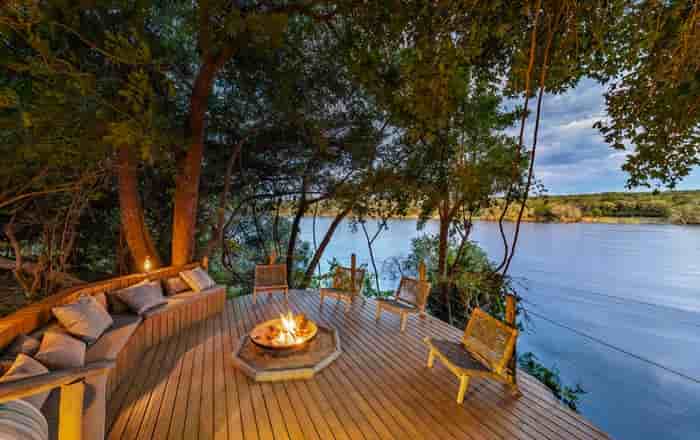
Near Victoria Falls, Tsowa Safari Island sits within the Zambezi National Park and taps into the growing demand for river-based experiences.
Game drives remain a major drawcard, but travellers are increasingly embracing canoe safaris, river cruises and birdwatching excursions that slow the pace and deepen the connection with the landscape.
Conservation is becoming another decisive factor.
Today’s travellers increasingly want to know where their tourism dollars end up.
Rhino Ridge Safari Lodge, located within South Africa’s oldest proclaimed game reserve, is among the operators placing conservation outcomes and community involvement at the centre of the guest experience.
Then there is the coastline.
While the interior delivers classic safari conditions, KwaZulu-Natal’s coast enters one of nature’s great annual spectacles.
From June to October, humpback whales migrate along the shoreline in remarkable numbers.
At Thonga Beach Lodge, guests can spend the morning tracking wildlife in protected wilderness and the afternoon watching whales breach offshore.
That’s a combination even Europe’s most glamorous beach clubs would struggle to match.
For travel advisors, the message is becoming increasingly clear.
Southern Africa is not trying to become the next Europe.
It doesn’t need to.
Its strength lies precisely in what Europe is increasingly losing: space, authenticity, wildlife and the luxury of not having to share every memorable moment with another thousand tourists.
And in an era where travellers are seeking fewer crowds and more meaning, that may be the most valuable tourism asset of all.
By: Anne Keam – © 2026.
Read Time: 4 Minutes.
About the Author.
 Anne Keam’s story begins in Queensland, on a grain farm in the state’s wide western reaches, where the days were long and the lessons simple: work hard, look after your own, and don’t make a fuss. Those early years left their mark.
She later studied Arts at the University of Queensland, before doing what felt natural at the time, heading back home to the family property. But the world was calling. Anne packed a backpack and went looking, spending years on the road and finding herself most alive in South America. She wrote everything down along the way. Those notebooks, full of dust, colour, and curiosity, eventually became her blog, a quiet, personal record of seeing the world and learning from it.











