

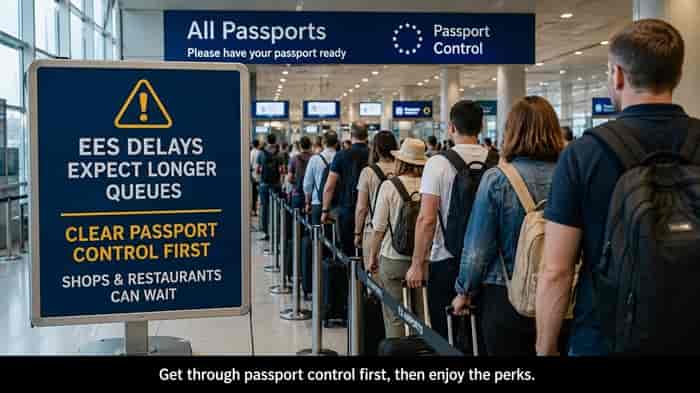
If you’ve ever treated the airport terminal like a shopping centre with wings, this summer might be the season to rethink that strategy.
Travellers heading through Europe’s busiest airports are being warned to make one task their absolute priority before browsing duty-free bargains, ordering an overpriced airport sandwich or settling into a lounge with a flat white: get through passport control first.
The caution comes as disruption linked to the European Union’s Entry/Exit System (EES) continues to create significant delays at major gateways across the continent, leaving some passengers stranded and flights departing far emptier than airlines ever intended.
For holidaymakers dreaming of Spanish beaches, Italian piazzas, Portuguese sunsets, or Greek island escapes, the biggest travel challenge this summer may not be finding a deckchair. It may be surviving the queue.
Border Control Becomes the New Bottleneck
The EU’s Entry/Exit System, introduced across the Schengen Area earlier this year, requires non-EU travellers to undergo biometric processing when entering and leaving participating countries.
The process combines passport verification with fingerprint and facial recognition checks. While designed to improve border security and modernise immigration procedures, the rollout has created substantial pressure on airport infrastructure.
Across Europe, reports have emerged of lengthy queues stretching through terminals at major airports including Lisbon, Paris, Brussels, Amsterdam and Faro.
One of the most publicised incidents involved an easyJet service from Milan to Manchester that departed with only 34 passengers on board after more than 120 travellers reportedly failed to clear passport control in time. Some passengers claimed they had waited as long as three hours despite arriving well ahead of departure.
For airlines, that’s an operational headache. For travellers, it’s the sort of holiday story nobody wants to tell over dinner.
The Airport Routine That No Longer Works
According to Jürgen Himmelmann, Co-Founder of Global Work & Travel, many travellers are still operating with a pre-EES mindset.
“Many travellers still have the old airport mindset of arriving, checking in and then spending an hour shopping or having a meal before heading towards the gate.
“This summer, that could be a costly mistake.
“If you’re travelling through an airport affected by EES checks, your priority should be getting through security and passport control as quickly as possible. The shops, restaurants and lounges can wait.
“Numerous airports now have food outlets, coffee shops and retail stores beyond passport control.
“Once you’re through, you can relax. Until then, you’re taking a risk because queues can build incredibly quickly and move far slower than people expect.”
It’s practical advice that runs counter to years of traveller habits.
For decades, passengers have checked in, wandered through terminal shops and leisurely made their way towards departure gates. The challenge with EES is that it introduces a new level of uncertainty into a process many travellers thought they understood.
Unpredictability Is the Real Problem
The issue isn’t simply that queues are longer.
It’s that nobody can reliably predict how long they will be.
Security screening has become relatively predictable. Travellers know roughly how long baggage drop will take. Border control under EES, however, can vary dramatically depending on staffing levels, airport capacity and the number of first-time travellers requiring biometric registration.
Himmelmann said unpredictability was becoming one of the system’s most enduring challenges.
“One of the biggest issues is unpredictability. Travellers know how long security usually takes.
“They know roughly how long bag drop takes. With EES, the experience can vary dramatically depending on the airport, staffing levels, and the number of first-time registrations being processed.
“Even arriving three hours before departure is not always proving enough in some cases.
“If you’re travelling through a busy European airport this summer, particularly if you’re heading home from Spain, Italy or Portugal, treat passport control as the first job, not the last.”
That warning is likely to resonate with thousands of Australians travelling through Europe during the Northern Hemisphere summer peak season.
With passenger numbers climbing and airports operating at near-capacity levels, even minor disruptions can quickly become major delays.
How Travellers Can Stay Ahead
Industry experts say preparation remains the best defence against missing a flight.
Global Work & Travel has outlined several practical steps that can significantly reduce the risk of being caught in lengthy EES queues:
- Arrive earlier than usual, especially on weekends and during school holidays.
- Head directly to security screening and passport control after check-in.
- Leave shopping, dining and duty-free browsing until after border formalities are complete.
- Allow additional time when travelling with children.
- Monitor airport announcements and queue information where available.
- Avoid tight connection schedules.
- Investigate whether airports offer any biometric pre-registration options.
These recommendations may not sound glamorous, but they could save a holiday.
After all, nobody wants their European getaway to end before they’ve even reached the departure gate.
A Summer of Patience
While European authorities continue refining EES operations, travellers may need to adjust expectations.
The days of arriving at the airport with military precision and just enough time for a quick coffee before boarding are becoming increasingly risky in some locations.
Himmelmann offered one final reminder for travellers preparing to fly.
“The travellers who are least likely to be affected are the ones who treat getting through border control as their main priority.
“The biggest mistake we’re seeing is people assuming they have plenty of time because they’ve already checked in. Unfortunately, that’s undoubtedly what many of the stranded passengers thought too.”
For travellers navigating Europe this summer, that may prove the most valuable piece of travel advice they’ll receive.
Because while airport shops can wait, a departing aircraft most certainly won’t.
By: Christine Nguyen – © 2026.
Read Time: 4 Minutes.
About the Author.
 Christine’s story is one of quiet courage, told without fuss and lived with remarkable grace. She arrived in Australia as a young refugee from Vietnam, carrying little more than hope, family, and a curiosity that refused to be extinguished. Sydney became home, built patiently, brick by careful brick.
She studied Tourism at TAFE and soon found her place in inbound travel, working with one of the city’s leading destination companies. Christine loved showing visitors the Australia that lives beyond postcards, warmer, truer, and far more interesting.
When the sea began to whisper, and life asked for a gentler rhythm, she listened. Designing brochures, writing blogs, she discovered storytelling waiting quietly inside her.
Today, at Global Travel Media, Christine writes with warmth and wisdom, reminding us, softly and persuasively, why travel still matters.











