

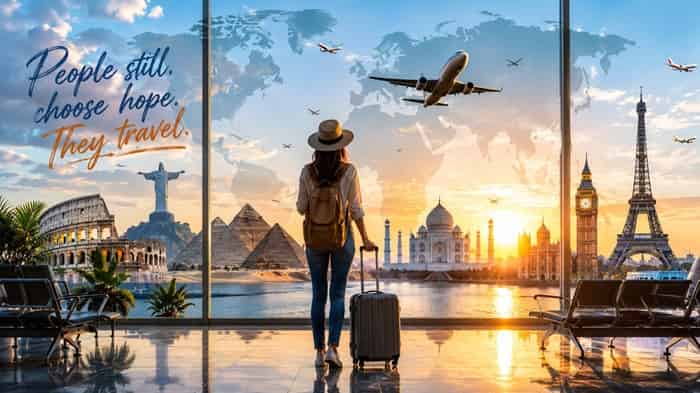
If there is one lesson the travel industry keeps teaching the rest of the world, it is that people possess an extraordinary reluctance to stay put.
Wars come and go. Economies rise and fall. Fuel prices surge. Airlines redraw route maps overnight. Yet somehow, travellers continue wheeling suitcases through terminals, searching departure boards and dreaming about places they have never been.
The first quarter of 2026 was supposed to be another year of recovery.
Instead, it became another test.
Conflict erupted across the Middle East, one of the world’s most important aviation crossroads. Aircraft suddenly found themselves taking longer routes. Airlines scrambled to adjust schedules. Fuel markets became nervous. Travellers became cautious.
For a moment, the industry held its breath.
Then the travellers did what travellers have always done.
They travelled.
Fresh figures from UN Tourism reveal international tourist arrivals reached 307 million during the first three months of 2026, representing a growth of 2 per cent compared with the same period last year.
Six million additional international journeys.
Six million decisions to keep moving despite a world that occasionally appears determined to stand in the way.
That number alone tells only part of the story.
The real story sits behind it.
It is the story of an industry that has spent the better part of a decade absorbing shocks that would have crippled many sectors. First came the pandemic. Then labour shortages. Aircraft shortages. Inflation. Rising interest rates. Geopolitical tensions.
Now another conflict.
Yet tourism continues to adapt.
UN Tourism Secretary-General Shaikha Al Nuwais captured the challenge facing the sector when she said:
“The ongoing conflict in the Middle East is disrupting travel patterns well beyond the region itself, including rising inflation, particularly in transport and accommodation. This is placing pressure on travellers, businesses and destinations alike. Even amid this uncertainty, international tourism continued to show resilience in the first quarter of 2026, with 307 million people travelling internationally, a 2% increase on last year. At a time of growing geopolitical and economic pressure, this reinforces tourism’s wider role in supporting economies, creating opportunity and sustaining communities far beyond the sector itself.”
That last observation matters.
Tourism is often discussed as though it simply involves holidays and leisure spending.
In reality, tourism is a job.
Tourism is a family business.
Tourism is restaurants opening their doors each morning, hoping visitors will walk in.
Tourism is tour operators, coaches, guides, airports, attractions, cruise terminals and countless small enterprises whose fortunes rise and fall with visitor numbers.
Every additional traveller represents economic activity somewhere.
And right now, many destinations need it more than ever?
Europe once again proved why it remains the heavyweight champion of global tourism.
The continent welcomed more than 130 million international visitors during the quarter, recording growth of 4 per cent and extending the strong momentum built throughout 2025.
Some destinations benefited from travellers changing plans and seeking perceived stability.
Southern Mediterranean Europe performed strongly. Northern Europe continued attracting visitors in impressive numbers. Central and Eastern Europe maintained its recovery with growth of 6 per cent.
For many operators, the message was clear.
When uncertainty rises, travellers don’t necessarily cancel.
They redirect.
Africa also continued its impressive climb.
Visitor arrivals increased by 4 per cent overall, while North Africa delivered particularly strong gains. In March alone, arrivals surged by 18 per cent in parts of the region.
There is a growing sense among tourism leaders that Africa’s moment may finally be arriving.
Improved connectivity, expanding tourism infrastructure, and growing global interest are helping place several African destinations firmly on travellers’ radar screens.
Across Asia-Pacific, the recovery remains a work in progress.
Growth reached 3 per cent during the quarter, although performance varied considerably.
The disruption affecting major Middle Eastern aviation hubs created significant challenges for some markets. South Asia experienced a sharp decline as airline schedules and passenger flows were affected.
Yet, there were also remarkable success stories.
New Zealand emerged as one of the world’s strongest-performing destinations, recording a stunning 45 per cent increase in international arrivals.
Not bad for a country that sits about as far from Europe as one can travel without falling off the map.
Oceania recorded growth of 9 per cent overall, while North-East Asia continued rebuilding momentum.
The Americas delivered modest growth of 2 per cent, although Central America surged ahead with an impressive 18 per cent increase.
Meanwhile, anticipation is already building around the FIFA World Cup scheduled for Canada, the United States and Mexico.
The tournament is expected to inject enormous energy into tourism markets across North America later this year.
Then there is the Middle East.
No region has felt the impact of the current conflict more directly.
International arrivals declined 14 per cent during the quarter as airlines reduced services and travellers reconsidered plans.
Yet even here, the picture is far from uniform.
Egypt recorded a remarkable 16 per cent increase in visitor arrivals, proving once again that tourism rarely follows a straight line.
Some destinations lose.
Others gain.
Some struggle.
Others seize the opportunity.
That constant reshuffling has become one of the defining characteristics of modern tourism.
If conflict represents one challenge, cost represents another.
And unlike geopolitics, cost hits consumers directly in the wallet.
Every spike in oil prices eventually works its way through the tourism ecosystem.
Airlines pay more for fuel.
Hotels face higher operating costs.
Transport providers absorb increased expenses.
Eventually, travellers see the bill.
According to tourism experts surveyed by UN Tourism, rising transport costs, accommodation prices and the ongoing Middle East conflict now rank among the industry’s biggest concerns.
Yet there is little evidence suggesting consumers are abandoning travel altogether.
Instead, they are becoming smarter.
More selective.
More value-conscious.
The destination may be closer to home.
The trip may be shorter.
The spending may be more carefully planned.
But the desire to travel remains.
Perhaps that should not surprise us.
Travel has always been about more than movement.
At its heart, travel is an act of optimism.
Every booking assumes tomorrow will arrive.
Every holiday assumes better days lie ahead.
Every boarding pass is, in its own small way, a vote of confidence in the future.
That optimism is being tested once again in 2026.
Fuel markets remain volatile. Air routes remain uncertain. Inflation continues to squeeze household budgets. Geopolitical tensions show little sign of disappearing.
Yet 307 million people still crossed international borders during the first quarter.
Not because the world suddenly became predictable.
But because human curiosity remains stronger than uncertainty.
The first quarter of 2026 will not be remembered as a period of calm.
It will be remembered as another reminder that tourism’s greatest asset is not aircraft, airports or hotel rooms.
It is people.
People who continue exploring.
People who continue to discover.
People who continue believing that somewhere beyond the horizon lies an experience worth pursuing.
And as long as that spirit survives, tourism will continue finding a way forward, no matter how complicated the world becomes.
By Sandra Jones – © 2026.
Read Time: 7 Minutes.
About the Author.
 Sandra has spent a working lifetime quietly rescuing journeys, one itinerary, one anxious caller, one impossible connection at a time. Years in Australia’s finest travel agencies taught her the art of calm, how to find a flight in a fog of cancellations, how to soothe a traveller when luggage wanders, how to turn nine frantic days in Europe into something resembling sense. Qualified, seasoned, endlessly patient, she learned that good travel advice is part logistics, part listening.
But the storyteller in her was always waiting its turn. Writing offered a new map, a way to turn experience into reflection, detail into delight. At Global Travel Media, Sandra now writes the truths only insiders know: the mishaps, the laughter, the grace found between gates and goodbyes. She reminds us that travel, for all its fuss, is still one of life’s better ideas.











