

If you’ve spent any time talking to hotel operators lately, you’ll hear the same complaint before the second coffee arrives.
Finding staff has become harder than finding a deckchair on a cruise ship at sunrise.
Recruitment remains difficult. Labour costs continue climbing. Guests expect faster service than ever. Meanwhile, hotel owners are under constant pressure to do more with less.
So when China announced plans for the world’s first fully robot-serviced hotel this week, many hospitality executives probably did the same thing.
They stopped and paid attention.
Because while the headlines are all about robots, artificial intelligence and futuristic technology, the real story is much simpler.
The hospitality industry is searching for answers.
And China believes it may have found one.
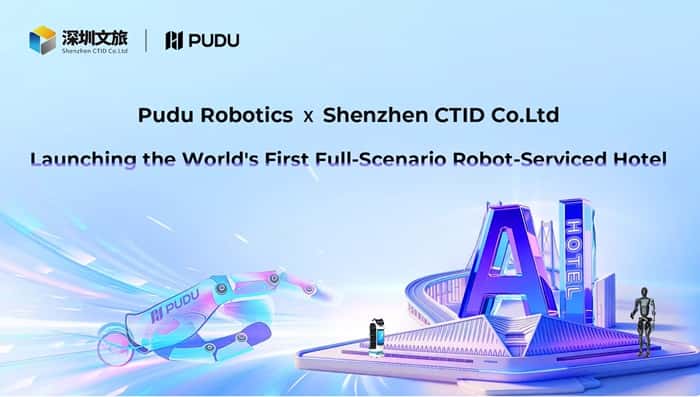
The ambitious project, announced by Pudu Robotics and Shenzhen Culture & Tourism Industry Development Co. Ltd., will see a new-generation hotel built on the West Artificial Island of the Shenzhen-Zhongshan Link, one of the most remarkable infrastructure projects on the planet.
If all goes according to plan, guests checking into the property in the coming years may discover something rather unusual.
The smiling receptionist behind the desk won’t be human.
The porter carrying the luggage won’t be human.
The room service attendant delivering dinner won’t be human either.
For some travellers, that’s exciting.
For others, it sounds like the opening scene of a science-fiction movie that perhaps shouldn’t have been made.
Either way, it’s coming.
And perhaps sooner than many people think.
The irony, of course, is that hospitality has always been one of the most human industries imaginable.
A warm welcome.
A helpful concierge.
A bartender who remembers your favourite drink.
A hotel manager who somehow knows your name despite overseeing hundreds of guests.
Those little moments create loyalty.
They create memories.
Most importantly, they create repeat business.
That’s why this project is so fascinating.
It’s not simply testing technology.
It’s testing whether technology can replicate the very thing that made hospitality successful in the first place.
The project itself is undeniably impressive.
Pudu Robotics has become one of the world’s leading commercial robotics companies and intends to deploy robots across virtually every stage of the guest journey.
Reception.
Check-in.
Room delivery.
Food service.
Housekeeping.
Guest assistance.
All connected through a shared artificial intelligence platform designed to allow different robotic systems to communicate and work together.
Think of it less as a collection of robots and more as an entire robotic workforce.
That’s a very different proposition from the novelty robots occasionally seen wandering through hotel lobbies.
According to Cong Guo, Co-founder and Chief Technology Officer of Pudu Robotics, the project represents an important milestone.
“This partnership represents an important step toward large-scale deployment of embodied intelligence in premium hospitality environments,” Guo said.
“It also provides an opportunity to explore new service models where AI and robotics work together to deliver intelligent, end-to-end experiences in the real world.”
Translation?
The company isn’t experimenting anymore.
It’s moving towards commercial reality.
And that’s what should capture the attention of travel professionals globally.
Because the technology is no longer theoretical.
It’s operational.
During the official signing ceremony, guests witnessed a preview of how the future hotel might function.
Robots delivered beverages.
Robots carried luggage.
Robots cleaned floors.
Robots served coffee.
Robots handed out snacks.
One robot even entertained guests.
Somewhere in the background, one suspects a few traditional hoteliers were quietly wondering whether they should be impressed or slightly nervous.
Perhaps both.
The location itself adds another layer to the story.
The Shenzhen-Zhongshan Link is not merely another transport project.
It is a staggering feat of engineering, connecting key cities throughout China’s Greater Bay Area with a combination of bridges, tunnels, underwater interchanges, and artificial islands.
The scale borders on the absurd.
Which, in many ways, makes it the perfect location for a project designed to challenge conventional thinking.
China has never been particularly interested in taking small steps.
When it decides to pursue a future vision, it generally prefers to build the entire future and worry about the details later.
That willingness to think big has become one of the defining characteristics of modern Chinese infrastructure and technology development.
This hotel fits neatly into that narrative.
The broader question, however, is whether travellers are ready.
That’s where the story becomes genuinely interesting.
Many guests already embrace automation.
Airline apps have largely replaced paper tickets.
Airport kiosks replaced countless check-in desks.
Digital room keys are increasingly common.
Online travel agencies transformed booking behaviour almost overnight.
History tells us that travellers are often sceptical right until the moment convenience wins.
And convenience usually wins.
Still, hospitality presents unique challenges.
People don’t merely buy a room.
They buy reassurance.
They buy the service.
Furthermore, they buy the feeling that somebody is looking after them.
Can a robot provide that feeling?
Perhaps.
Can artificial intelligence create memorable guest experiences?
Possibly.
Can a machine genuinely replace the warmth of human hospitality?
That answer remains considerably less certain.
Yet uncertainty has never stopped innovation.
The project will roll out in stages, with trial operations expected by the end of 2026.
Early visitors will effectively become participants in one of the most ambitious hospitality experiments ever attempted.
Some will arrive out of curiosity.
Others will come specifically to experience the technology.
Many will undoubtedly leave with stories.
And isn’t that what tourism has always been about?
Stories.
The truth is that nobody yet knows whether robot-serviced hotels represent the future of hospitality or simply a fascinating side road on the industry’s long journey.
What we do know is this.
The travel sector is changing faster than at any point in recent memory.
Artificial intelligence is reshaping business models.
Automation is redefining service delivery.
Technology is altering traveller expectations almost daily.
Against that backdrop, China’s robot hotel is more than a building.
It is a statement.
A statement that the future of hospitality may look very different from its past.
Whether travellers embrace that future remains to be seen.
But one thing is certain.
Somewhere on an artificial island off the coast of southern China, the hotel of tomorrow is already checking in its first employees.
And none of them is asking for annual leave.
By My Thanh Pham – © 2026.
Read Time: 6 minutes.
About the Author.
 My Thanh Pham has lived more of a life of travel than most people ever do. After studying tourism, she went straight into the work of building journeys across South-East Asia, temples, beaches, night trains, and all, quietly fixing the messy bits, so others could enjoy the ride.
She was never meant to stay behind a desk. Airline life followed, dividing her days between reservations and the airport floor, right where travel shows its true colours. Missed flights, tight hugs, frayed tempers, sudden joy, she saw it all, close up.
Now at Global Travel Media, My Thanh has traded ticket stubs for a keyboard. She writes the way she once worked: steady, clear-eyed and respectful of the road’s unpredictable rhythm, guiding readers through a world she knows from the inside.











