

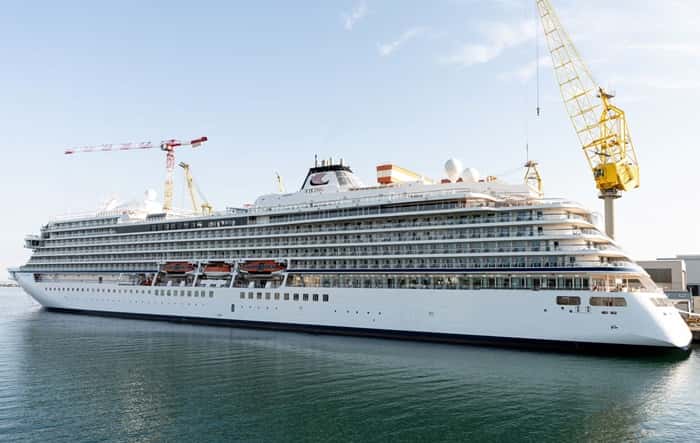
There was a time when cruise lines competed by building ships so large they practically needed their own postcode.
Viking, however, has spent the better part of the past decade proving that bigger isn’t always better.
That philosophy was on full display this week when the company took delivery of its newest ocean vessel, Viking Mira, at Fincantieri’s shipyard in Ancona, Italy.
On the surface, it’s another ship joining another fleet. Cruise lines constantly do this.
But scratch beneath the polished Scandinavian interiors and the celebratory photographs, and the arrival of Viking Mira tells a much bigger story about where the cruise industry is heading.
At a time when competitors are wrestling with rising operating costs, environmental scrutiny and increasingly demanding travellers, Viking continues to double down on a strategy that has made it one of the most formidable brands in global cruising.
The newest addition carries 998 guests across 499 staterooms, maintaining Viking’s preference for smaller vessels that can access ports and destinations often beyond the reach of the industry’s floating giants.
It’s a formula that has worked remarkably well.
While some operators continue to chase scale, Viking has quietly built a loyal following among travellers more interested in exploring destinations than in conquering buffet queues.
Leah Talactac, President and CEO of Viking, welcomed the vessel into the company’s growing fleet.
“We are delighted to welcome the Viking Mira to our elegant fleet of small sister ships,” Talactac said.
“Our guests are curious travellers, and the arrival of a new ship allows us to offer them even more opportunities to explore the world in Viking comfort. We look forward to welcoming guests on board the Viking Mira during her inaugural season and for many years ahead.”
The ship will now begin her inaugural voyages across the Mediterranean and Northern Europe, regions that remain among the most sought-after destinations for Australian travellers seeking a blend of culture, history and scenery.
Yet the most interesting part of the Viking Mira story isn’t necessarily the ship itself.
It’s what comes next.
Cruising has spent years searching for the answer to one awkward question: how does an industry built on mobility dramatically reduce emissions without compromising the guest experience?
Viking believes it may have found part of that answer.
Currently taking shape at the same Italian shipyard is Viking Libra, a vessel expected to make maritime history when it enters service in late 2026.
The ship is slated to become the world’s first hydrogen-powered cruise vessel capable of operating with zero emissions.
That’s a sentence capable of turning heads well beyond the cruise industry.
Hydrogen technology has long been discussed as a possible game changer for shipping, but turning ambitious engineering into commercial reality has proven considerably harder than producing glossy sustainability reports.
If Viking succeeds, it won’t merely launch another cruise ship.
It may help redraw the industry’s environmental roadmap.
The company has already committed to a second hydrogen-powered vessel, Viking Astrea, scheduled to arrive in 2027.
Importantly, Viking Mira has also been future-proofed, allowing emerging propulsion technologies to be integrated as they mature.
That suggests Viking isn’t viewing sustainability as a marketing exercise. It appears to be building long-term infrastructure around a future many industry executives believe is inevitable.
The delivery also highlights the sheer scale of Viking’s growth ambitions.
The company expects to receive 24 additional river ships by 2028, alongside nine new ocean vessels and two expedition ships by 2031.
Should those plans remain on schedule, Viking will operate 114 river vessels and 26 ocean and expedition ships within the next five years.
That’s a remarkable trajectory for a company that began as a specialist river cruise operator.
For travel advisors, the expansion means more inventory, more itineraries and more opportunities to tap into the lucrative premium cruise sector.
For competitors, it serves as a reminder that Viking isn’t merely growing its fleet.
It’s steadily strengthening its position in one of travel’s most fiercely contested battlegrounds.
And for passengers?
The arrival of Viking Mira means another elegant ship, another collection of remarkable destinations and another chance to explore the world without needing a vessel the size of a small city.
Sometimes the biggest statement in cruising comes from a ship that deliberately refuses to be the biggest in the harbour.
By May Marclay – © 2026.
Read Time: 4 Minutes.
About the Author.
 May Marclay’s career hasn’t followed a straight line, and she’s better for it. She began in real estate, then moved into hospitality, finding her rhythm with Centara in the Maldives. There, she worked the Asian markets the old-fashioned way: building trust, closing deals, and turning conversations into lasting business.
The UAE sharpened its focus. At IHG, supporting an Area General Manager, she saw the machinery of a major travel hub from the inside, no gloss, just how things actually get done.
Now, with her sights set on healthcare, May brings a broader lens than most. She speaks three languages, reads widely, travels with intent, and writes with the calm assurance of someone who understands both the detail and the bigger picture without needing to say so too loudly.











