

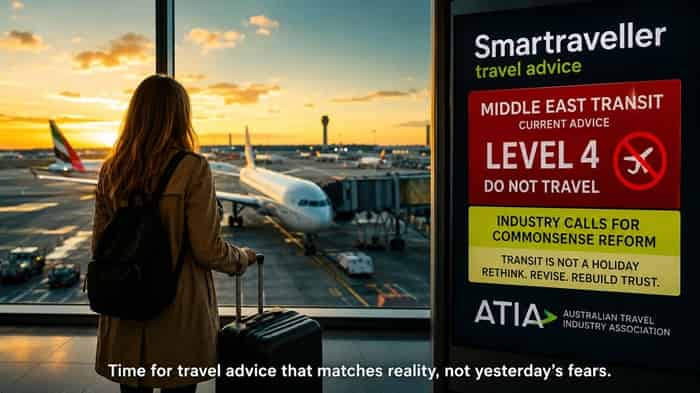
The Australian travel industry is no stranger to turbulence. Airlines deal with it daily, travellers expect it occasionally, and politicians often create it unexpectedly. But right now, the latest bout of turbulence isn’t happening at 35,000 feet. It’s unfolding on the ground, inside Australia’s travel advisory system.
The Australian Travel Industry Association (ATIA) has dramatically escalated its Campaign for Commonsense, turning a growing industry frustration into a national conversation as pressure mounts on the Federal Government to review Smartraveller advice covering airport transit through major Middle Eastern hubs.
After a weekend of extensive coverage across News Corp publications, commercial television networks and national radio programs, ATIA has moved into a new phase of advocacy, mobilising members across Australia to push for what it describes as a practical and proportionate adjustment to existing travel advice.
At the heart of the dispute lies a problem that sounds technical but carries very real consequences for thousands of Australians.
Travel agents and tour operators have repeatedly reported that clients are safely transiting through major international hubs such as Dubai, Abu Dhabi and Doha without incident. Yet, Australia’s current Level 4 “Do Not Travel” advisory continues to apply broadly, creating unintended complications for travellers who may unknowingly find themselves without valid travel insurance coverage during transit.
It’s a situation many in the industry believe defies common sense.
According to ATIA, more than 150,000 Australians have safely passed through these transit hubs during the past six weeks alone. Meanwhile, several of Australia’s closest international allies have already refined their travel advice frameworks.
Countries including the United Kingdom, Germany, France and Ireland have adjusted their advisories to distinguish airport transit from broader in-country travel, generally applying a lower Level 3 warning for transit passengers.
Australia remains one of the few nations maintaining a blanket approach.
That divergence is increasingly becoming difficult for the industry to explain to consumers.
ATIA has consistently emphasised its support for both the Department of Foreign Affairs and Trade and the Smartraveller program. The association’s concern is not with the existence of travel warnings but with ensuring those warnings accurately reflect different levels of risk.
The organisation argues that a traveller spending 90 minutes airside at a major international airport faces a substantially different risk profile from someone embarking on an extended holiday within the region.
To help drive the campaign, ATIA has launched a dedicated Member Toolkit, enabling travel businesses nationwide to engage customers, policymakers and local communities. The toolkit includes social media assets, client talking points and template correspondence for elected representatives and government stakeholders.
For ATIA, the stakes extend beyond insurance.
The organisation warns that public confidence in official travel advice could be undermined if travellers perceive government warnings as disconnected from their lived experience.
ATIA Chief Executive Officer Dean Long said the campaign emerged directly from concerns raised by frontline travel professionals.
“This campaign started exactly where it should: with our members. Our travel advisor and tour operator members raised the alarm because their clients are transiting these airports safely every day, yet many of them are flying into a travel insurance void because the official advice refuses to decouple a brief airport transit from an in-country holiday.”
Long said ATIA had spent months working collaboratively with government agencies before deciding to intensify public advocacy.
“We have worked constructively and quietly with the government for two months now but we have reached an inflection point where Australia is a total outlier. More than 150,000 Australians have transited these hubs safely over the last six weeks alone. We are absolutely not telling people to holiday in Dubai or Doha; we are asking for a staged, common-sense approach for transit passengers.”
His warning was equally pointed when addressing the longer-term consequences of maintaining the current settings.
“The greatest risk right now is that Australians stop trusting Smartraveller altogether because the advice doesn’t match the reality on the ground. That is a dreadful outcome for travellers, for the industry, and for the government. Following this weekend’s incredible wave of national media support, we are providing our members with the tools and assets to stand together and push for a common-sense adjustment immediately.”
For an industry built on confidence, clarity and trust, that final point may prove the most important.
Travel advisories exist to protect Australians. The challenge now confronting policymakers is ensuring those advisories remain credible, relevant and proportionate to the risks travellers actually face.
Because when travellers start trusting social media posts more than official government guidance, everyone loses.
For consumers seeking a verified travel professional, ATIA recommends using the Travel Accreditation Tick (TravelTick) program to find accredited Australian travel businesses.
By Sandra Jones – © 2026.
Read Time: 3 Minutes.
About the Author.
 Sandra has spent a working lifetime quietly rescuing journeys, one itinerary, one anxious caller, one impossible connection at a time. Years in Australia’s finest travel agencies taught her the art of calm, how to find a flight in a fog of cancellations, how to soothe a traveller when luggage wanders, how to turn nine frantic days in Europe into something resembling sense. Qualified, seasoned, endlessly patient, she learned that good travel advice is part logistics, part listening.
But the storyteller in her was always waiting its turn. Writing offered a new map, a way to turn experience into reflection, detail into delight. At Global Travel Media, Sandra now writes the truths only insiders know: the mishaps, the laughter, the grace found between gates and goodbyes. She reminds us that travel, for all its fuss, is still one of life’s better ideas.











