There are holidays, and then there’s Antarctica.
The former you plan. The latter, if you’re sensible, you prepare for, and even then, it has a habit of reminding you who’s in charge.
With upwards of 100,000 travellers expected to venture south this season, the once-rare pilgrimage to the White Continent has become something of a modern badge of honour. Not quite mass tourism, but no longer the preserve of hardened explorers either.
Which is precisely why so many people get it slightly wrong.
Kevin Moore, Polar Regions Team Lead with Adventure Life, has seen it all before. The eager travellers who arrive armed with expectations shaped by glossy brochures rather than cold reality. The well-heeled guests who board floating palaces only to realise the real action is happening somewhere decidedly less upholstered.
His advice is not revolutionary, but it is essential.
The Great Luxury Delusion
It starts, as these things often do, with the wrong priority.
Antarctica has become just fashionable enough to attract travellers who assume the experience should mirror a Mediterranean cruise, only colder and with better bragging rights. Cue spas, suites and the sort of indulgences that make perfect sense in the Caribbean.
Less so here.
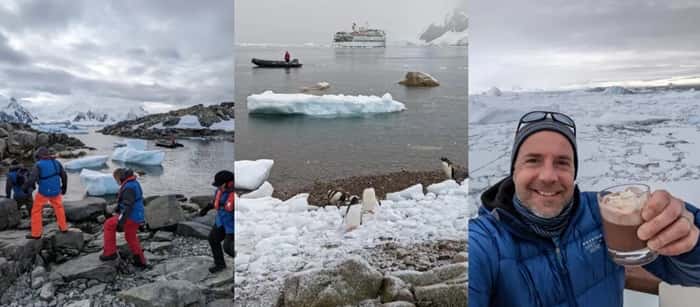
Moore is gently blunt on the matter: if you’re choosing your ship based on the wine list, you’ve already missed the point. Antarctica happens off the vessel among the ice floes, the wildlife, and the sort of silence that makes you instinctively lower your voice.
A well-appointed cabin is pleasant. A Zodiac landing among a colony of penguins is unforgettable. One suspects only one of those will feature in stories told back home.
When Bigger Quietly Means Worse
There’s a peculiar irony in Antarctic travel: the more you pay for scale, the less you often receive in experience.
Under the rules of the International Association of Antarctica Tour Operators, ships carrying more than 200 passengers simply cannot land everyone at once. Someone is always waiting. Always missing out, if only temporarily.
Push past 500 passengers, and landings disappear altogether.
It’s not widely advertised, but it should be. The difference between a 180-passenger expedition ship and a 600-passenger leviathan is not subtle; it’s existential.
In Antarctica, access is the currency. Spend it wisely.
The Itinerary Will Not Obey You
For travellers who like their days neatly itemised, Antarctica can feel faintly rebellious.
You may have a schedule. The ice does not.
Weather shifts. Channels close. Wildlife turns up precisely where it pleases. Captains adjust, pivot, and occasionally abandon Plan A altogether in favour of something far better or simply more possible.
Those who arrive with rigid expectations tend to leave with mild frustration. Those who accept the fluid nature of the place usually come away quietly delighted.
There’s a lesson in that, though Antarctica rarely feels the need to spell it out.
It’s Cold But Not Quite That Cold
Antarctica’s reputation for brutal cold is well-earned, but not always well-understood.
Along the Antarctic Peninsula, temperatures often hover between the low teens and single-digit Celsius. Bracing, certainly. Apocalyptic, no.
The real challenge lies elsewhere: wind that cuts sideways, wet landings that demand balance and a sense of humour, and the simple physicality of getting in and out of small boats in full kit.
It’s less about enduring extremes and more about being properly prepared, something seasoned travellers tend to appreciate.
Rules Worth Respecting
To the uninitiated, the regulations governing Antarctic travel can seem a touch fussy.
Boot checks. Wildlife distances. Strict landing protocols.
In truth, they are the quiet guardians of the continent’s integrity.
IAATO’s framework ensures that each visitor leaves little more than a footprint and even that, ideally, a temporary one. It’s a model that has allowed tourism to grow without eroding the very qualities that make Antarctica extraordinary.
Moore puts it plainly: the rules don’t diminish the experience, they protect it.
And in a place defined by its remoteness, that protection feels not just sensible, but necessary.
Getting Antarctica Right
What becomes clear from listening to those who know the region best is that Antarctica rewards a certain mindset.
Curiosity over comfort. Flexibility over control. Experience over indulgence.
It’s not a destination that bends to the traveller. It asks the traveller to meet it halfway and, in doing so, offers something rather rare in modern travel: a genuine sense of perspective.
For those willing to approach it properly, Antarctica is less a holiday and more a quiet recalibration.
And that, in the end, is why people go.
Watch the Full Expert Insight
For those planning their own journey south, Kevin Moore’s insights are well worth a few minutes of your time:
Watch: Antarctic Planning Mistakes Explained.