

There’s a moment in every industry when a good plan must give way to a better one. For New Zealand tourism, that moment has arrived quietly, deliberately, and with the sort of steady hand that suggests experience rather than panic.
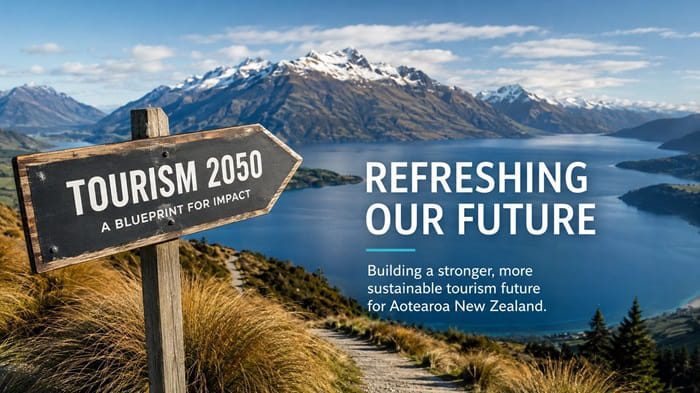
At this week’s TRENZ 2026 in Tāmaki Makaurau, Auckland, Tourism Industry Aotearoa (TIA) confirmed it will refresh its Tourism 2050 Blueprint, an acknowledgement that the world has shifted, and the industry must move with it.
First published in November 2023, Tourism 2050: A Blueprint for Impact was never intended to gather dust on a shelf. It was, and remains, a working document, part roadmap, part conversation starter designed to guide the sector through a decade that has already proven anything but predictable.
TIA Chief Executive Rebecca Ingram was candid in her assessment. “In 2023, Tourism 2050 was the right document for the world we were in,” she said. “It has been the cornerstone of New Zealand’s tourism industry strategy since then.”
And it has delivered. The Blueprint helped usher in Akiaki, a business capability programme aimed at strengthening industry resilience, while the Tiaki promise, New Zealand’s sustainability initiative, has continued to gain traction both domestically and abroad. More importantly, it has provided a credible framework for dialogue with the government, particularly around the thorny issue of sustainable tourism funding.
That dialogue is now bearing fruit. A Tourism Policy Statement is in development, and recent government moves to modernise the relationship between tourism and conservation suggest a more pragmatic, mutually beneficial approach is taking hold.
Still, as Ingram noted with understatement, “The operating environment for tourism continues to shift.” It’s a line that carries weight. In an era defined by geopolitical uncertainty, changing traveller expectations, and the growing influence of digital platforms, standing still is not a strategy; it’s a liability.
The refresh, however, is no radical overhaul. In a sensible nod to continuity, TIA has made it clear it won’t be starting from scratch. The vision, framework, and ten-action architecture that underpin Tourism 2050 will remain intact. Instead, the focus will be on refining what’s already there, updating the strategic context, strengthening how success is measured, and sharpening specific actions where required.
In other words, this is less a reinvention than a recalibration.
That approach feels Kiwi distinctly. There’s no appetite here for grandstanding or unnecessary disruption. Instead, there’s a quiet confidence in what has already been built, coupled with a willingness to adjust course where needed. It’s the sort of pragmatic thinking that has long underpinned New Zealand’s tourism success.
The timing is also telling. Announced on day two of TRENZ 2026, New Zealand’s largest international tourism business event, the refresh comes as the industry gathers to take stock. With 1,200 delegates in attendance, including 379 buyers from 27 countries and 315 tourism operators, the mood is one of cautious optimism.
Tourism is back. But it is not the same tourism.
And that, ultimately, is the point of this exercise. The refreshed Tourism 2050 Blueprint is expected to be completed by August, following consultation with TIA members. When it lands, it will need to do more than inspire it must provide clarity in a world that is anything but clear.
As Ingram put it, “We want the updated Tourism 2050 to continue serving the industry, as a guiding document for the future of tourism in Aotearoa New Zealand.”
It’s a modest ambition, on paper. In reality, it’s a significant undertaking.
Because in tourism, as in life, the future rarely arrives as expected. The best you can do is be ready for it.
by Prae Lee – (c) 2026.
Read Time: 3 minutes.
About the Author.
 You can tell a great deal about a person by how they meet a Bangkok morning. Prae Lee doesn’t charge into it; she glides, unhurried, as if time itself has agreed to behave. There is a calm assurance about her, the sort earned by knowing both your roots and your destination.
A graduate of Chulalongkorn University, she earned her business degree with quiet pride, then further polished it in Singapore and Australia. Travel didn’t change her. It refined what was already there: curiosity, discipline, grace.
Back in Bangkok, she slipped modern life into the family business, mastering social media with an instinct for listening and selling with Thai gentleness.
Prae never seeks attention, yet everything she touches grows brighter.
Now with Global Travel Media, she writes with authenticity, drawing on culture, travel and a rare, steady confidence.











