

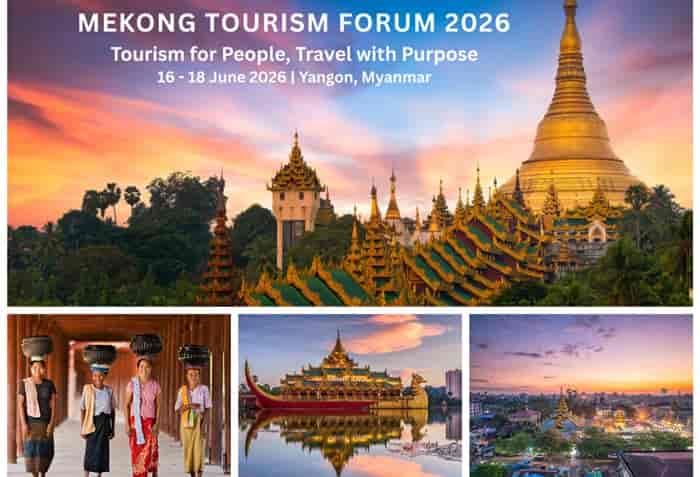
There was a time when tourism conferences were largely about numbers of arrivals up, spending up, optimism up. These days, the smarter conversations are shifting tone. It’s less about how many visitors arrive and more about what they leave behind economically, culturally and, ideally, respectfully.
That’s the territory the Mekong Tourism Forum 2026 is stepping into when it lands in Yangon from 16–18 June. Under the banner “Tourism for People, Travel with Purpose,” the event promises something more substantial than the usual carousel of PowerPoint slides and polite applause.
Hosted by Myanmar’s Ministry of Hotels, Tourism and Culture alongside the Mekong Tourism Coordinating Office, the forum will unfold at the Pan Pacific Yangon, a suitably central perch for a region that thrives on connection.
And connection, in all its forms, sits at the heart of this year’s agenda.
“Tourism is one of the few sectors where local communities can directly benefit from human connection, cultural exchange, and shared experiences,” said Executive Director Dee Suvimol Thanasarakij. “MTF 2026 is built around the belief that tourism should serve people and places first.”
It’s a line that could easily drift into brochure territory, but here it carries a little more weight. Across the Mekong region, Cambodia, China, Lao PDR, Myanmar, Thailand, and Viet Nam, the tension between growth and preservation isn’t theoretical. It’s lived daily in markets, villages and city streets where tourism can either lift communities or quietly erode them.
The forum’s keynote, delivered by Masaru Takayama, leans into that reality. His session, “Tourism for People: From Principles to Lasting Impact,” will explore the now-familiar quartet of Conservation, Community, Culture and Commerce. Not revolutionary concepts, perhaps, but in the right hands, powerful ones.
What gives the program its edge is the mix of voices. Alongside industry heavyweights from organisations like AirAsia MOVE, Planeterra and the Asian Ecotourism Network, there’s a deliberate spotlight on local practitioners the people actually doing the work on the ground. Community leaders, social enterprises, researchers and small operators will step forward, not as token additions but as central players.
It’s a subtle but important shift. Tourism has long been very good at talking about communities; it has been less consistent at talking with them.
Beyond the conference floor, Yangon itself becomes part of the narrative. Delegates will be ushered into the city’s rhythm through cultural visits, technical tours and a regional gastronomy showcase that celebrates the Mekong’s culinary depth. It’s an old-fashioned idea, really learn by seeing, tasting and listening, but one that tends to stick far longer than any keynote.
There’s also a practical streak running through proceedings. A pre-forum workshop on evidence-based destination marketing will tackle the business end of tourism data, insights and the sometimes murky art of understanding what travellers actually want, rather than what we assume they want.
It’s here that the forum earns its keep. Because while purpose-driven tourism sounds admirable, and it is, it also needs to be commercially viable. Communities can’t thrive on good intentions alone.
For the Greater Mekong Subregion, the stakes are clear. The region has the stories, the landscapes and the cultural depth to remain one of the world’s most compelling travel theatres. The question is whether it can manage that appeal without losing the very character that draws visitors in the first place.
If Yangon offers any answers this June, they’re unlikely to be wrapped in grand declarations. More likely, they’ll emerge in the quieter moments in side conversations, shared meals and the occasional frank admission that tourism still has a way to go.
And perhaps that’s the point. The industry doesn’t need more slogans. It needs sharper thinking, steadier hands and, occasionally, the humility to listen.
Registration, fittingly, is open and free via the Mekong Tourism Coordinating Office at www.mekongtourism.org. Which, in a region built on accessibility and exchange, feels entirely appropriate.
by Supaporn Pholrach – (c) 2026.
Read Time: 3 minutes.
About the Author.
 Supaporn Pholrach came up in advertising when deals were sealed with a handshake, and deadlines lived on scraps of paper, not dashboards. She learned early that people mattered more than process, and it stuck. Armed with solid training and a stubborn work ethic, she built a reputation for getting results without turning hard or hollow.
Fifteen years at Bangkok Shuho would test anyone’s stamina. Supaporn stayed the distance. These days, as Sales Manager at Global Travel Media, she helps tourism brands cut through the noise with common sense, good humour and genuine warmth.
She doesn’t chase quick wins. She earns trust, builds loyalty and keeps her word. In an industry that rarely slows down, Supaporn is someone you’re quietly glad to have on your side.











