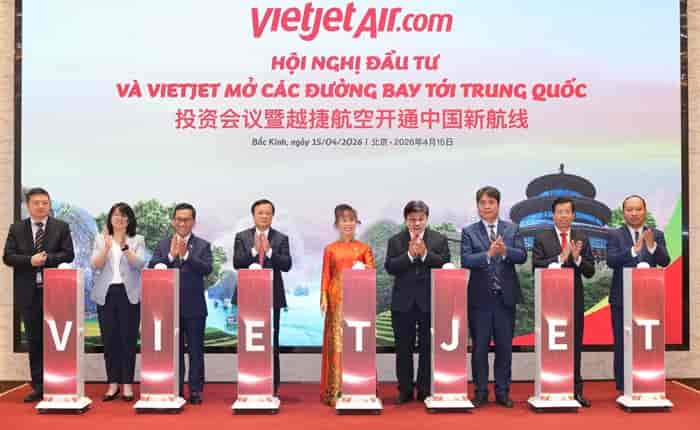
Airlines, like seasoned card players, tend not to show their full hand too early. Vietjet, however, has just pushed its chips firmly to the centre of the table, doing so with a confidence that suggests it knows exactly where the game is heading.
Announced during the state visit of Vietnam’s General Secretary and President, To Lam, to China, hosted by Xi Jinping, the low-cost carrier’s latest moves go well beyond the routine business of adding a few extra flights. This is a strategy with breadth, and, more importantly, intent.
Five routes, but a much bigger picture
On paper, the addition of five new routes might seem like a familiar headline. Hanoi to Hangzhou, Enshi and Huangshan; Ho Chi Minh City to Guilin and Huangshan. Sensible city pairs, neatly aligned with tourism and trade flows.
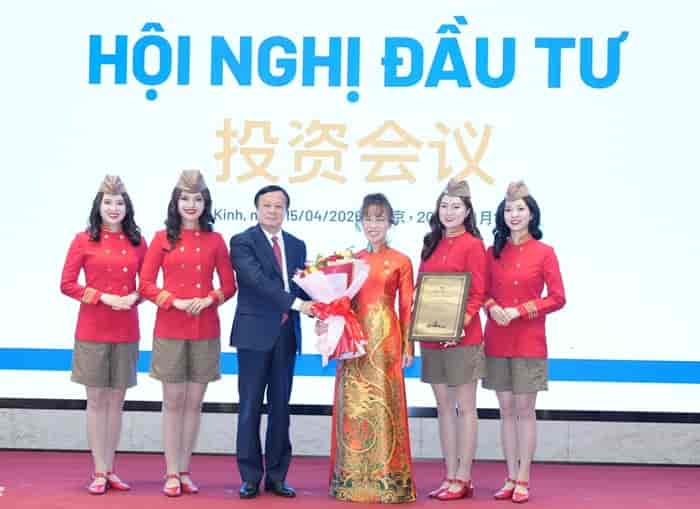
Vietjet Chairwoman Dr Nguyen Thi Phuong Thao was awarded the title of Distinguished Professor
But look a little closer, and the pattern becomes clearer.
Two of those routes, Hanoi–Enshi and Ho Chi Minh City–Guilin, are already airborne, having quietly launched earlier this month. No fanfare, no fuss. Just aircraft in the sky doing what they’re meant to do. It’s a very Vietjet way of operating: announce the ambition, then get on with delivering it.
Over the past decade, the airline has stitched together a remarkably dense network between Vietnam and China—131 routes, nearly 70,000 flights, and some 14.5 million passengers. That’s not expansion; that’s infrastructure.
And with 2026 marking the Vietnam–China Tourism Cooperation Year, the timing is less coincidence and more choreography.
Following the money and securing the metal
Of course, routes are only as good as the aircraft that fly them. And aircraft, as any airline executive will tell you, are rarely cheap.
Vietjet’s agreement with SPDB Financial Leasing, part of Shanghai Pudong Development Bank, provides the financial scaffolding for its next phase of growth. The deal covering up to ten COMAC C909 aircraft signals a deliberate diversification of both fleet and funding.
There’s a certain pragmatism here that would have been familiar to airline pioneers decades ago: secure your supply, spread your risk, and keep your costs under control. It’s hardly revolutionary, but it is effective.
More intriguingly, it also opens the door for greater deployment of COMAC aircraft on Vietnam–China routes. That, in itself, is a subtle nod to shifting dynamics in global aviation manufacturing.
Inside the cabin and behind the curtain
Passengers may judge an airline by its fares and punctuality, but increasingly, the battle is being fought inside the cabin.
Vietjet’s partnership with AVIC Cabin Systems, working alongside Jiatai, aims to refine that experience while building something more substantial behind the scenes: a localised supply chain and deeper industrial cooperation.
It’s the sort of agreement that doesn’t make headlines at departure gates but matters enormously over time. Interiors, after all, are where brand meets passenger and where margins can quietly improve.
Beyond that, the collaboration hints at a broader trend across Asia-Pacific aviation. Airlines are no longer merely operators; they are increasingly embedded in complex ecosystems spanning finance, engineering, logistics, and manufacturing. It’s a return, in many ways, to the old notion of aviation as an industry rather than just a service.
A nod to leadership and long-term thinking
Amid the commercial detail, there was also a moment of recognition. COMAC University awarded Vietjet Chairwoman Nguyen Thi Phuong Thao the title of Distinguished Professor.
It’s an accolade that reflects not only her personal influence but also Vietjet’s growing role in shaping aviation dialogue across the region.
Dr Thao put it plainly: “Collaborations between Vietjet, Sovico, and leading Chinese partners are opening up new development opportunities not only for businesses but also for the broader economic ecosystems of both countries. In a rapidly restructuring world, relationships built on trust, long-term vision, and shared values will form the foundation for sustainable success.”
It’s the sort of statement that could easily read as corporate boilerplate. Yet, in this context, it feels grounded—perhaps because the airline is already acting on it.
The long game in a fast-moving region
There’s an old aviation adage: growth is easy; sustainable growth is not. Vietjet appears to understand the distinction.
By aligning route expansion with financing and financing with industrial cooperation, the airline is building a framework that extends beyond immediate gains. It is, quite deliberately, positioning itself within a broader Asia-Pacific narrative one defined by connectivity, collaboration, and, increasingly, competition.
For travellers, the outcome is straightforward enough: more routes, better access, and the continued promise of competitive fares.
For the industry, however, the message runs deeper. The centre of gravity in aviation is shifting, and airlines that recognise this quietly, methodically, and with a touch of boldness are likely to be the ones still standing when the dust settles.
Vietjet, if nothing else, seems determined to be among them.
by My Thanh Pham – (c) 2026.
Read Time: 3 minutes.
About the Author.
 My Thanh Pham has lived more of a life of travel than most people ever do. After studying tourism, she went straight into the work of building journeys across South-East Asia, temples, beaches, night trains, and all, quietly fixing the messy bits so others could enjoy the ride.
She was never meant to stay behind a desk. Airline life followed, dividing her days between reservations and the airport floor, right where travel shows its true colours. Missed flights, tight hugs, frayed tempers, sudden joy, she saw it all, close up.
Now at Global Travel Media, My Thanh has traded ticket stubs for a keyboard. She writes the way she once worked: steady, clear-eyed and respectful of the road’s unpredictable rhythm, guiding readers through a world she knows from the inside.