

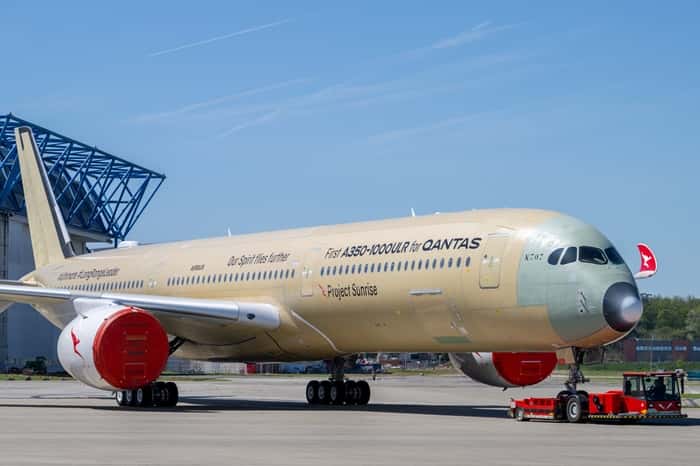
There’s a quiet confidence about Qantas these days, less fanfare, more follow-through. And if the latest developments out of Airbus in Toulouse are anything to go by, Project Sunrise is no longer a moonshot. It’s a matter of timing.
The first of Qantas’ specially configured Airbus A350-1000ULR aircraft has now rolled out of the assembly hangar, engines bolted on and ready for the hard yards. Powered by the formidable Rolls-Royce Trent XWB, the jet will soon embark on a two-month flight testing program, an essential rite of passage before it earns its stripes.
This rollout signals more than just another aircraft delivery milestone. Structurally complete with fuselage, wings, tail, landing gear and engines all in place, it marks the transition from engineering ambition to operational reality. The next phase will test everything from onboard systems to performance limits, including certification of the aircraft’s ultra-long-range modifications.
And here’s where things get interesting. A newly installed 20,000-litre rear centre fuel tank gives the aircraft the legs to stretch to an eye-watering 22 hours in the air. Non-stop from Australia’s east coast to London or New York is no longer a theoretical exercise; it’s being engineered into existence.
Meanwhile, a second A350-1000ULR is steadily progressing along the final assembly line, keeping the broader fleet program on schedule. In total, 12 of these aircraft will eventually take to the skies, each bearing a name inspired by the stars, a nod to Qantas’ storied past.
It’s a tradition worth revisiting. During the Double Sunrise flights, the airline’s Catalina flying boats navigated vast Indian Ocean stretches guided by celestial markers. Those journeys were long, arduous, and legendary. Today’s version? Slightly more comfortable, though no less ambitious.
Inside, the aircraft will reflect a deliberate pivot toward premium travel. More than 40 per cent of seats will be allocated to premium cabins, a clear signal that Qantas is betting on comfort, not just connectivity. It’s a calculated move, particularly as demand for point-to-point travel continues to surge.
Recent performance backs that strategy. Non-stop services from Perth to London, Paris and Rome have not only held their own, but they’ve also excelled, delivering some of the highest customer satisfaction scores across the airline’s network. Travellers, it seems, are willing to trade stopovers for time.
And time is precisely what Project Sunrise promises to save. By eliminating the need for transit hubs, journeys between Australia and key global cities could be cut by up to four hours. For business travellers, that’s not just convenience, it’s productivity. For leisure travellers, it’s the difference between enduring a journey and enjoying it.
Of course, aviation has a long memory, and bold promises have come unstuck before. But this feels different. There’s a sense of measured progress, of engineering discipline meeting commercial pragmatism.
Qantas isn’t chasing headlines here; it’s building a legacy, one that stretches from wartime navigation by starlight to modern-day ultra-long-haul precision.
And if all goes to plan, the next sunrise might just be witnessed somewhere over the Atlantic non-stop, naturally.
by Alison Jenkins – (c) 2026.
Read Time: 2 minutes.
About the Author.
 Alison Jenkins has lived most of her working life in the slipstream of aviation, where timetables matter, and people matter more. In airline sales, she built a reputation the old-fashioned way: by knowing her clients, her routes, and never missing the human detail.
Quick with a smile, quicker with a solution, she made deals with warmth and kept her edge intact.
Trade shows, FAMILS, airport lounges and hotel lobbies became her second address. And somewhere along the way, notebook in hand, she began writing the journeys rather than selling them. Her reports grew lively, observant, full of the small truths only travellers notice.
That was the moment it dawned on her: she wasn’t simply travelling. She belonged in its stories.











