

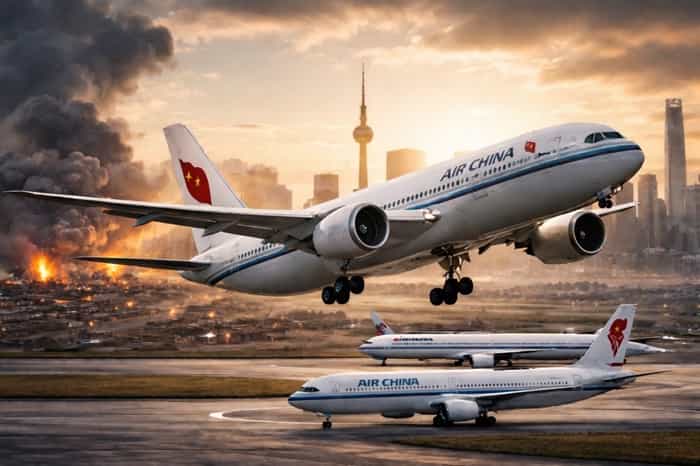
There is something faintly ironic about the current reshuffling of global air routes. Just as the industry was settling back into its familiar rhythms, geopolitics has intervened again, reminding everyone who is really in charge.
The disruption across parts of the Middle East, tied to the widening tensions around Iran, has done what such events always do: it has complicated what was once straightforward. Airspace closures, insurance concerns, longer routings, all the usual irritants have returned, unwelcome but not entirely unexpected.
What is interesting is not the disruption itself. Aviation, after all, has a long memory for disruption. It is what happens next that tends to matter.
And at the moment, what is happening next is China.
A gap appears and is quietly filled
For years, the great connectors between Europe and Asia have been the Gulf hubs. Dubai, Doha, Abu Dhabi, efficient, well-positioned, and, until recently, reassuringly predictable. Passengers flowed through them with barely a second thought.
Now, that flow has become rather less certain.
Flights are being rerouted. Some have been reduced. Others have disappeared altogether, at least for now. The effect is not dramatic in isolation, but collectively it creates something aviation notices immediately: a gap.
Chinese airlines, it seems, have noticed too.
Without much fanfare, capacity between China and Europe has been increasing. More seats, more frequencies, more presence. Not aggressively, that would be out of character, but steadily, and with purpose.
Geography lends a hand
It helps, of course, to be well placed.
Chinese carriers continue to enjoy access to Russian airspace, which, in the current climate, is something of a luxury. While others take the long way round, burning fuel and patience in equal measure, Chinese airlines are still able to operate more direct routings into Europe.
The advantage is not subtle. Shorter flight times mean lower costs, and lower costs, in aviation, tend to speak quite loudly.
There is no need to make a song and dance about it. The numbers do that perfectly well on their own.
Passengers adjust, as they always do
Travellers are not particularly sentimental. They tend to choose routes that are efficient, reasonably priced, and, above all, predictable.
With uncertainty creeping into traditional Middle Eastern transit points, some are simply choosing alternatives. Beijing and Shanghai, once largely seen as origins rather than connectors, are beginning to play a different role.
It is not yet a wholesale shift, but it does not need to be. In aviation, small changes in behaviour, repeated often enough, become trends.
A useful outlet for excess capacity
There is also a domestic story lurking behind the international one.
China’s internal aviation market is vast, but not immune to pressure. Competition is intense, and yields have softened in places. Aircraft, however, still need to fly.
Expanding into Europe, particularly at a moment when competitors are constrained, offers a rather neat solution. Capacity is redeployed, revenue opportunities improve, and market presence quietly strengthens.
It is not a grand strategy so much as a practical one, which, in aviation, is usually the more effective approach.
Not untouched, just less troubled
None of this suggests that Chinese airlines are somehow insulated from the wider challenges facing the industry. Fuel remains expensive, margins remain tight, and uncertainty remains, well, uncertain.
But compared with some of their competitors, they are currently less encumbered. Fewer restrictions, more direct routes, and a willingness to move when circumstances allow.
Sometimes, that is all it takes.
The map, gently redrawn
What we are seeing is not a dramatic upheaval, but something quieter. The global aviation map is being adjusted, not erased and redrawn, but nudged into a slightly different shape.
The Gulf hubs will not disappear, nor will their importance. But for the moment, their dominance is being tested, and alternatives are emerging.
China, whether by design or simply by being ready, has stepped into that space.
For the region, a watching brief
For Southeast Asia, including Thailand, the implications are not entirely clear-cut.
On the one hand, improved connectivity between China and Europe may open new opportunities. On the other hand, shifts in transit patterns can be unpredictable and not always beneficial to those accustomed to established flows.
As ever, the region will adapt. It usually does.
A familiar lesson
If there is a lesson in all this and aviation does enjoy its lessons, it is that disruption rarely leaves a vacuum for long.
Someone, somewhere, will step in.
This time, it’s China.
Not with a flourish, not with bold declarations, but in a manner that feels entirely in keeping: measured, deliberate, and just noticeable enough for those paying attention.
The rest of the industry, one suspects, is paying very close attention indeed.
by Amdrew Wood and edited by Stephen Morton – (c) 2026.
Read Time: 4 minutes.
About the Author.
 Andrew J. Wood has lived in Thailand since 1991. He is a former Director of Skål International and a Past President of Skål International Asia, Skål International Thailand, and Skål International Bangkok.
A former hotelier with senior management experience at leading hospitality groups including Shangri-La, Minor International, Landmark and Royal Cliff, he writes regularly for international travel and hospitality publications.
His work focuses on tourism trends across Asia, sustainable tourism development, and the future of travel and hospitality in the Asia-Pacific region.











