

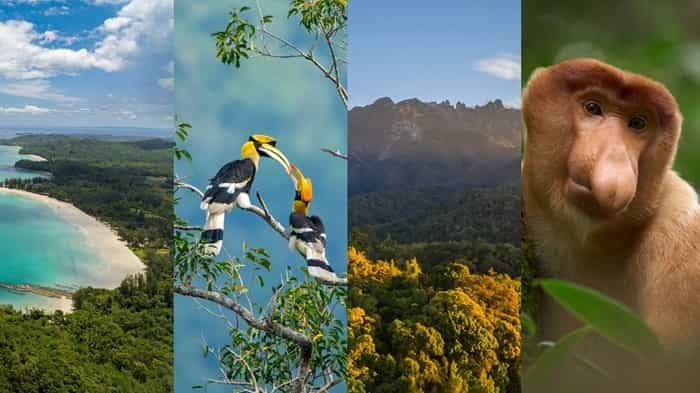
There’s a particular moment in the life of a new resort when the brochures stop talking and the bookings open. For Club Med, that moment arrives on 23 March 2026, when reservations go live for its long-anticipated Borneo debut, an expansion that says as much about shifting demand in Asia Pacific as it does about one brand’s confidence in Sabah.
Set on the relatively untouched coastline of Kuala Penyu, around 90 minutes from Kota Kinabalu, Club Med Borneo will welcome its first guests in November 2026. It follows the enduring success of Club Med Cherating, but this is a different proposition altogether, larger in scale, sharper in positioning, and pitched squarely at the premium end of the all-inclusive market.
And that’s no accident.
A calculated play for Sabah
Sabah has long been the quiet achiever of Malaysian tourism, rich in природal assets, light on overdevelopment, and often overshadowed by better-marketed neighbours. Club Med’s arrival suggests that it may be changing.
For Australian travellers in particular, the timing is neat. As Bali grapples with saturation and parts of Thailand edge further upmarket, Sabah presents a familiar but less crowded alternative: beaches, rainforest, and a cultural narrative that hasn’t yet been over-polished.
Club Med appears to be betting that travellers are ready for exactly that.
Scale, with a degree of restraint
The numbers tell one story. The resort will feature 400 rooms, including 39 Exclusive Collection Suites, along with the now-standard “resort within a resort” concept, a private lounge, a dedicated pool, and an elevated service tier.
But what matters more is how it’s been put together.
The design draws from traditional Rumah Rungus longhouses, with a central timber pavilion that avoids the usual glass-and-steel anonymity seen elsewhere. More importantly, the development sits alongside a protected mangrove reserve, an inclusion that suggests sustainability here is more than a line item.
Club Med says the property will be its first large-scale BREEAM-certified beach resort in the Asia Pacific. In practical terms, that places it ahead of many competitors still navigating how to balance expansion with environmental expectations.
Familiar formula, refined
Operationally, the offer is recognisable. Pools, Kids’ Club, multiple dining venues, evening entertainment, it’s the Club Med playbook, and it works.
The difference is in the setting.
Dining concepts The Alam, The Laut and The Pasir lean into local identity without overcomplicating things, while the spa and wellness spaces are set within the surrounding forest rather than bolted on as an afterthought.
For families, it remains a safe bet. For couples or higher-yield guests, the Exclusive Collection provides enough separation to justify the premium.
Why this matters now
The broader significance lies in where Club Med is placing its chips.
Asia Pacific continues to lead global travel recovery, but competition for the “premium family” segment is intensifying. Brands are no longer just competing on price or inclusions; they’re competing on space, authenticity, and increasingly, sustainability.
Sabah ticks those boxes, but until now, it has lacked the scale of an international product needed to convert interest into bookings.
Club Med Borneo changes that.
Early incentives and early expectations
Bookings open 23 March 2026, with a launch offer that includes complimentary upgrades to Deluxe rooms for stays between 16 November 2026 and 3 January 2027, subject to availability.
It’s a familiar tactic, but an effective one: seed early demand, fill the first season, and let word-of-mouth do the rest.
The real test, of course, will come after the opening offers fade.
Club Med Borneo isn’t just another resort announcement. It’s a signal of where demand is heading, of how brands are repositioning, and of a destination that may finally be stepping out of the shadows.
For the trade, it’s one to watch closely. And, if early interest is anything to go by, one to sell with some confidence.
by Soo James – (c) 2026.
Read Time: 3 minutes.
About the Writer.
 There’s nothing rehearsed about Soo James, and that’s precisely the point. Malaysian by heritage, Sydney by schooling, she arrived at UNSW to study Arts, then took a left turn into IT, not out of ambition but out of curiosity. Somewhere among systems and schedules, she worked out what really held her attention: people, language, and the quiet spaces between them.
Writing followed naturally. Travel and lifestyle gave her room to observe, to listen, to notice the details others rush past. Soo writes the way good travellers move, watching the room before admiring the view, catching the gesture before chasing the headline.
At Global Travel Media, her stories don’t shout or sell. They linger. They slow you down, open a door, and gently suggest there’s more to see if you’re willing to look.











