

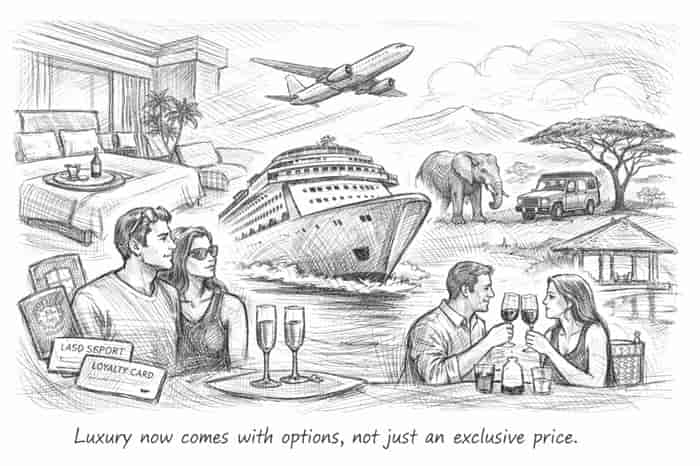
There was a time, not all that long ago, when “luxury travel” meant something rather precise. Private transfers, white-glove service, and a price tag that politely suggested you probably shouldn’t ask.
That tidy definition is now being quietly dismantled.
New research from arrivia suggests the luxury segment is stretching well beyond its traditional ultra-wealthy base, with a growing cohort of what the industry has started calling “aspiring luxury travellers” stepping confidently into the frame. These are not high-rolling billionaires, but households with net worths somewhere between comfortable and ambitious, in the $100,000 to $1 million bracket, and, crucially, willing to spend when it counts.
Not everywhere. Just where it matters.
Luxury, Rewritten in Plain English
Arrivia’s New Luxury Travel Playbook, built on responses from more than 2,000 U.S. leisure travellers, lands on a rather refreshing truth: luxury is no longer about price. It’s about relief.
A full 34 per cent of respondents nominated comfort as the single most important factor when booking a luxury experience. Not status. Not bragging rights. Comfort.
Close behind were convenience, privacy and attentive service, hardly revolutionary concepts, but their elevation is telling. For seasoned high-net-worth travellers, these are givens. For the next wave coming through, they’re the difference between a standard trip and something worth remembering.
Put simply, luxury today is less about what you add and more about what you remove stress, friction, and the creeping irritation of too many decisions.
The Rise of the Selective Spender
If there’s a thread running through the data, it’s this: travellers are getting smarter about where they splurge.
Millennials make up the lion’s share of this aspiring luxury segment, while Gen Z, often underestimated, is already dipping into high-end experiences, from private villas to safari-style escapes and premium event travel.
They’re not travelling lavishly across the board. They’re picking their moments.
Fly economy, upgrade the hotel. Skip the five-star lobby, book the unforgettable experience. It’s a deliberate trade-off, and one that’s reshaping how luxury is sold and packaged.
Cruises Quietly Steal the Spotlight
Then there’s cruising, which continues to defy its old stereotypes.
Nearly half of those surveyed have already taken a luxury cruise, a figure that would have seemed optimistic a decade ago. And what defines that experience? Not excess, but ease.
Less crowding. Better food. Staff who remember your preferences without being asked twice.
But the real drawcard is the all-inclusive model. Pay once, relax thereafter. No constant calculations, no drip-feed of extras. In a world where travellers are increasingly time-poor, that simplicity is proving irresistible.
It’s luxury without the mental arithmetic.
Special Occasions Still Drive the Upgrade
For all the talk of democratisation, luxury travel hasn’t become routine; it’s still tied to moments that matter.
Some 28 per cent of respondents said special occasions were the primary reason for booking a premium experience. Anniversaries, milestone birthdays, long-overdue family trips, the kinds of events where “good enough” simply won’t do.
For the trade, that’s a useful reminder: the emotional hook often matters more than the itinerary.
Loyalty Programs Find Their Moment
Perhaps the most actionable insight for the industry sits in loyalty.
Arrivia’s data shows 43 per cent of consumers belong to at least one luxury travel loyalty program, with younger travellers particularly engaged. And when it comes to redeeming those points, the preference is clear upgrades.
Rooms. Suites. Better views. More space.
Not cheaper travel better travel.
“Luxury travel preferences are evolving alongside a broader group of travellers who are willing to trade up when it feels worth it,” said Mark Wilson, Senior Vice President, Product Strategy & Operations, Cruise & Tour at arrivia.
It’s a polite way of saying the market is no longer fixed, and those who recognise that early stand to gain.
A Market in Motion
For suppliers, the takeaway is straightforward, if not entirely simple.
Luxury is no longer defined by who the traveller is, but by how they choose to travel. The old markers of income, status, and frequency are giving way to something more fluid.
And that demands a different approach. Less assumption, more nuance. Fewer blanket offerings, more tailored moments.
Because if this research proves anything, it’s that luxury hasn’t lost its appeal.
It’s just found a broader audience, and they’re arriving with clear expectations.
by Karuna Johnson – (c) 2026.
Read Time: 4 minutes.
About the Writer.
 Karuna Johnson’s career only makes sense if you know she truly loves travel. Thai by birth, with dual citizenship, she moves easily between worlds, equally at home sharing street food in Bangkok or sitting quietly through a Sydney boardroom meeting.
Educated in both Thailand and Australia, she speaks several languages and has applied them across destination management companies and hotels, spanning sales and administration. She’s the sort who keeps things running smoothly while others are still waking up.
Her journeys have taken her across Asia, Europe, and the United States, but it’s the smaller details that stay with her: people, customs, and the stories beneath every trip.
Worldly without being showy, Karuna brings a steady, thoughtful voice to Global Travel Media, exactly the kind of travel needs.











