

In aviation, there are airlines that shout and those that simply get on with the job.
flydubai has always belonged firmly in the latter camp. No grandstanding. No theatrical strategy pivots. Just a steady drumbeat of growth built on network logic, cost discipline and a deep alignment with Dubai’s broader aviation ambitions.
And once again, that approach has paid off.
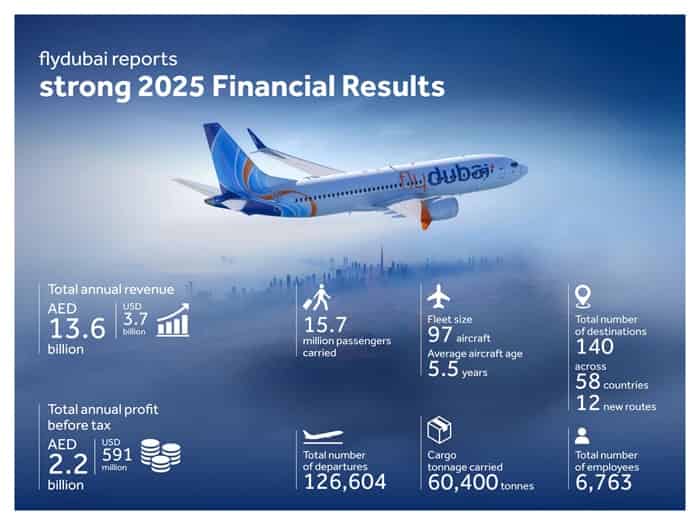
For the year ending 31 December 2025, the Dubai-based carrier reported a pre-tax profit of AED 2.2 billion (USD 591 million), with revenue climbing six per cent to AED 13.6 billion (USD 3.7 billion). Profit after tax landed at AED 1.9 billion, not just healthy, but remarkably consistent in an industry still recalibrating after years of volatility.
More tellingly, it marks the airline’s fifth consecutive year of strong profitability. In aviation terms, that’s less a statistic and more a statement of intent.
Built for Dubai’s long game
To understand flydubai, you have to understand Dubai.
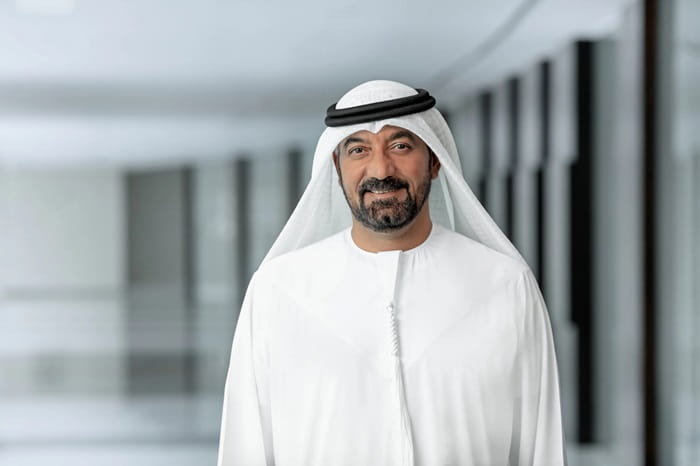
His Highness Sheikh Ahmed bin Saeed Al Maktoum, Chairman of flydubai
This is a city that plays the long game, where aviation isn’t simply an industry, but infrastructure. A strategic tool. A national obsession, if we’re being honest.
Chairman His Highness Sheikh Ahmed bin Saeed Al Maktoum framed the results squarely within that context, linking the airline’s trajectory to Dubai’s wider economic vision under the leadership of His Highness Sheikh Mohammed bin Rashid Al Maktoum.
It’s a reminder that flydubai was never designed to be a vanity airline. It was built as connective tissue linking the emirate with markets others overlooked, and quietly widening Dubai’s gravitational pull.
That mission is now well advanced.
Growth measured in connections, not headlines
The airline carried a record 15.7 million passengers in 2025, a figure that doesn’t scream disruption, but does signal durability.
Business Class demand surged 19 per cent, suggesting a carrier that’s steadily maturing, attracting travellers who might once have defaulted to legacy brands.
The network story is even more revealing. flydubai added nine new destinations, taking its reach to 140 cities across 58 countries. New dots on the map ranged from Eastern European secondary markets to African and Middle Eastern gateways, precisely the kind of routes that rarely make splashy announcements but quietly reshape connectivity.
It’s a classic flydubai move: expand where others hesitate, then let the numbers speak later.
Capacity followed suit. Available Seat Kilometres rose six per cent, matched by similar growth in passenger traffic. Yield ticked up three per cent modestly, but meaningfully in a cost-sensitive environment.
Doing the hard yards in a messy world

Ghaith Al Ghaith, Chief Executive Officer at flydubai
If the past few years have proven anything, it’s that airline profitability is no longer a given.
Supply chain bottlenecks, geopolitical tensions and spiralling maintenance costs have become the industry’s background noise. Against that backdrop, flydubai’s results look even more deliberate.
Chief executive Ghaith Al Ghaith struck a calm tone when reflecting on the year, pointing to operational resilience and disciplined growth as defining traits.
The airline operated more than 126,000 flights during the year, the second-highest number in the UAE, and during peak periods pushed beyond 400 daily departures. That’s not startup energy. That’s scale.
A fleet that signals intent
Airlines reveal their true confidence through aircraft orders, not press releases.
In 2025, flydubai took delivery of 12 Boeing 737 MAX 8 aircraft, bringing the fleet to 97 and averaging just 5.5 years old, enviably young by global standards.
Three older aircraft exited stage left, while retrofit programs continued, lifting product consistency across cabins. It’s a subtle but important detail: passengers are increasingly noticing inconsistencies, and airlines are learning that uniformity sells.
But the real headline came at the Dubai Airshow, where the airline unveiled a sweeping order book spanning Airbus A321neos and additional Boeing 737 MAX jets.
In aviation, airlines don’t commit to that scale unless they’re very sure of the road ahead.
Sustainability without the sermon
The industry’s sustainability narrative often swings between urgency and overstatement. flydubai’s approach feels more grounded.
The Boeing 737 MAX continues to anchor efficiency gains, delivering roughly 14 per cent better fuel burn than previous-generation aircraft. Not revolutionary, but materially useful.
A solar initiative at the airline’s campus is expected to cut emissions by over 1,200 tonnes annually, a small step individually, but emblematic of the incrementalism that defines real progress.
The airline also joined the Buckingham Palace Declaration, aligning with global efforts to combat wildlife trafficking. Not a headline-grabber, but a meaningful nod to broader responsibility.
A quiet shift in the onboard experience
One of the more interesting developments last year wasn’t financial; it was philosophical.
In November, flydubai rolled out a revamped Economy Class offering, adding meals and in-flight entertainment across all fares. It marked a subtle but important evolution of the airline’s hybrid model.
For years, flydubai has straddled the line between low-cost efficiency and full-service aspiration. This move nudges it further toward the latter, without abandoning its cost DNA.
Then there’s Starlink.
The agreement to roll out high-speed in-flight connectivity from 2026 positions the airline squarely in the next phase of passenger expectations, where connectivity is becoming less of a luxury and more of a baseline.
Partnerships that amplify scale
Perhaps flydubai’s most strategic asset remains its relationship with Emirates, a partnership that continues to deepen.
In 2025 alone, more than 2.5 million passengers benefited from seamless connectivity across the combined network, which now spans 243 destinations in 103 countries.
It’s a uniquely Dubai model of cooperation where others might pursue competition.
Beyond Emirates, flydubai expanded its interline network to 42 partners and maintained codeshares with Air Canada and United Airlines, bringing the total number of reachable destinations to over 300.
In modern aviation, reach often matters more than ownership.
Investing in the future workforce
Behind every growth story is a talent story, and flydubai is clearly planning ahead.
Headcount climbed 11 per cent to 6,763 employees, supported by pilot cadet programs, engineering apprenticeships and expanded training infrastructure.
New simulators and a forthcoming maintenance facility at Dubai South are designed to bring more capability in-house, a sensible move in an era where external capacity is increasingly constrained.
Airlines that control their training pipelines tend to sleep better at night.
Recognition follows reliability
Awards rarely define an airline, but they do reflect industry sentiment.
In 2025, flydubai was again named Airline of the Year at the Aviation Achievement Awards and secured a Four-Star Major Airline rating from APEX. It also picked up recognition for connectivity in the Middle East, perhaps the most fitting accolade of all.
Because if flydubai has a superpower, it’s connectivity.
Looking ahead without theatrics
The airline’s 2026 outlook feels refreshingly grounded.
Demand remains healthy. Leisure is resilient. Corporate travel is stabilising. The usual caveats apply to geopolitics, supply chains, and macroeconomics, but the fundamentals look solid.
Twelve aircraft deliveries are expected, including higher-capacity MAX 9 variants. Bangkok is on the horizon, signalling a deeper push into Southeast Asia and reinforcing Dubai’s eastward flow.
Digitisation, AI-driven efficiencies and leadership development remain front of mind, fewer buzzwords, more operational reality.
In other words: evolution, not reinvention.
The value of staying the course
What makes flydubai interesting isn’t just the numbers. It’s the restraint.
In an industry that often chases reinvention, the airline has stayed remarkably faithful to its blueprint: grow methodically, invest sensibly, connect intelligently.
It’s an old-fashioned formula, and perhaps that’s precisely why it works.
While aviation headlines tend to chase disruption, history suggests the real winners are often the airlines that master the fundamentals and stick with them long enough for compounding to do the heavy lifting.
flydubai’s 2025 performance suggests it’s firmly in that camp.
And in a sector still relearning the virtues of patience, that may prove its most enduring advantage.
Performance at a glance
-
Revenue: AED 13.6 billion (+6%)
-
Pre-tax profit: AED 2.2 billion
-
Passengers: 15.7 million
-
Fleet: 97 aircraft
-
Destinations: 140 across 58 countries
-
Employees: 6,763
by Bridget Gomez – (c) 2026.
Read Time: 8 minutes.
About the Writer.
 Bridget has never been built for stillness. Of Portuguese heritage, she began as a nurse, tending veterans at the Repatriation Hospital, listening to stories as colourful as the life she was yet to live. It was worthy, steady work, but wanderlust, as always, proved louder than routine.
So she traded starch for a backpack and disappeared for a year, chasing trains, sunsets and the occasional regrettable glass of wine. She wrote everything down: the dust, the laughter, the missteps, the magic. Those notebooks became a travel blog, then a habit, then a calling.
Eventually, she found Global Travel Media, or perhaps it found her.
Today, Bridget writes with heart, humour and a dash of mischief, still travelling, just now with words.










