
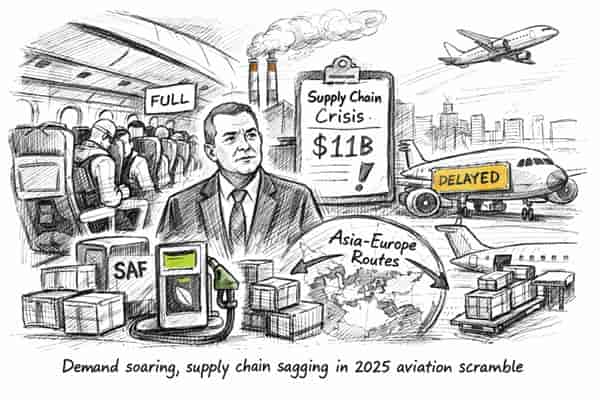
If aviation were a pub on a Friday night, 2025 would have been standing room only.
The world wanted to fly again, not with the frantic urgency of the post-pandemic rebound, but with something far more telling: consistency. According to fresh data from the International Air Transport Association (IATA), global passenger demand reached record territory last year, rising 5.3% compared with 2024. Capacity grew almost in lockstep at 5.2%, pushing the worldwide load factor to an eye-watering 83.6%, the highest ever recorded for a full year.
For an industry that once measured success in survival, these are numbers worth framing.
Yet beneath the celebratory headline sits a quieter, more complicated truth. Aircraft are full sometimes uncomfortably so, and airlines are discovering that demand is the easy part. Supplying the seats is another matter entirely.
As Willie Walsh, IATA’s Director General, observed with characteristic candour:
“2025 saw demand for air travel grow by 5.3% with international demand growing by 7.1% and domestic by 2.4%. This returns industry growth to align with historical growth patterns after the robust post-COVID rebound. The strong and continuous increase in demand puts into sharp focus two key challenges decarbonization and supply chain.”
In other words, aviation is healthy but hardly carefree.
For readers wanting to examine the raw numbers, IATA’s official analysis can be accessed here:
👉 https://www.iata.org/en/pressroom/air-passenger-market-analysis/.
International Travel Leads the Charge
International markets once again proved the industry’s engine room.
Traffic climbed 7.1% for the year, outpacing capacity growth of 6.8% and nudging load factors to a record 83.5%. December provided a suitably strong curtain call, with demand rising 7.7% year-on-year.
Asia-Pacific airlines stole the spotlight. International traffic surged 10.9%, supported by capacity expansion of 10.2%, while load factors edged up to 84.4%, the highest of any region.
Not bad for a part of the world that only recently reopened many of its borders.
Europe delivered a solid, if less theatrical, performance, posting 6.0% traffic growth and maintaining a load factor above 84%. Meanwhile, Middle Eastern carriers, long the maestros of hub connectivity, recorded a 6.7% increase, with December demand jumping 9.5%.
North America, however, appeared content to stroll rather than sprint. Traffic rose just 2.1%, the slowest globally, suggesting a mature market settling into equilibrium rather than chasing expansion.
Latin America grew briskly at 8.6%, though capacity increases slightly outpaced demand, trimming load factors. Africa achieved a quieter but meaningful milestone: while its 74.9% load factor remains the lowest, it represents a regional record and the largest worldwide improvement.
One senses a continent steadily finding its wings.
Domestic Markets: Solid, Sensible, and Slightly Slower
Domestic travel, the dependable backbone of airline balance sheets, also reached record passenger numbers, though growth cooled to 2.4% after 2024’s exuberance.
Brazil emerged as the standout performer with an impressive 11.1% increase in domestic RPKs, while Japan recorded the sharpest improvement in load factor.
The United States told a different story, with demand slipping 0.6% and load factors falling nearly two percentage points, a reminder that even aviation giants have off seasons.
Australia, meanwhile, posted a relatively modest but stable year. Domestic demand rose 2.2%, capacity tracked closely, and load factors settled at 81.2%, the lowest among the markets listed but still comfortably healthy by historical standards.
In aviation terms, that’s less a concern than a sign of breathing room.
The Supply Chain Headache No Panadol Can Fix
Of course, every boom carries its irritations, and for airlines the ache comes from the supply chain.
Walsh did not mince words:
“People clearly wanted to travel more, but airlines were continually disappointed with unreliable delivery schedules for new aircraft and engines, maintenance capacity constraints, and resultant cost increases that are estimated to exceed $11 billion.”
It is a staggering figure, one that explains why carriers have been stretching aircraft lifespans, maximising utilisation, and squeezing extra seats wherever engineering permits.
Those record load factors? Effective, yes. Sustainable? Perhaps less so.
Walsh continued:
“With load factors just shy of 84%, it’s clear that these measures were an effective band aid, but we need a real solution. It’s vital that 2025 proves to be the nadir of the supply chain crisis, and 2026 marks a rebound.”
The industry will certainly hope he’s right. Each delayed aircraft represents postponed growth, constrained routes, and frustrated network planners.
Yet there is an upside worth noting.
“Every new aircraft means a quieter, cleaner fleet, with more capacity and flight options than at any previous point in history, which is what airlines and their customers want to see.”
That future efficient, modern, and environmentally leaner depends heavily on production catching up with ambition.
Decarbonisation: Aviation’s Long Game
Beyond logistics lies the industry’s defining challenge: sustainability.
Walsh framed it plainly:
“Governments whose economies grow because of aviation and whose citizens thirst for connectivity need to provide the supportive fiscal policy framework to rapidly accelerate progress particularly for the energy sector to grow Sustainable Aviation Fuel (SAF) production.”
SAF remains aviation’s most credible pathway toward net-zero emissions, yet supply is stubbornly limited and prohibitively expensive.
Without government backing, subsidies, incentives, or regulatory clarity, scaling production will remain aspirational rather than operational.
For travellers, the message is subtle but significant: the ticket of the future may reflect not just distance travelled, but carbon reduced.
Cargo Quietly Delivers a Strong Year
Passenger jets may command the glamour, but cargo keeps global commerce humming, and 2025 proved reassuringly resilient.
IATA reported 3.4% growth in cargo tonne-kilometres (CTK), with capacity rising 3.7%. December capped the year with demand up 4.3%.
Importantly, yields fell just 1.5%, the smallest decline in three years, and remain 37.2% above 2019 levels, a lingering dividend of pandemic-era pricing power.
Walsh again:
“Air cargo delivered a strong performance in 2025, with demand up 3.4% year-on-year. Global e-commerce strength drove volumes, even as trading relationships with the US faced rising tariffs, the removal of de minimis tariff exemptions, and continuing policy uncertainty.”
In short, online shopping continues to fill bellies below the cabin floor.
Further details are available via IATA’s cargo analysis: 👉 https://www.iata.org/en/pressroom/air-cargo-market-analysis/.
Trade Lanes Shift Eastward
Perhaps the most intriguing subplot is the redrawing of global cargo routes.
Traffic has increasingly shifted from the once-dominant Asia–North America corridor to the Asia–Europe corridor, driven by tariff pressures and evolving trade policies.
The numbers tell the tale:
-
Europe–Asia: +10.3%
-
Within Asia: +10.0%
-
Europe–North America: +6.8%
-
Asia–North America: –0.8%
Geopolitics, it seems, is now a cargo planner.
Asia-Pacific carriers led demand growth at 8.4%, while North America was the only region to decline, at 1.3%, a rare reversal that underscores shifting economic gravity.
Fuel Prices Ease, But Not Enough
Jet fuel averaged 9.1% lower in 2025 than the previous year, which should have been cause for mild celebration. Yet higher refining margins absorbed part of the benefit, ensuring airlines saw only partial relief.
Meanwhile, global manufacturing sentiment edged into expansion territory at 50.9, though export orders remained cautious.
Translation: optimism tempered by realism.
What Lies Ahead for 2026?
IATA expects cargo demand growth to moderate to around 2.4%, aligning with long-term averages. Passenger demand is unlikely to retreat; either way, travel has reasserted itself as a structural behaviour rather than a discretionary splurge.
The real question is whether supply can keep pace.
Aircraft manufacturers face mounting pressure to accelerate deliveries, while maintenance networks must expand to support ageing fleets.
And then there is the sustainability aviation marathon rather than a sprint.
Still, history offers reassurance. Airlines are nothing if not adaptable.
As Walsh noted:
“Whatever trading patterns emerge, we can be confident that reliance on air cargo to keep global supply chains running will remain, with carriers responding to the challenge by deploying capacity and designing their networks for optimum flexibility.”
Flexibility has always been aviation’s quiet superpower.
The Bigger Picture
Strip away the spreadsheets, and one conclusion becomes unavoidable: people are travelling because they want to, not because they must.
That distinction matters.
It signals confidence, economic, personal, and cultural and suggests aviation has resumed its traditional role as facilitator of opportunity rather than symbol of recovery.
Yet the industry now faces a paradox of success. Demand is abundant; capacity is scarce. Sustainability is essential; infrastructure is catching up.
If 2024 was the rebound and 2025 the stabiliser, then 2026 may well become the year aviation decides what kind of growth it truly wants.
Measured and sustainable? Or exuberant and constrained?
For now, the cabins are full, the cargo holds are busy, and the horizon, despite a few logistical clouds, remains reassuringly clear.
And if history teaches us anything, it is this: aviation has always preferred headwinds to stagnation.
by Bridget Gomez – (c) 2026.
Read Time: 10 minutes.
About the Writer.
 Bridget has never been built for stillness. Of Portuguese heritage, she began as a nurse, tending veterans at the Repatriation Hospital, listening to stories as colourful as the life she was yet to live. It was worthy, steady work, but wanderlust, as always, proved louder than routine.
So she traded starch for a backpack and disappeared for a year, chasing trains, sunsets and the occasional regrettable glass of wine. She wrote everything down: the dust, the laughter, the missteps, the magic. Those notebooks became a travel blog, then a habit, then a calling.
Eventually, she found Global Travel Media, or perhaps it found her.
Today, Bridget writes with heart, humour and a dash of mischief, still travelling, just now with words.