

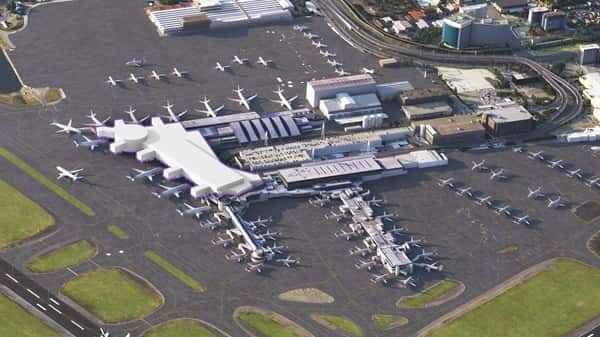
Sydney Airport has taken a decisive stride into its next era, appointing global architecture practice Grimshaw and international engineering powerhouse Mott MacDonald as lead consultants for the long-anticipated T2-T3 terminal link, a project set to redefine how Australia’s busiest aviation hub welcomes the world.
Part of a sweeping $6 billion capital works program, the appointment signals more than a contractual milestone. It represents a philosophical shift in how the airport intends to build its future with fewer fragmented contracts and more enduring partnerships designed to deliver consistency, innovation and, importantly, speed.
After a global tender process that drew the industry’s finest, the two firms emerged as clear favourites, entrusted with shaping infrastructure that must serve not just today’s travellers but the swelling ranks expected in decades ahead.
A partnership built for the long haul
In aviation, where ambition often meets logistical complexity, Sydney Airport is abandoning the piecemeal “project-by-project” approach in favour of a long-term framework model. It is a move seasoned infrastructure observers will recognise as both pragmatic and quietly bold.
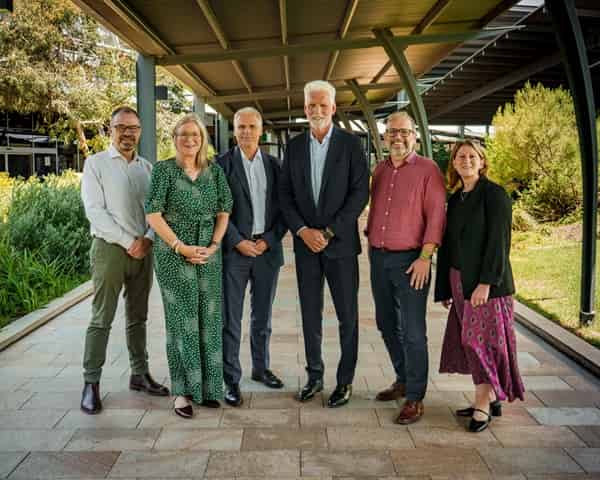
From Left to Right: Chris Turton – Aviation Leader ANZ, Mott MacDonald
The strategy aims to sharpen delivery efficiency while fostering design excellence across a pipeline of projects scheduled over the next five years, a period likely to test even the most robust planning frameworks as global travel demand continues its spirited rebound.
Sydney Airport CEO Scott Charlton was characteristically measured yet unmistakably confident about the significance of the appointment.
“Our $6 billion capital program is critical to maintaining an efficient, high-quality experience for airlines and passengers as we grow towards our Master Plan forecast of 72 million passengers a year by 2045,” Charlton said.
“By partnering with world-class firms like Grimshaw and Mott MacDonald we’re strengthening our ability to deliver major projects that support jobs, economic growth and Sydney’s role as Australia’s global gateway.”
There it is, the phrase every great airport covets: global gateway. And Sydney, never one for modest aspirations, intends to earn it.
Designing the next chapter
Grimshaw will take the architectural helm, bringing with it a formidable aviation résumé spanning Heathrow, Istanbul, Lima, JFK and Shenzhen airports that are less transport nodes and more miniature cities humming with perpetual motion.
Meanwhile, Mott MacDonald steps forward to lead engineering, drawing on deep multidisciplinary expertise and a strong Australian footprint to navigate the intricate demands of terminal construction, structural design and building services.
Paul Willis, Sydney Airport’s Group Executive for Planning and Delivery, suggested the framework mirrors the sheer scale of what lies ahead.
“We would like to congratulate Grimshaw and Mott MacDonald on their appointment to the panel,” Willis said.
“Establishing long-term partnerships with leading design and engineering firms gives us greater consistency across projects, improves coordination between disciplines, and helps us move faster from concept to delivery while maintaining the highest standards of safety, sustainability and design quality.”
For travellers, those words translate rather simply: fewer bottlenecks, smarter spaces, and one hopes shorter queues.
Vision meets experience
Mark Middleton, Group Managing Partner at Grimshaw, captured the spirit of collaboration succinctly.
“We are proud to partner with Sydney Airport on this landmark project, bringing our global aviation experience to help shape a terminal that will deliver an outstanding passenger experience while supporting long-term capacity and sustainability,” he said.
Frances Badelow, Managing Director for Australia at Mott MacDonald, echoed the forward-looking tone.
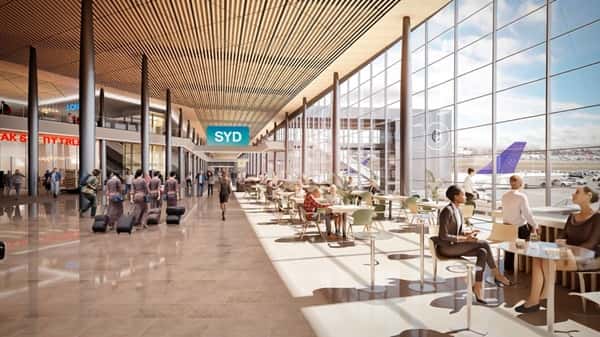
Terminal Expansion internal view
“We look forward to working with Sydney Airport to deliver a future-ready terminal, applying our engineering expertise and strong local capability to support the airport’s next phase of transformation.”
“Future-ready” is one of those phrases often tossed around in boardrooms, yet here it carries genuine weight. Airports, after all, are built not for the present but for generations yet to board their first flight.
Anchored in the Master Plan
The T2–T3 terminal link sits squarely within Sydney Airport’s preliminary draft Master Plan 2045, an expansive blueprint forecasting passenger numbers to reach 72 million annually by mid-century.
Should that figure feel ambitious, consider aviation’s enduring habit of outperforming expectations whenever barriers fall and economies flourish.
The project promises expanded terminal capacity, sharper airline efficiency and a far smoother passenger journey. Among the headline upgrades: up to 12 new swing gates capable of handling both domestic and international operations, the sort of flexibility modern airports increasingly require.
Early works will focus on design development, site surveys and risk identification, essential groundwork that often goes unnoticed but determines whether grand visions glide smoothly into reality or stall on the tarmac.
Building momentum
The embrace of long-term design partnerships is expected to accelerate decision-making and strengthen cross-disciplinary integration, a quietly transformative advantage in managing infrastructure of this magnitude.
Further announcements from consultants and contractors are expected soon, suggesting the airport’s transformation is less a distant concept and more an unfolding narrative.
For Sydney, a city whose identity has always been intertwined with movement, trade and tourism, the implications are substantial. Jobs will follow cranes, economic activity will shadow investment, and travellers will ultimately judge the success of it all in those fleeting moments between kerbside drop-off and boarding call.
Yet if history offers any lesson, it is that great airports are never truly finished; they simply evolve.
And so, with Grimshaw’s design flair and Mott MacDonald’s engineering rigour now in harness, Sydney Airport appears determined to ensure its next chapter is written with both confidence and craft.
One suspects the millions who will pass through its terminals in the decades ahead will scarcely spare a thought for the planning meetings and procurement frameworks that made it possible, but they will notice the ease, the flow, and perhaps even the quiet pleasure of a journey well begun.
Not a bad legacy for a link between two terminals.
by Anne Keam – (c) 2026.
Read Time: 4 minutes.
About the Writer.
 Anne Keam’s story begins in Queensland, on a grain farm in the state’s wide western reaches, where the days were long and the lessons simple: work hard, look after your own, and don’t make a fuss. Those early years left their mark.
She later studied Arts at the University of Queensland, before doing what felt natural at the time, heading back home to the family property. But the world was calling. Anne packed a backpack and went looking, spending years on the road and finding herself most alive in South America. She wrote everything down along the way. Those notebooks, full of dust, colour and curiosity, eventually became her blog, a quiet, personal record of seeing the world and learning from it.











