

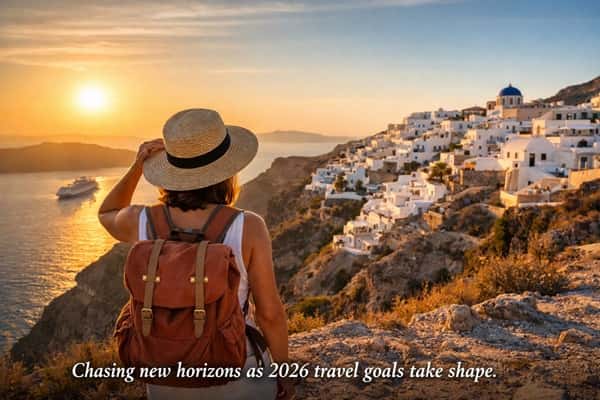
Not restless in the fidgety, gate-lounge sense, though there’s plenty of that, but restless in a deeper way. After years of stop-start borders, reshuffled routes and fragile certainty, travellers are no longer content with returning to the familiar. In 2026, they want somewhere new. Preferably somewhere few of their friends have been.
That, at least, is the clear message from the latest Global Rescue Winter 2026 Traveller Sentiment and Safety Survey, which paints a portrait of a travelling public that is more ambitious, more curious, and quietly more strategic than at any point in the past decade.
At the top of the list: new countries, new continents, new stamps in the passport.
Fully 41 per cent of respondents say their most important travel resolution for 2026 is to visit someplace new. Don’t travel more. Not travel cheaper. Not travel better. Simply: go somewhere they’ve never been.
Exploration, it seems, has reclaimed its crown.
The appetite is strongest among women, with 46 per cent naming new destinations as their chief priority, compared with 40 per cent of men. Geographically, the divide is sharper still. Among non-US travellers, 54 per cent plan to prioritise new destinations next year, against 38 per cent of their American counterparts.
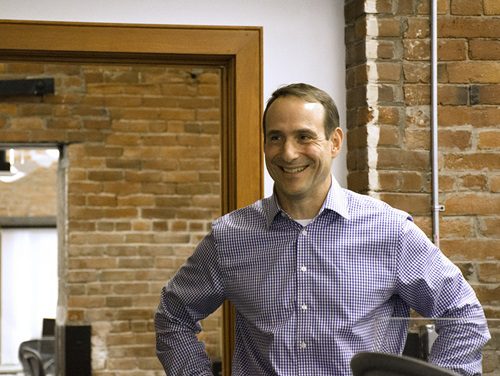
Dan Richards is standing in the operations room.
US travellers, by contrast, appear more focused on volume than novelty. Twenty-one per cent say their main ambition is simply to travel more often, compared with 15 per cent of travellers elsewhere.
In other words: Americans want more trips. The rest of the world wants better ones.
“Travellers are clearly prioritising discovery in 2026,” says Dan Richards, chief executive of The Global Rescue Companies and a member of the US Travel and Tourism Advisory Board at the US Department of Commerce. “Whether it’s a first-time destination or an entirely new region, that sense of exploration comes with added complexity, and it reinforces why medical, security and evacuation preparedness remain essential.”
It is a neat reminder that adventure and logistics have always been uneasy travelling companions.
Hidden seasons step out of the shadows
The hunger for novelty is being matched by a quieter but equally telling shift in timing.
Peak season, once the unquestioned king of holiday planning, is losing its grip.
While most travellers are not dramatically rewriting their calendars, a growing minority are leaning deliberately into what the industry calls the “hidden season”, those awkward shoulder months when prices dip, crowds thin, and weather sits somewhere between charming and challenging.
According to the survey, 57 per cent expect to travel off-peak about as often as before. But a substantial 34 per cent say they are more likely to do so in 2026.
Women again lead the charge. Thirty-nine per cent say they plan to travel in hidden seasons more often, compared with 33 per cent of men.
US travellers remain more cautious. Ten per cent say they are less likely to travel off-peak, compared with just 1 per cent of non-US travellers.
“Hidden-season travel offers fewer crowds and often better value, but it can also mean limited infrastructure and reduced local services,” Richards says. “Travelers need to balance opportunity with risk awareness.”
Translation: the bargains are real, but so are the closed restaurants.
Lesser-known destinations take centre stage
If timing is changing, so too is geography.
The classic circuit Paris, Rome, London, repeat is being quietly dethroned by something more obscure, more personal and, perhaps, more Instagrammable.
More than half of all respondents (52 per cent) say they prefer lesser-known international destinations with fewer crowds in 2026. Only 12 per cent favour well-worn tourism hubs. The remainder sit on the fence, passports open.
Women are again at the vanguard. A striking 63 per cent prefer emerging or less crowded destinations, compared with 49 per cent of men.
Non-US travellers show a similar inclination, with 55 per cent favouring the road less travelled, against 52 per cent of Americans.
“Travellers are pushing beyond traditional hotspots,” Richards says. “That trend increases the importance of having rapid access to medical care, evacuation services and real-time security intelligence, especially in destinations where resources may be limited.”
It is the fine print of adventure: thrilling at the front end, logistical at the back.
A new travel psychology emerges
Taken together, the numbers reveal something more than shifting preferences. They point to a subtle change in travel psychology.
This is not revenge travel. Nor is it escapism. It is deliberate exploration measured, informed and, increasingly, risk-aware.
Travellers want novelty, but not naivety. They want solitude, but not vulnerability. They want value, but not at the expense of resilience.
For airlines, tour operators and destinations, the message is unambiguous. The future market is not chasing landmarks. It is chasing stories.
For governments and insurers, the implications are more sobering. As travellers move away from infrastructure-rich capitals into thinner, quieter regions, preparedness becomes less optional and more essential.
And for travellers themselves, 2026 offers a rare luxury: choice.
New countries. New seasons. New maps.
Just don’t forget to pack the contingency plan.
For further details, visit www.globalrescue.com.
by Anne Keam – (c) 2026.
Read Time: 4 minutes.
About the Writer.
 Anne Keam’s story begins in Queensland, on a grain farm in the state’s wide western reaches, where the days were long and the lessons simple: work hard, look after your own, and don’t make a fuss. Those early years left their mark.
She later studied Arts at the University of Queensland, before doing what felt natural at the time, heading back home to the family property. But the world was calling. Anne packed a backpack and went looking, spending years on the road and finding herself most alive in South America. She wrote everything down along the way. Those notebooks, full of dust, colour and curiosity, eventually became her blog, a quiet, personal record of seeing the world and learning from it.











