

For decades, small business owners treated cyber insurance much like a fire extinguisher, something you bought after the smoke alarm went off. Now, a new GlobalData survey suggests SMEs are buying protection not because they’ve been burned, but because they can smell the smoke and it smells a lot like artificial intelligence.
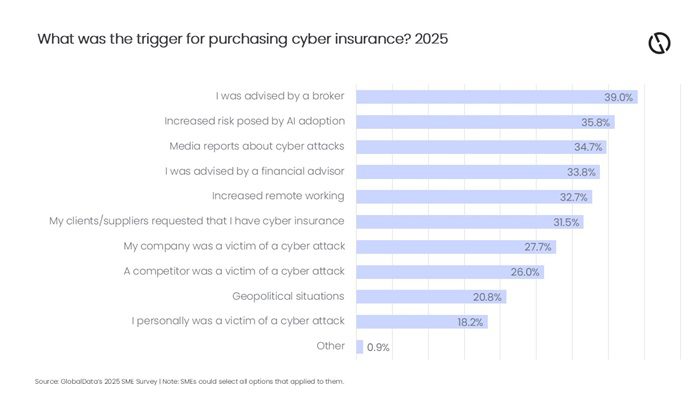
According to GlobalData’s 2025 SME Survey, professional advice is now the single biggest driver of cyber insurance adoption worldwide. Being nudged by a broker tops the list at 39%, followed by guidance from financial advisers at 33.8%.
But it’s the quiet panic over AI that’s really shifting behaviour. A striking 35.8% of SMEs now cite risks from AI adoption as a core reason for taking out cyber insurance, making it the second most important factor overall.
In plain English: small businesses are more worried about what their own algorithms might do than what some hoodie-wearing hacker might try.
And, frankly, who can blame them?
The AI Gap in Cyber Cover
Beatriz Benito, Lead Insurance Analyst at GlobalData, puts it bluntly.
“The rapid spread of AI and its integration across all industries is making SMEs feel uneasy and anxious about the technology, perceiving that it may pose significant risk. Given that many standard cyber policies do not mention AI cover, there could be a gap between what clients expect from their policy and what it actually covers.”
That “gap” is more than academic. Most standard cyber policies still don’t cover losses caused by a business’s own AI tools producing incorrect or misleading outputs, such as a chatbot quoting the wrong legal advice or an algorithm making biased decisions that trigger litigation.
Ironically, while insurers are happy to cover losses caused by AI-powered hackers, they are far less keen to insure the consequences of a company’s own AI mistakes.
It’s a bit like insuring your house against burglars, but not against your own robot vacuum smashing into the plumbing.
Brokers Become the New Cyber Sherpas
As SMEs navigate this unfamiliar terrain, brokers and financial advisers are emerging as the unlikely heroes of the cyber insurance story.
“Brokers and financial advisors are uniquely positioned to assess clients’ risks and needs and match them to products that meet their requirements,” Benito says.
“For clients seeking protection against AI risks, they should consider offering cyber insurance policies with add-ons that explicitly cover AI-related incidents; otherwise, they should offer them specialist policies alongside cyber insurance.”
In other words, SMEs need guidance, not guesswork. The days of buying a one-size-fits-all cyber policy and hoping for the best are quietly coming to an end.
Fear, Not Fire, Is Changing Buying Behaviour
The survey also reveals a subtle but important cultural shift.
External factors such as media reports and public discussion of cyber threats are now more influential than lived experience. Only 27.7% of SMEs said they bought cyber insurance because they’d personally been hit by a cyberattack. Even fewer (26%) were prompted by a competitor’s attack.
That’s a remarkable reversal. It suggests that cyber insurance is becoming preventative rather than reactive, a sign that the market is maturing.
Benito welcomes the shift but warns it comes at a price.
“While this shift makes businesses safer, SMEs may not always be able to afford the cost of a policy, or the technology (such as software upgrades) required by insurers.”
In short, the door is open, but the threshold remains high.
A Market Ripe for Smarter Policies
GlobalData’s message to insurers is unambiguous: simplify, specialise and focus on what actually goes wrong for small businesses.
“Given the high barrier to entry for SMEs, insurers should focus on developing policies covering just the risks that are most common to such businesses,” Benito concludes.
That means fewer bloated policies stuffed with exclusions and more targeted products that explicitly address AI risk, operational tech failures, and real-world small-business exposures.
It also means confronting the uncomfortable truth that AI isn’t just a productivity miracle. It’s a liability minefield.
The Bottom Line
SMEs aren’t buying cyber insurance because they’ve been hacked. They’re buying it because they don’t trust what their own technology might do next.
And in an age when a chatbot can misquote a contract, an algorithm can discriminate without trying, and a rogue update can shut down operations overnight, that caution looks less like paranoia and more like prudence.
The cyber insurance market, long built for yesterday’s threats, is now being dragged into tomorrow’s risks, one uneasy small business at a time.
by Karuna Johnson – (c) 2026.
Read Time: 4 minutes.
About the Writer.
 Karuna Johnson has one of those rare careers that could only belong to someone who genuinely loves travel. A Thai national with dual citizenship, she’s as comfortable swapping stories over street food in Bangkok as she is discussing strategy in a Sydney boardroom.
Educated in Thailand and Australia, Karuna speaks several languages fluently, a skill that’s served her well across a career that’s taken her through the inner workings of three Destination Management Companies and a string of hotels. She’s done everything from sales to admin, always with the kind of quiet competence that keeps things moving while everyone else still finds the coffee.
Her travels have taken her far and wide across Asia, Europe, and the United States, yet she still finds joy in the details: the people, the culture, and the stories behind every journey.
She’s worldly, poised, and precisely the kind of voice Global Travel Media was made for.
======================================











