
Samoa has never struggled to attract attention. What it has guarded more carefully is control.
For decades, the Pacific nation has watched international hotel brands circle its beaches with interest, often accompanied by the usual promises of investment, exposure and “global reach”. What has been notably rarer is a deal that arrives without demanding ownership in return.
That is why this week’s agreement between Return to Paradise Resort and the Radisson Hotel Group matters not as a branding exercise, but as a signal that Samoa may finally have found a model that works on its own terms.
Under the arrangement, Return to Paradise will join Radisson Individuals, a soft-branding platform designed for independently owned hotels that want access to global distribution without surrendering operational control. Crucially, the resort remains fully Samoan-owned and operated, a point emphasised repeatedly by both sides and not without reason.
In a region where offshore capital has often come with offshore decision-making, that distinction carries weight.
A local institution, not a blank canvas
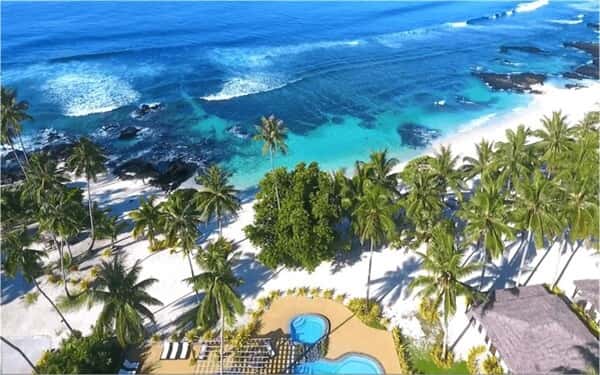
Return to Paradise is not a new entrant looking for validation. Sitting directly on Lefaga’s sweep of white sand, a beach already familiar to generations of Samoans and repeat visitors alike, the resort has long been one of the country’s most recognisable tourism assets.
The property comprises 117 rooms and villas, ranging from traditional resort accommodation to larger, self-contained family units, all set within dense tropical gardens. Its restaurants, including Paradise Kitchen and the Rockpool Bar, have built a reputation around local produce and flavours rather than imported menus designed to offend no one.

Return to Paradise Resort, a member of Radisson Individuals.
In other words, this was never a site waiting to be activated.
What the Radisson deal offers is not reinvention but amplification: access to a global booking engine, international loyalty networks, and operational support that smaller, independent resorts struggle to build on their own.
Ownership – and the line not crossed
For Aiono Hinauri Petana, Board Chairperson of Return to Paradise Resort Samoa, the appeal of the partnership lay in what it did not require.
“We are proud to remain fully Samoan-owned and operated, staying true to our values, people, and culture, while partnering with one of the world’s most respected hotel groups,” she said.
“Working with Radisson allows us to share the magic of Samoa with a wider global audience while continuing to be authentically ourselves.”
That insistence on authenticity is not rhetorical. Samoa’s tourism sector remains deeply intertwined with village structures, land tenure systems, and family ownership models that do not always align with conventional international hotel agreements.
By design, Radisson Individuals allows properties to retain their name, character and management, a model that appears to have made this deal politically and culturally palatable.
Government support – cautiously enthusiastic
The Samoan Government’s endorsement was equally measured.
Finance Minister Mulipola Anarosa Molio’o welcomed Radisson’s involvement while underlining that the resort’s ownership structure would remain intact.
“Return to Paradise is a well-known and much-loved icon in Samoa,” she said.
“The Government is delighted to see that, as a Radisson Individual, Radisson Hotel Group will support the resort while it retains its unique Samoan family-style ownership and management.”
In a country where tourism policy is as much about social cohesion as economic growth, that reassurance was not incidental.
Why Radisson – and why now
For Radisson Hotel Group, the move fits neatly within a broader regional strategy: expanding its footprint in the Pacific without assuming the risk or resistance that full-scale acquisitions can bring.
Danilo Curcuruto, Radisson’s Director of Development for Australasia, framed the partnership as an example of how global brands can integrate without overpowering local operators.
“This collaboration supports and celebrates Samoan ownership, culture and hospitality, which remain firmly at the heart of the resort,” he said.
“Samoa is one of the most culturally rich destinations in the Pacific, and we appreciate the trust placed in us.”
That trust, however, will ultimately be tested on execution.
The resort is expected to undergo a refurbishment program aligned with Radisson’s international standards, raising the familiar question of how much modernisation is too much. Management has been careful to stress that any upgrades will preserve the property’s Samoan design language rather than replace it.
A broader shift in Pacific tourism
More broadly, the deal reflects a subtle recalibration underway across the Pacific.
As travellers become less impressed by generic luxury and more interested in place-specific experiences, destinations like Samoa have gained leverage. The value now lies not only in beaches and climate, but in culture, something that cannot be franchised or rapidly reproduced.
Samoa’s emphasis on Fa’a Samoa, the Samoan way of life, has increasingly become a commercial strength rather than a constraint. Carefully structured partnerships such as this one suggest that international operators are beginning to recognise that reality.
Not a takeover – a test case
For Return to Paradise, the agreement marks a new chapter but not a surrender of identity. For Radisson, it offers credibility in a market that has historically resisted outside control. And for Samoa, it provides a test case for how global capital and local ownership might coexist without friction.
There will be other deals. Not all will be this carefully balanced.
But for now, Samoa has managed something rare in international tourism: inviting the world in, without giving the house away.
by Prae Lee – (c) 2025
Read Time: 5 minutes.
About the Writer.
 You can tell a lot about a person by how they handle a busy Bangkok morning. Prae Lee doesn’t rush; she glides through it. There’s a calm certainty about her, the sort that comes from knowing where you come from and where you’re going.
Educated at Chulalongkorn University, she took her business degree with the quiet pride of someone who believes in doing things correctly. Her travels for further study in Singapore and Australia didn’t change her; they polished what was already there: curiosity, discipline, and grace.
She returned to her family business in Bangkok, breathing a little modern life into it. She handled social media with the intuition of someone who listens and sells with the gentle persistence the Thais do so well.
Prae doesn’t make a fuss, but everything she touches shines brighter.
Now part of the Global Travel Media family, Prae brings authenticity and quiet confidence to her writing, drawing from a life steeped in culture, travel, and connection.