Bali has never been short of spectacle. Over the years, it has learned how to build loudly sky-high beach clubs, endless infinity pools, and resorts that announce themselves with fireworks rather than whispers. Yet in Pererenan, the quieter neighbour just beyond Canggu’s relentless thrum, something different is taking shape.
On August 22, 2025, Indonesian developer JHL Collection will open Noema, a 157-room resort that is deliberately swimming against the tide of Bali’s high-decibel tourism economy. It is not chasing the island’s party crowd. It is courting a slower, older idea of travel: one rooted in curiosity, calm, and connection.
“The name ‘Noema’ is a philosophical term which is often used to describe the object or content of a thought from within an intentional experience. It’s with that thinking in mind that every corner of the hotel has been designed – to purposefully foster creativity, connection and calm,” says Kay Tadjoedin, JHL Collection’s Corporate Director of Marketing.
“This is a place where we want surfers, families, digital nomads, culture seekers and dreamers to feel at home yet relaxed while simultaneously experiencing the rhythm and richness of Bali.”
It is the language of intention rather than indulgence, and in today’s Bali, that distinction matters.
A Resort Built for Stillness, Not Status
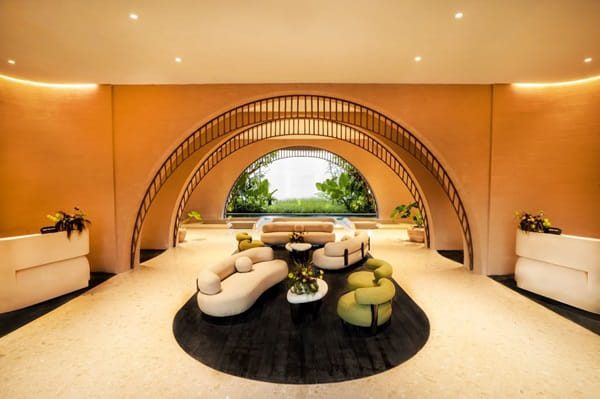
Noema’s physical scale is generous without being overpowering. The 157 rooms include rooftop suites, a three-bedroom penthouse, and a mix of family-friendly and retreat-style accommodations. Design leans into Bali’s natural rhythm: open air, soft materials, unforced lines. Every room has a private balcony. None of it feels showy.
The resort sits around 90 minutes from Denpasar airport, positioning it neatly between the weekend staycation market for Indonesians and the longer-haul international visitor. Importantly, it also places Noema just far enough from Canggu’s gridlock to feel like an escape, without being isolated.
This is not the Bali of champagne spray and DJ decks. It is a Bali that assumes guests still enjoy the sound of the wind.
Food That Speaks Locally, Not Loudly
Dining at Noema avoids the tired theatrics of resort gastronomy. Instead, it leans into regional truth and quiet confidence.
At the heart of the offering is Paparempa, a 78-seat restaurant devoted to Indonesian flavours drawn from across the archipelago. Dishes are prepared using traditional methods, lightly modernised but not re-engineered for Western palates. In a dining scene often obsessed with reinvention, Paparempa’s restraint may be its boldest move.
By contrast, Mamaloma, the 143-seat poolside venue, is built for ease. It runs all day, blending Asian influences with international comfort standards. Its Saturday brunch is expected to become a fixture for both travellers and the local Pererenan community.
Then there is Menika Rooftop, a versatile open-air space that shifts with the day, yoga at sunrise, weddings and intimate dinners by night, all carried by coastal air and unforced elegance.
Wellness Without the Theatre
Bali’s wellness scene is crowded. What Noema introduces is not spectacle, but specificity.
Oori Concept Spa, located on the rooftop, will be Bali’s first luxury Korean scrub spa. Drawing on Korean bathhouse traditions, it offers full-body scrubs, infrared saunas and cold plunges, using natural ingredients sourced from Balinese medicinal plants.
It is an unusual cultural pairing, Korea meets Bali at altitude, yet it feels thoughtful rather than gimmicky. This is wellness that invites participation, not performance.
A Rare Thing in Bali: A Resort That Welcomes Children Properly
Families are often accommodated in theory at luxury resorts and tolerated in practice. Noema has chosen a different path.
The centrepiece is Noema Hoola Play, a three-storey vertical playground designed by SIURA Studio, inspired by the myth of a descending kraken. It is joined by climbable walls by Japanese artist Kanoko Takaya, creative installations by Iwan Yusuf and Sekar Puti, and shared community zones designed to encourage interaction across generations.
Co-working nooks sit alongside play zones. Wellness programming runs parallel to family recreation. It is one of the few new resorts in Bali to attempt a multi-generational model without segregation.
More Than a Launch – A Local Statement
Noema’s opening will be marked by a three-day community festival from August 22–24, 2025, featuring workshops, food, cultural programming and wellness. It is envisioned as an annual event, less a marketing splash than a statement of intent.
That intent is clear: Noema wants to belong to Pererenan, not merely trade on its postcode.
In an era where tourism development often displaces rather than integrates, this approach may quietly become Noema’s most substantial commercial advantage.
What Noema Represents for Bali – and for Australia’s Travellers
For Australian travellers, who have shaped Bali’s modern identity as much as any market, Noema signals a return to something familiar: Bali as refuge rather than spectacle.
This is a luxury that does not require narration. It is a design that assumes no explanation. It is hospitality rooted in place, not performance.
In a tourism economy increasingly crowded with excess, Noema is betting that the next iteration of Bali’s success will be built on calm, craft and cultural respect, not volume.
And for once, that feels less like branding and more like belief.
by Octavia Koo – (c) 2025
Read Time: 6 minutes.
About the Writer
 Indonesian-born Octavia Koo arrived in Australia in the early 1980s, drawn by the creative promise of Sydney and a place at UNSW, where she studied Arts and soon discovered her flair for visual storytelling. She began as a graphic designer, quickly turning her sharp eye for detail towards the digital frontier, designing websites and crafting polished descriptions that draw people in—and keep them reading.
Her next chapter took her to Singapore, where she built and managed blogs for several tourism platforms, uncovering a natural gift for SEO long before the term became fashionable. There, amid the buzz of ITB Asia, she met Stephen, who suggested she consider Global Travel Media. A few years later, she did just that.
Now part of GTM’s editorial family, Octavia brings a quiet brilliance to her work. She merges art, technology, and intuition to tell travel stories that charm and perform, much like their author.