

Every time a traveller books a flight or hotel online, it feels instant. A few clicks, a confirmation email, and it’s done. But behind that smooth experience, there’s a lot that can go wrong. The truth is, payments are still one of the most significant pain points in global travel.
For years, travel companies have focused on loyalty programs, user experience, and marketing. Payments, meanwhile, have remained messy — slow settlements, failed transactions, and high cross-border costs. It’s not something travellers see, but it affects every online booking.
The Hourglass Problem – How the Internet Manages Scale & Interoperability
I often compare this to how the Internet works – think of the Internet Protocol (IP) that powers the web. Despite the explosion of applications above (browsers, apps, platforms) and connectivity layers below (fibre, Wi-Fi, 5G), the entire Internet is built on one unifying layer – the “hourglass neck” – that connects everything seamlessly. It’s simple and unified. Everything above and below it can evolve freely because that middle layer keeps it all connected.
Payments don’t have that. Every market has its own rules, payment methods, and banking systems. When a travel company operates in 10 countries, it ends up managing 10 distinct setups – multiple PSPs, acquirers, currencies, and compliance checks.
The result is what I call the “hourglass gap”. There’s no single layer that connects all these systems. Each new market adds another point of failure. 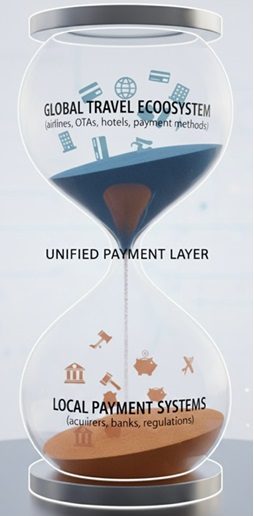
A Simple Example
Imagine a traveller in Singapore booking a flight to Tokyo through an Online Travel Agency (OTA) based in Dubai, using an Australian credit card. That one payment can pass through five different systems — the OTA’s payment gateway, a regional PSP, an airline’s acquirer, a card network, and an FX partner.
Each handoff adds friction. A minor currency mismatch, a timeout, or a fraud rule can cause the transaction to fail. The traveller sees an error message and gives up. For the business, that’s lost revenue and support costs.
Now multiply that across millions of transactions every month. You get the scale of the problem.
Cross-border payments are expensive – not just in fees, but in complexity. Decline rates can be 20–30% for international cards. Refunds take days. FX losses eat into margins. Each acquirer and PSP has its own format for settlement reports, so reconciliation becomes a daily battle. And when something fails, the blame game starts: Was it the acquirer? The card network? The risk engine? No one really knows because the system was never designed to work as one.
Why the Industry Needs a Common Layer
The travel industry needs a unified payment layer – a framework that connects local payment systems. This isn’t about replacing acquirers or PSPs. It’s about making them work together more innovatively.
A unified layer should:
- Route transactions to the right acquirer based on geography or success rate
- Store and manage payment data securely in one place
- Give a single view of performance and settlement
- Automate retries and refunds
- Adapt easily to local rules and methods
This kind of setup is what we call payment orchestration — a neutral layer that connects everything without adding complexity.
Why This Matters for Travel
Travel is global by nature, but payments are not. An Australian airline expanding into Southeast Asia can’t rely only on cards – it needs wallets, BNPL, and local methods. But integrating each one takes time and effort. Without orchestration, it’s like building a new checkout from scratch every time you enter a new market.
Even a small increase in authorisation rates, say 3-5%, can recover millions in revenue for a large airline or OTA. More importantly, it ensures a consistent customer experience. A traveller shouldn’t have to think about whether their payment method will work.
From Cost Centre to Intelligence Layer
Once payments are unified, they stop being just a backend process. They become a source of insight. When all transactions flow through one system, you can:
- See which routes or issuers have high declines
- Understand FX impact in real time
- Personalise payment options by market
- Catch fraud patterns early
That’s the real power of orchestration – not just reducing friction, but using data to make smarter business decisions.
For travel companies, payments shouldn’t be what slows them down – they should be what helps them scale. Platforms like Juspay enable businesses to launch faster in new markets, reduce costs, and offer travellers more choice.
Building this unified layer won’t happen overnight. It takes the right partners and technology. But it’s worth it because every friction in payments means friction in travel.
The next phase of travel growth will come from removing these hidden barriers. When payments finally work as smoothly as booking a ticket, we’ll have built a truly global travel experience — one where borders matter for destinations, not for transactions.
By Nakul Kothari – (c) 2025
About the Writer
About the Author
Nakul Kothari is the Head of APAC & Middle East at Juspay, a global payments infrastructure platform that works with leading enterprises and banks to deliver seamless payment experiences. Nakul joined Juspay in 2019 and currently leads the company’s expansion across Asia-Pacific and the Middle East. With over a decade of experience in payments, fraud prevention, and fintech consulting, he brings deep industry expertise and strategic insights. Nakul is also a regular speaker at principal payments and fintech conferences worldwide. He holds an MBA from the Indian Institute of Management Calcutta.











