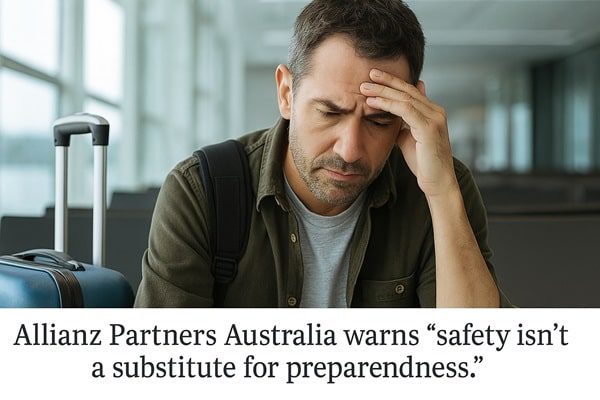
You know something’s amiss when a company like Allianz Partners sounds like a school principal warning students before a long-awaited excursion. New data from the Insurance Council of Australia (ICA) and DFAT’s Smartraveller program has revealed that one in seven Australians still head overseas without travel insurance. This statistic leaves Allianz’s executive team more than a little alarmed.
“It is concerning that those travellers who might decide against purchasing insurance are doing so because they think a destination is safe,” says Damien Arthur, Executive Head of Travel at Allianz Partners Australia. “That doesn’t take into account accidents, medical emergencies or travel interruptions, all of which can be very costly if travelling without insurance.”
A false sense of security
Australians ‘ casual confidence abroad remains unshakable despite years of campaigns and real-world cautionary tales. The ICA-DFAT survey found that 65 per cent of uninsured travellers had deliberately skipped coverage. Their reasons? Roughly a third believed their destination was safe, 27 per cent thought insurance was poor value, and 22 per cent figured they could handle emergencies on their own — an optimism that rarely survives contact with foreign hospital invoices.
Younger travellers, particularly those under 30 and Australians born overseas, were the most significant risk-takers: 23 per cent in both groups travelled uninsured on their last international trip. Many of those journeys were short-haul visits to friends and family or returns to their country of birth, where familiarity, it seems, breeds complacency.
Counting the real cost
Arthur is blunt about the stakes. “The reality is nobody plans for things to go wrong,” he says. “Even in destinations considered safe, such as Japan, medical emergencies can result in claims worth tens of thousands of dollars covering hospital care, extended accommodation, and repatriation.”
He’s not exaggerating. Allianz Partners points to the case of Melissa Borody, whose family ski holiday in Japan was derailed when a sudden illness left her in intensive care. “When I suddenly became seriously ill during a family ski trip in Japan, having Allianz there made all the difference,” Borody recalls. “Their team supported my husband and me at every step, explained what was happening, and gave us the confidence that we were being properly looked after.”
For Allianz, such examples are marketing gold, but they’re also sobering reminders of why travel insurance exists. What began as an industry convenience has become a core risk-management product for global mobility and, increasingly, a litmus test of personal responsibility.
Shifting attitudes, shifting markets
The travel-insurance business is quietly evolving into a data-driven frontier. Allianz Partners, which handles millions of policyholders globally, now uses real-time analytics and behavioural modelling to understand where coverage gaps persist.
“Every claim teaches us something,” Arthur says. “We see not just the financial impact but the human cost the anxiety, the logistical headaches, the families who don’t know what to do next. Those insights guide how we communicate the value of protection.”
That communication challenge is formidable. With international departures from Australia surpassing pre-pandemic levels, and revenge travel morphing into routine travel, the insurer must walk a fine line between education and fear-mongering. “We’re not trying to scare people,” Arthur insists, “but to help them see that safety isn’t a substitute for preparedness.”
A policy for the times
Allianz’s warning dovetails with a growing recognition that risk and recovery are inseparable for the broader travel sector. Airlines, tour operators and travel agents have all had to rebuild consumer trust after years of disruption. The insurance industry is now positioned as both the safety net and the moral voice of responsible travel.
According to the ICA, overseas hospitalisation claims can exceed AUD 50,000, while emergency repatriation to Australia can top AUD 200,000. For an uninsured traveller, that’s not a bill, it’s bankruptcy.
Yet the message struggles to land even with such numbers in black and white. Australians, famously, prefer optimism over paperwork. As Peter Costello once joked, “We’re a country that assumes she’ll be right until she isn’t.”
The trusted companion
For Allianz Partners, the challenge isn’t only selling policies; it’s the prudence of sale. The firm has spent decades positioning itself as the quiet companion in travellers’ back pockets — not glamorous, but indispensable when the unexpected strikes.
“Peace of mind has a commercial value,” says Arthur. “We’re not just protecting wallets; we’re protecting experiences. The point of travel is to enjoy it, not to worry about what could go wrong.”
A call for responsibility
As summer approaches and passport lines lengthen again, Allianz’s message is old-fashioned and forward-looking: get insured, travel smart, and don’t mistake confidence for cover. As any seasoned traveller will tell you, the numbers are too stark to ignore, and the stakes are never just financial.
For more information or to assess your own coverage options, visit www.allianz.com.au/travel-insurance.