

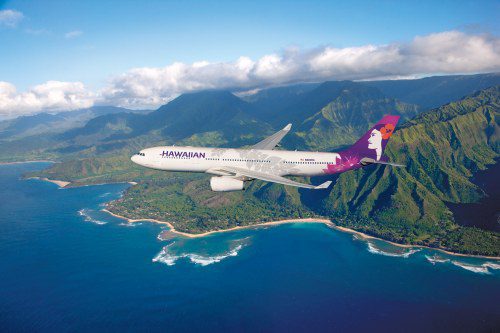
There’s something quietly reassuring about an airline reviving a route it once mothballed. In a world where network planners speak in spreadsheets and algorithms, the decision to bring back Auckland-Honolulu feels almost quaint a nod to an era when routes were built on instinct and a handshake rather than a data dashboard.
Hawaiian Airlines will once again link New Zealand and Hawaiʻi from 16 November 2025, flying three times weekly through to the end of April 2026. It’s a seasonal play, yes but one that carries the scent of a strategic experiment wrapped in nostalgia.
A calculated return to the South Pacific
The Honolulu–Auckland sector has always been a niche connector not vast enough for daily year-round service, but potent when the Southern Hemisphere’s sun is high and Kiwi wanderlust peaks.
Hawaiian has served Auckland since 2013, but the pause brought on by COVID and shifting fleet priorities gave the airline time to rethink its Pacific strategy. Now, as the carrier prepares to join the oneworld alliance in 2026, the Auckland link forms part of a broader repositioning designed to deepen connectivity with Alaska Airlines and the North American network.
“We know Kiwi travellers have long awaited the return of our seasonal service, and our crews are thrilled to welcome them onboard once again with the authentic hospitality and care for which Hawaiian Airlines is known,” says Andrew Stanbury, Regional Director South Pacific for Hawaiian Airlines and Alaska Airlines.
“Now, thanks to the strength of our combined global network, every guest flying from Hawaiʻi, the U.S. mainland and New Zealand will have more options than ever to explore the world.”
It’s the sort of confident talk that would have once sounded like standard PR fare except this time, the economics make sense.
Why the timing works
New Zealand’s outbound travel appetite is surging again. According to Stats NZ, Kiwi departures are up 14 per cent year-on-year, with strong demand to Pacific leisure markets. Meanwhile, inbound tourism to Aotearoa is recovering faster from North America than from Europe. For Hawaiian, the gap between hemispheres presents a clean opportunity: fill seats with both directions of traffic.
Operating a 278-seat Airbus A330-200 complete with 18 lie-flat Business Class seats, 68 Extra Comfort (soon to be Premium Class) seats and 192 Economy — keeps the economics sound. Each rotation offers enough capacity to capture high-yield leisure travellers and a handful of corporate customers heading to the U.S. West Coast.
And in a neat twist of modernisation, passengers will find complimentary high-speed Starlink Wi-Fi, an investment that keeps the in-flight experience competitive against the long-haul majors.
Hawaiian + Alaska = Reach
When Alaska Airlines took a stake in cooperation with Hawaiian earlier this year, analysts wondered if the integration would simply remain cosmetic. The Auckland relaunch suggests otherwise. The carriers now share the Atmos™ Rewards program a combined loyalty engine allowing travellers to earn and redeem points across more than 30 airlines through the oneworld network.
For Kiwis, that means booking a single itinerary from Auckland to Honolulu, then connecting the same day to Los Angeles, Seattle, Portland or Las Vegas all on one ticket, with loyalty accrual intact. (hawaiianairlines.com)
For Hawaiian, it means something rarer: a southern gateway that feeds traffic to its North American base without oversaturating its home hub.
The Pacific as a bridge, not a boundary
In geopolitical terms, the Pacific has once again become a contested commercial theatre airlines jostling for the same high-value transpacific dollar. Qantas and Air New Zealand dominate much of the Tasman and long-haul capacity, while United and American muscle in from the U.S. mainland. Hawaiian’s advantage lies in its brand of aloha the cultural authenticity that still differentiates it from the big players.
The Auckland service doubles as a bridge between indigenous communities, a subtle but meaningful strand in the airline’s story. Since 2013, the route has connected Māori and Native Hawaiian families and enabled Pacific businesses to collaborate more freely. That social capital gives Hawaiian a legitimacy no spreadsheet can measure.
Seasonality with purpose
There’s an honesty to seasonal flying that the industry rarely acknowledges. It allows an airline to serve a market when demand and yield justify it and bow out gracefully when the economics fade.
Operating from November through April captures peak Kiwi summer, school holidays, and the Northern Hemisphere winter-escape traffic. The schedule fits around fleet availability and high-demand U.S. mainland periods.
It also lets Hawaiian redeploy aircraft for its core Japan and California services once the season winds down. “Flexibility is the new efficiency,” one aviation consultant quipped recently and the Auckland service is proof.
Points, partners and Pacific pragmatism
For loyalty enthusiasts, Hawaiian’s growing web of partners is a story in itself. Beyond Atmos Rewards, Qantas Frequent Flyer members can now redeem Qantas Points for one-way or return flights on Hawaiian’s Auckland service, as well as onward sectors to U.S. gateways. (qantas.com/frequentflyer)
That cross-redemption deal, launched mid-2025, gives Qantas members fresh access to Honolulu without needing to transit Sydney or Brisbane. It’s a reminder that in modern aviation, alliances are as much about psychology as geography travellers like having choices that feel exclusive yet familiar.
Economics in an uncertain sky
Airlines love to talk about “resilience,” though few back the word with results. Hawaiian’s decision to keep a measured seasonal presence rather than force year-round service reflects fiscal restraint a quality increasingly rare in a sector addicted to expansion.
Analysts at CAPA Centre for Aviation note that limited duration operations can improve annual fleet utilisation without incurring new capital expenditure. By re-deploying A330s seasonally rather than acquiring new aircraft, Hawaiian keeps fixed costs flat while testing demand strength in the post-pandemic era.
It’s a strategic playbook similar to that of Singapore Airlines’ regional brand Scoot, which operates seasonally into Berlin and Athens — profitable, lean, and low-risk.
A note of realism
One might imagine a time, not long ago, when a route announcement like this would’ve drawn a shrug from the industry desk. Yet in 2025, every reinstated service carries symbolic weight. It suggests an airline confident enough to re-invest, a region steady enough to receive it, and a traveller ready to spend again.
For Kiwi travellers, Honolulu once again becomes a same-day reality rather than a two-stop odyssey. For Hawaiian, Auckland offers a well-timed pipeline of leisure demand and corporate connection. And for the aviation market, it’s proof that cautious optimism not overreach is the smarter way to fly.
A traditional close
In the end, the story isn’t really about one airline or one route. It’s about the steady hum of recovery, the return of measured ambition, and a nod to the Pacific’s enduring role as both bridge and buffer.
As Peter Needham might put it with a grin over his coffee “There’s comfort in seeing a tailfin you recognise taxi past the window again. It means the world’s turning the right way up.”
The wait, it seems, is over.
By Michelle Warner
BIO
 Michelle Warner is a storyteller with jet fuel in her veins — the sort of woman who could turn a long-haul delay into a lesson in patience and prose. She began her career in media publications, learning the craft of sharp sentences and honest storytelling, before trading deadlines for departures as a flight attendant with several major airlines. Years spent at thirty thousand feet gave her a keen eye for human nature and a deep affection for the grace and grit of travellers everywhere.
Now happily grounded, Michelle has returned to her first love, writing, with the same composure she once brought to a turbulent cabin. Her work combines an editor’s precision with a traveller’s curiosity, weaving vivid scenes and subtle humour into stories that honour the golden age of travel writing. Every line is a small act of civility, polished, poised, and unmistakably human.











