


There’s a quiet revolution underway in hotel boardrooms. It has little to do with plush pillows or loyalty points and everything to do with data, algorithms and a race to simplify systems that long ago became too complicated for their own good.
IDeaS, a SAS company and one of the better-known names in revenue management software, has released its latest Future Forecast: Hospitality Tech Predictions for 2026, an annual digest of where the hotel industry believes it’s heading. The findings point to an era of consolidation, automation and, inevitably, artificial intelligence with the promise of fewer systems, faster decisions and, perhaps, fewer headaches.
For an industry long defined by service over circuitry, it’s a striking shift.
Simplifying the System Maze
The report’s central message is simplicity, a rare virtue in technology circles. According to IDeaS’ survey, just over half of hoteliers (54 percent) currently use integrated tools. The rest, one imagines, are juggling a spaghetti bowl of booking systems, payment gateways, and channel managers that barely speak to each other.
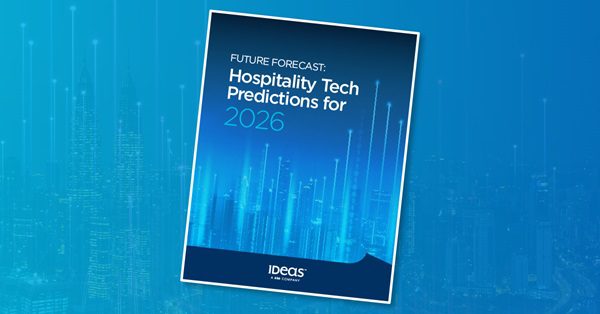
Predictions Ebook
IDeaS argues the days of running half a dozen overlapping systems are numbered. Consolidation, the report says, is not a choice but a commercial imperative. In other words, it’s time the industry that perfected efficiency at check-in did the same behind the counter.
Artificial Intelligence Moves In
Artificial intelligence, the once-distant buzzword, is now front and centre. Eighty-nine per cent of hoteliers surveyed plan to roll out new AI applications over the next two years. Most will be modest initially, with automated check-ins, predictive pricing tools, and voice-activated guest services, but the direction is clear.
The “augmented hotelier,” IDeaS calls it, is no longer a curiosity. It’s the emerging standard.
Klaus Kohlmayr, Chief Evangelist and Development Officer at IDeaS, puts it plainly:
“Hospitality is at a pivotal moment, where technology, AI and unified strategies can unlock entirely new ways of operating. This isn’t about replacing people. It’s about empowering them to simplify complexity, innovate faster, and deliver exceptional experiences that drive both profitability and sustainability.”
The notion that technology should amplify human judgment rather than replace it might sound quaint in some industries. However, it remains fundamental in hospitality.
The Commercial Convergence
Another clear signal in the report is the move toward a single commercial strategy that aligns sales, marketing, and revenue management with shared data. It’s the hotel equivalent of tuning the orchestra before the symphony begins.
In the past, each department played its own tune. Marketing pushed offers, revenue chased yields, and sales filled the rooms. Now, the pressure of real-time markets is forcing integration. Future-ready hotels, the report notes, will rely on a single source of truth for data and decisions.
The payoff? Faster reactions to market swings, tighter segmentation, and less confusion about who’s responsible when the month’s results disappoint.
Sustainability and the Workforce Question
No business forecast these days is complete without the sustainability section, and IDeaS’ report delivers it with a measure of realism. While environmental goals remain prominent in public statements, many operators still treat them as optional extras once the budget tightens. The eBook’s argument is pragmatic: sustainability and profitability are not opposing forces when guided by better forecasting and more intelligent resource allocation.
Equally pressing is the question of labour. After several turbulent years, hotels invest heavily in automation, cross-training and upskilling to steady their workforces. The aim is not simply to cut costs but to protect institutional knowledge and attract younger, tech-literate staff who see hospitality as a career rather than a stopgap.
Charting the Road Ahead
The Future Forecast also canvases the views of industry figures, including Clément Dénarié (Oaky), Katie Moro (Amadeus Hospitality), Mercedes Minghelli (TrustYou) and Werner Meyer (Busyrooms). Their collective outlook suggests a sector moving cautiously but decisively toward technological and organisational integration.
The change is notable for an industry often accused of clinging to tradition. The real challenge, as the report hints, will be balancing the warmth of service while embracing the cold logic of data.
Hospitality has always thrived on intuition knowing when to pour another coffee, when to leave a guest in peace. As 2026 approaches, the task will be to pair that instinct with information systems that make it faster, sharper and more consistent.
The human touch, it seems, will remain the industry’s most outstanding technology of all.
Read the full report at IDeaS Future Forecast 2026.
By Jason Smith
BIO:
 Jason Smith has the kind of story you can’t fake, built on long flights, new cities, and that unmistakable hum of hotel life that gets under your skin and never quite leaves. Half American, half Asian, he grew up surrounded by the steady rhythm of the tourism trade in the U.S., where his family helped others see the world long before he did.
Eager to carve out his own path, Jason packed his bags for Bangkok and the Asian Institute of Hospitality & Management, where he majored in Hotel Management and found a career and a calling. From there came years on the road, Singapore, Malaysia, Vietnam — each stop adding another thread to his craft.
He made his mark in Thailand, eventually becoming Director of Sales for one of the country’s leading hotel chains. Then came COVID-19: borders closed, flights grounded, and a new chapter began.
Back home in America, Jason turned his knack for connection into words, joining Global Travel Media to tell the stories behind the check-ins written with the same warmth and honesty that have always defined him.











