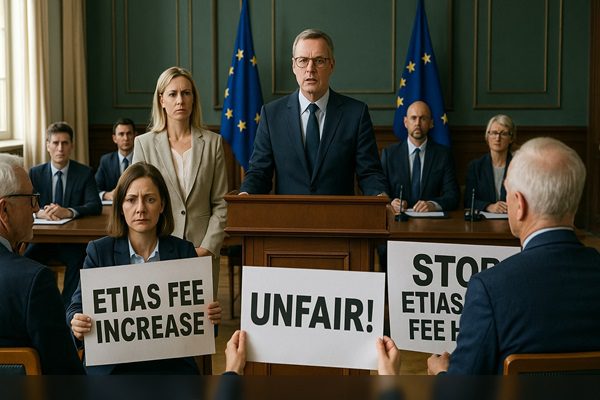
The European travel and tourism industry, still catching its breath from the pandemic’s aftershocks, economic uncertainty, and a volley of rising taxes, has now been hit with another whammy: the European Commission’s proposal to nearly triple the ETIAS travel authorisation fee, from €7 to a stonking €20.
And no, it’s not April Fool’s Day.
Slated to take effect in late 2026, ETIAS—short for the European Travel Information and Authorisation System—will require non-EU, visa-exempt travellers to apply for online clearance before entering the Schengen Area. This modernised gatekeeping system bolsters security at Europe’s external borders, much like the US ESTA or the UK’s newer ETA scheme.
However, unlike its counterparts, ETIAS seems to have adopted a pricing manual that nobody in the travel trade has ever approved.
While €20 might not sound like a princely sum to those booking five-star suites in Saint-Tropez or skiing in St. Moritz, the European tourism industry has made it crystal clear: the principle, not just the price, rankles.
A Fee Too Far?
The industry’s collective eyebrow has risen not only because of the proposed increase’s size but also because of its lack of justification. As one industry source quipped, “We don’t mind paying the bill—we just want to see the receipt.”
When the co-legislators of the European Parliament and Council originally agreed to a modest €7 fee in 2018, the travel and tourism sector supported it as a reasonable compromise—a small price to pay for security and smart borders. Fast-forward to 2025, and the Commission’s proposed €20 charge feels, in the words of industry advocates, “disproportionate” and “opaque.”
Critically, no public cost breakdown has been provided, and there is little evidence that other pricing models – say, €10 or €12 – were even considered. Instead, the Commission appears to have taken inspiration from unrelated schemes like the US ESTA (€21) or the UK ETA (£10), with little concern for whether ETIAS has comparable operational costs or legal footing for such a jump.
A Call for Clarity, Not Just Cash
Industry groups aren’t pulling any punches. Their demands are pointed and pragmatic:
-
Publish an impact assessment: The Commission is being urged to reveal what precisely makes ETIAS such an expensive system to run. What’s the actual cost? Where does the extra revenue go? Could it be done cheaper?
-
Reject the €20 fee: The European Parliament and the Council are being called upon to send the Commission back to the drawing board and settle on a more evidence-based, proportionate fee.
-
Put the surplus to good use: If the system turns a profit (which it surely will if €20 becomes the standard), then the excess revenue should be reinvested – not into Brussels bureaucracy, but into the very tourism sector bearing the brunt. Think improved infrastructure, staff training, and sustainable development. Now that would be money well spent.
The Bigger Picture: Balancing Security and Competitiveness
The ETIAS system, like its cousins abroad, isn’t inherently villainous. The industry supports smart borders – no one’s arguing against keeping Europe safe and secure. However, this fee hike, particularly without adequate justification, is considered an unnecessary financial burden, especially when Europe’s competitiveness as a travel destination is under strain.
Throw in a cocktail of geopolitical instability, high inflation, and rising overnight taxes in many popular EU cities, and you’ve got the makings of a system that might dissuade travellers instead of welcoming them.
“Every euro counts,” said one travel executive. “Especially when you’re travelling as a family. Add a €20 ETIAS fee per person, a few nights of city tax, and suddenly that charming week in Europe is looking like a pricey proposition before you’ve even booked your flights.”
The Road Ahead
The European Commission has yet to respond fully, but pressure is mounting. This is a test not just of fiscal transparency but also of how seriously the EU takes the tourism sector—a sector that generates millions of jobs and billions in revenue annually.
Will cooler heads prevail? Will the fee be scaled back to something that doesn’t feel like a tourist tollbooth?
For now, Europe’s travel industry waits – passports in hand, eyebrows raised, and calculators at the ready.
For further information on ETIAS, visit the European Commission’s official page.
By Bridget Gomez