

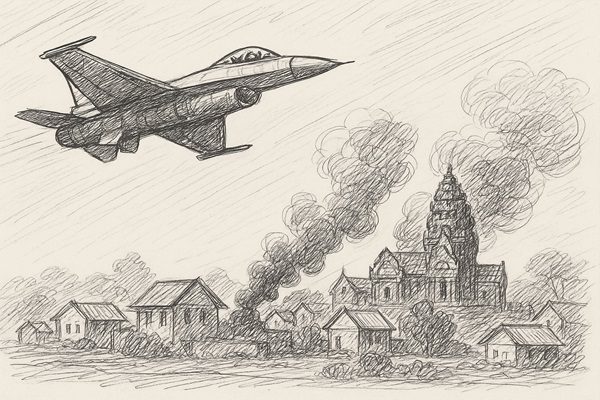
F‑16s, Landmines and Lost Tempers: The Thailand–Cambodia Border Boils Over Again.
Ah, the joys of geopolitics. When the Southeast Asian dry season was behaving itself, and travellers were returning to temple trails and tuk‑tuk tours, the old Thai–Cambodian border dispute ghosts had decided to rise—this time, with the thunderous roar of F‑16s overhead.
Now, before anyone cancels their hotel in Siem Reap or rebooks that flight to Ubon Ratchathani, let’s breathe. Yes, it’s serious. Yes, military strikes have occurred. But no, the region isn’t descending into all-out war—yet.
Let’s dig in, shall we? And no, I don’t mean digging trenches. That’s for the troops.
A Border Dispute With an Unwelcome Sequel
It all started (again) at about 8:20 a.m. on July 24 in the misty borderlands between Oddar Meanchey Province in Cambodia and Surin Province in Thailand. We’ve not seen artillery shells, rocket fire, or chest-thumping military manoeuvres since the last time this argument boiled over.
For the history buffs out there, this is no fresh quarrel. It’s a decades-old debacle about temple territory—specifically, who claims ancient religious sites like Ta Muen Thom and the far more famous Preah Vihear, perched cliffside like a stone-clad middle finger daring someone to claim it.
The International Court of Justice ruled this way back in 1962 (and again in 2013). But as anyone who’s tried to settle a family inheritance dispute knows, what’s written in law doesn’t always fly at the family BBQ. In this case, the “family” is armed with tanks, mortars, and fighter jets.
F‑16s in the Fray
Now here’s where things go supersonic—literally.
Just before midday on July 24, Thailand launched six F‑16 fighter jets from Ubon Ratchathani Air Force Base, targeting what the Thai military described as “Cambodian military installations.” According to Col Ritcha Suksuwanon, deputy spokesperson for the Royal Thai Army, the strikes were “calculated” and “essential” to retaliate after Cambodian troops allegedly fired at a Thai military base earlier that morning.
Cambodia, meanwhile, was less than thrilled. Government officials condemned the airstrikes as a “clear violation of sovereignty” and claimed the bombs didn’t just hit soldiers—they landed dangerously close to a hospital, residential homes and even a school. A child was among the casualties.
That’s right. At least 11 civilians have died in the chaos, including a young boy, with dozens more injured and thousands displaced. And if that doesn’t make your blood run cold, it should.
Landmines, Lies and the Line Between
Adding to the drama, Thai forces accuse Cambodia of planting new landmines near the border in Surin, which maimed five Thai soldiers on patrol. One lost a leg.
The Cambodian side figuratively shot back, saying the mines are leftover relics from the Cold War era. “We didn’t put them there,” they said. “They’ve always been there.” As excuses go, that’s like claiming the milk was sour before you poured it.
Meanwhile, more than 40,000 people have now been evacuated from affected zones. Border crossings in Buriram, Surin, Si Sa Ket, and Ubon Ratchathani are sealed tighter than a durian in a minibar.
Travel Advice: Reconsider That Border Adventure
Here’s the part where your humble correspondent puts on his travel writer hat (yes, it’s Panama straw).
If your plans involve wandering anywhere near the Thai–Cambodia border right now—especially through Buriram, Surin, Si Sa Ket, and Ubon Ratchathani—reconsider immediately. That’s not just me talking; that’s official advice from the Australian Government via Smart Traveller: smartraveller.gov.au/thailand.
And now, as of this week, the Royal Thai Army has temporarily closed several land border checkpoints in remote pockets of Ubon Ratchathani and Surin provinces. These closures are described as geographically restricted, so it won’t affect your plans to sip mango smoothies in Bangkok or chase waterfalls in Chiang Mai.
The Tourism Authority of Thailand and Cambodian authorities have issued statements reassuring travellers that all major tourist destinations remain safe and stable, with no disruption to flights, transfers or local hospitality. The usual caveats apply—stay informed, follow local guidance, and perhaps skip any detours into mine-riddled jungle zones.
Phuket International Airport, meanwhile, remains operational but on heightened alert after an explosive device was discovered earlier this month—part of a broader concern over sporadic terror threats in Thailand’s more touristy corners. Arrive early, stay vigilant, and avoid unattended drinks in bars—basic advice that’s never gone out of fashion.
In short, the country is open. Your travel dreams are still intact. Just steer clear of the flashpoints, mind the travel advisories, and save your jungle trekking for places not peppered with landmines.
A Diplomatic Donnybrook
As if missiles weren’t enough, we now have a good old-fashioned diplomatic tiff.
-
Thailand has expelled Cambodia’s ambassador in Bangkok.
-
Cambodia has done the same to Thailand’s envoy in Phnom Penh.
-
Both sides are lobbying the UN Security Council, with Cambodia playing the victim and Thailand presenting itself as the reluctant responder.
If it weren’t so tragic, it’d make great theatre.
And Yet, Life Goes On…
Despite the headlines, life in most parts of both countries ticks along. Tour groups are still clinking glasses over pad Thai in Chiang Mai. Monks in saffron robes still chant beneath ancient spires. The border dispute may roar along the fringes, but the heart of these two nations beats on.
The trouble is, when borders burn, everyone nearby catches a whiff of the smoke. And when fighter jets take off from regional air bases, travellers get nervous—and rightly so.
Final Word from Kanda
What does one say in the face of such familiar chaos?
We’ve seen it before. We’ll see it again. The Thai–Cambodian border is like that neighbourly feud over the fence that never quite ends. Only this one involves artillery shells and international condemnation.
So please—don’t be reckless. Follow the advice. Stay out of border zones. Support peace. Respect the culture. And maybe—just maybe—read the room before posting that temple selfie.
This isn’t just about territory. It’s about dignity. And as history so often shows, the innocents always pay the highest price when old grudges erupt into new wars.
Until then, as ever, safe travels—and may your next border crossing be stamped with peace, not shrapnel.











