

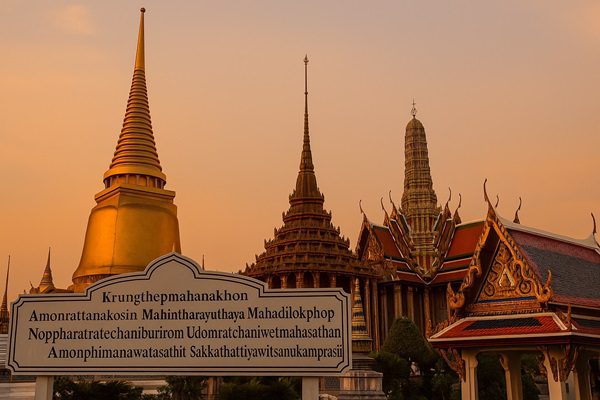
Forget everything you thought you knew about Bangkok. The bustling Thai capital—renowned for its tuk-tuks, temples, and tantalising street food—has been quietly harbouring a secret for over two centuries: a name so long, so lyrical, and so utterly extravagant it could make even a Welsh town blush.
Behold the world’s longest city name:
Krungthepmahanakhon Amonrattanakosin Mahintharayuthaya Mahadilokphop
Noppharatratchathaniburirom Udomratchaniwetmahasathan Amonphimanawatansathit
Sakkathattiyawitsanukamprasit.
That’s not a typo. It’s a 168-letter ceremonial moniker that most locals wouldn’t dare attempt after a few Chang beers, let alone recite before breakfast.
From “Bang Makok” to “City of Angels”
The Bangkok we casually name-drop on boarding passes and Instagram captions actually began life as Bang Makok, which means “place of olive plums.” Hardly the stuff of legend.
But in 1782, when King Rama I declared the eastern bank of the Chao Phraya River the new capital of Siam, a name of far greater grandeur was summoned. Inspired by the ancient courts of Ayutthaya and steeped in Pali and Sanskrit, the ceremonial name was crafted as both blessing and proclamation—part poetry, part statecraft, and entirely over the top.
The shorthand version still used formally today is Krung Thep Maha Nakhon, or “City of Angels,” which might ring a celestial bell for fans of Los Angeles. But unlike its Hollywood cousin, Bangkok’s angelic allusion comes with centuries of royal reverence, not red carpets.
Translating the Majesty
For the brave—or the linguistically masochistic—here’s a loosely translated interpretation of the full name:
“The city of angels, the great city of immortals, the magnificent city of the nine gems, the seat of the king, the city of royal palaces, home of gods incarnate, erected by Vishvakarman at Indra’s behest.”
You read that right: deities, royal palaces, immortals, sacred architecture—even the divine architect Vishvakarman gets a nod, working to spec from no less than Indra, king of the gods. Eat your heart out, Canberra.
Why So Long?
In traditional Siamese custom, especially during the Rattanakosin period, names were a form of reverence—not just labels but legacies. Bangkok’s full name is a verbal mural—a word palace in its own right. It reflects not only religious values and political aspirations but also Thailand’s enduring respect for the monarchy, Buddhist-Hindu heritage, and love of florid ceremony.
Much like the inscriptions in a royal temple, this name was not meant to be convenient, but to elevate.
In short, it’s not a name. It’s a national epic.
Still in Use? Well, Sort of…
Today, the mouthful that is Bangkok’s full name is rarely spoken, except on special occasions—or by determined schoolchildren hoping to impress their teachers. Most Thais say Krung Thep, while official documents use Krung Thep Maha Nakhon.
The full name remains a curiosity, a cultural artefact that occasionally surfaces on tourism campaigns or Guinness World Record lists.
You’ll find it printed in some Thai schoolbooks and taught in classrooms, but no one has updated their GPS yet.
Comparisons: The Runners-Up
Of course, Bangkok has competition. That charming Welsh village Llanfairpwllgwyngyllgogerychwyrndrobwllllantysiliogogogoch offers a hefty 58 letters of consonantal challenge. Meanwhile, a hill in New Zealand—Taumatawhakatangihangakoauauotamateapokaiwhenuakitanatahu—claims the title for the longest place name in an English-speaking country.
But these are place names, not cities. Regarding sheer ceremonial verbosity for an actual metropolis, Bangkok reigns supreme, tiara and all.
Why It Still Matters
In an age of abbreviations, emojis, and hashtags, Bangkok’s formal name proudly reminds us of the power of tradition, of a time when words were wielded like swords and syllables could shape empires.
It’s not just about length. It’s about identity—giving a city the dignity of poetry, invoking gods and kings, not just concrete and traffic.
In that sense, Bangkok’s name is a living relic—a glorious, extravagant bow to the past.
Final Thought
So next time you breeze through Suvarnabhumi Airport, remember this: you’re not just arriving in a city of nightlife and noodles. You’re stepping into the City of Angels, the Great City of Immortals, the Magnificent Jewel of the World—a city whose very name could double as a prayer, a poem, or perhaps, just perhaps, a tongue-twister for the ages.
Now, try saying it three times fast.











