
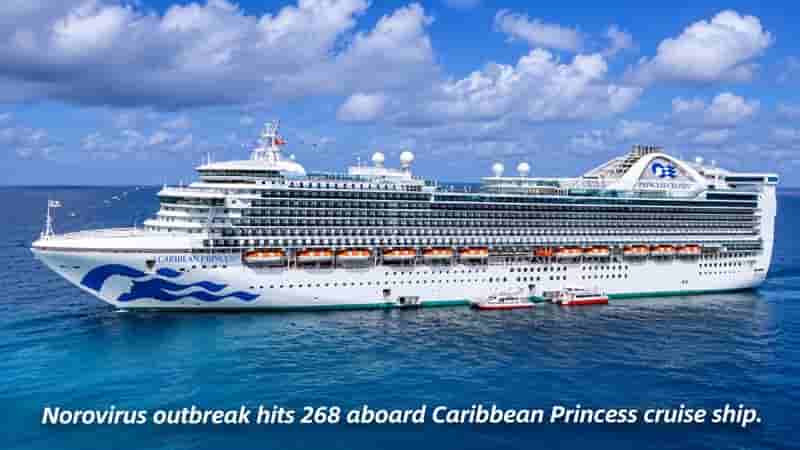
Princess Cruises records its fourth CDC-listed norovirus outbreak of 2026, with 753 cases of gastrointestinal illness reported across four affected voyages.
The figures are moving in the wrong direction for Princess Cruises. What began as an outbreak of gastrointestinal illness affecting 148 people aboard Caribbean Princess has climbed to 268, with US health authorities confirming norovirus as the culprit.
More troubling for the Carnival-owned cruise operator is that this represents the fourth norovirus outbreak aboard a Princess vessel recorded by US authorities this year and the second involving Caribbean Princess.
The ship returned to Port Everglades, Florida, on Monday, 23 November, following a 12-night voyage through the Caribbean and Central America.
In an updated report published on 24 November, the US Centres for Disease Control and Prevention (CDC) confirmed that 233 of the ship’s 2,936 passengers had reported illness, representing 7.9 per cent of guests.
A further 35 of its 1,132 crew members reported illness, accounting for 3.1 per cent of shipboard personnel.
Vomiting and diarrhoea were the predominant symptoms.
The outbreak, involving voyage B638, was first reported to the CDC’s Vessel Sanitation Program on 15 November, four days after departure. Authorities published their initial findings on 17 November.
Importantly, the revised figures represent cumulative cases throughout the voyage. They do not mean that 268 people were ill simultaneously.
Even so, it is hardly the sort of upward trend any cruise company wishes to see.
Four outbreaks and 753 reported cases
The latest incident becomes considerably more significant when viewed alongside Princess Cruises’ other reported outbreaks this year.
An examination of the CDC’s 2026 cruise ship outbreak register reveals four norovirus incidents involving the operator:
- Star Princess, 7–14 March: 193 cases.
- Caribbean Princess, 28 April–11 May: 160 cases.
- Ruby Princess, 12 June–2 July: 132 cases.
- Caribbean Princess, 11–23 November: 268 cases.
Collectively, the four voyages account for 753 reported cases, comprising 626 passengers and 127 crew members.
The latest outbreak is the largest recorded aboard a Princess Cruises vessel by the CDC this year.
Princess also accounts for four of the 10 gastrointestinal illness outbreaks currently appearing on the agency’s 2026 register.
Those figures deserve attention, but they require context.
The register covers voyages falling within the CDC’s jurisdiction, generally involving US and foreign ports. Outbreaks are ordinarily published when at least three per cent of passengers or crew report qualifying symptoms, although authorities may publish other incidents of public health significance.
The figures are not a worldwide tally, nor do they establish that Princess has inferior sanitation standards to competing cruise lines.
Such a conclusion would require considerably more data, including passenger volumes, voyage lengths and comparable illness rates across operators.
Princess responds as authorities investigate
In a statement reported by CBS News Miami on 23 November, Princess Cruises said:
“Our crew responded promptly by implementing enhanced sanitation protocols across the ship, including comprehensive cleaning and disinfection measures.”
The statement preceded the CDC’s revised figures.
According to health authorities, the ship intensified its disinfection procedures, isolated affected passengers and crew, collected specimens for testing and consulted officials on outbreak management.
CDC specialists also conducted an environmental assessment and investigation to help contain the outbreak.
The publicly available report does not identify how the virus was introduced aboard the vessel or establish that contaminated food, inadequate sanitation or any particular individual was responsible.
Nevertheless, the recurrence aboard the same ship within seven months raises reasonable questions about what additional preventive measures might be introduced.
Cruising hardly has a monopoly on norovirus
For all the attention cruise ship outbreaks attract, norovirus is hardly exclusive to holidays at sea.
Hospitals, schools, aged-care facilities, hotels and restaurants are equally familiar with its unwelcome presence.
Indeed, the CDC estimates that cruise ships account for only about one per cent of reported norovirus outbreaks.
The virus spreads readily between people and through contaminated surfaces, food and water. Its ability to survive some routine cleaning procedures makes it particularly challenging to contain.
Most sufferers recover within one to three days, although dehydration can present serious complications, particularly for older travellers and people with underlying health conditions.
A cruise ship accommodating several thousand people, many sharing dining rooms, lifts and entertainment venues, presents considerable challenges once an infection takes hold.
That does not make cruising inherently unsafe. It does make effective infection prevention and prompt reporting particularly important.
What Australian travellers should know
For Australians contemplating a cruise, the latest incident reinforces the value of some decidedly traditional precautions.
Regular handwashing with soap and water, particularly before meals and after using the toilet, remains one of the most effective defences against norovirus.
Alcohol-based hand sanitiser alone is not an adequate substitute.
Passengers experiencing symptoms should contact the ship’s medical centre promptly, maintain hydration and follow medical advice and isolation requirements.
Comprehensive travel insurance covering cruising, onboard medical treatment and emergency evacuation is also essential.
The Australian Government’s Smartraveller website provides valuable guidance for prospective cruise passengers.
As always, consult your trusted travel advisor first.
Passenger confidence is the real test
For Princess Cruises, part of Carnival Corporation, the challenge extends beyond managing a highly contagious virus.
It lies in reassuring passengers that lessons from previous outbreaks are informing future preventive measures.
The cruise industry has spent billions developing spectacular ships, extravagant accommodation, sophisticated restaurants and entertainment facilities that would put some land-based resorts to shame.
Yet sometimes the most important facility aboard a multimillion-dollar cruise ship remains the humble hand basin.
By: Jason Smith – © 2026.
Read Time: 5 minutes.
Author Bio:
 Jason Smith didn’t learn travel from textbooks. He learned it in airports, taxis and hotel lobbies, watching the business unfold long before he played his own part. Half American, half Asian, he grew up around the quiet workings of tourism, where people come and go, and stories rarely stand still.
Bangkok came first, then formal study, then a career that carried him through Singapore, Malaysia and Vietnam. Each place left something behind. In the end, Thailand felt like home, along with a senior role in hotel sales.
Then everything stopped. Borders shut, planes grounded, and Jason found himself back in America with time to reflect.
Now at Stephen’s EGT Media, he writes travel as it really is, not polished, not perfect, but human, and all the better for it.