
Seven safety investigations, mounting scrutiny of air traffic control and another runway scare raise awkward questions ahead of Australia’s Christmas travel rush.
There are several things passengers on a flight from Melbourne to Sydney might reasonably expect. Turbulence, a reluctant baggage carousel and perhaps a lengthy wait for a taxi.
An Air New Zealand Airbus crossing the runway as their aircraft approaches to land is not generally among them.
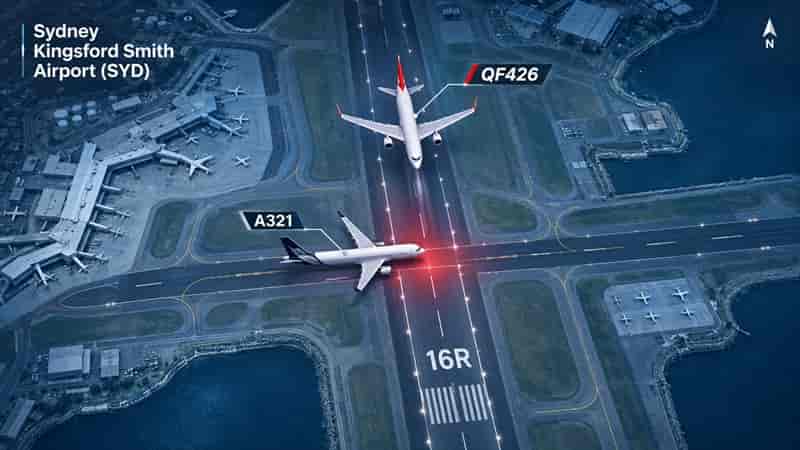
Yet that was the situation confronting the pilots of Qantas flight QF426 shortly before 10.15 am on Wednesday, 25 November, at Sydney Kingsford Smith Airport.
The crew abandoned the approach, climbed away and subsequently landed safely.
Nobody was injured, neither aircraft sustained damage, and the travelling public has been spared anything more serious than another unsettling aviation headline.
For the Australian Transport Safety Bureau (ATSB), however, it means a seventh investigation into aircraft conflict or separation issues at Sydney since July.
That is becoming quite a collection.
The latest occurrence involved a Qantas Boeing 737-800, registered VH-VZP, and an Air New Zealand Airbus A321neo, registered ZK-NNH, scheduled to fly to Auckland.
According to the ATSB’s official statement, the Qantas crew had been warned to expect delayed landing clearance on runway 16R because aircraft were crossing it.
The pilots observed the Air New Zealand aircraft crossing the runway at taxiway Golf and elected to discontinue their approach before receiving landing clearance.
Qantas said its crew had followed air traffic control instructions and confirmed it would assist investigators.
Airservices Australia, responsible for the country’s air traffic control services, has also undertaken to cooperate.
A go-around, it should be stressed, is neither an emergency in itself nor evidence that disaster was narrowly averted. Pilots train extensively for the manoeuvre, and passengers are considerably better served by a captain prepared to abandon an approach than one unduly attached to the timetable.
The interesting question is why this particular go-around has attracted the attention of Australia’s aviation safety investigators.
The answer lies partly in what has been happening at Sydney over the past four months.
Eleven incidents, three were expected
A statistical study published by the ATSB in September provides some rather sobering context.
During July and August, Sydney Airport recorded 11 runway and taxiway conflict occurrences. Based on aircraft movements and historical experience, investigators would ordinarily have expected about three.
August alone produced seven reported occurrences, the highest monthly total recorded at Sydney during the period examined.
The bureau’s research into Australia’s five major airports covered more than a decade, from January 2016 to August 2026.
Sydney’s long-term conflict rate was reasonably close to the average, although its post-pandemic rate was about 20% higher than the combined average.
More disturbing was the severity of some recent occurrences.
A runway incursion on 27 July involving a Qantas Boeing 737 and a QantasLink Dash 8 received the highest severity classification available for such an event.
It was the first occurrence of that severity recorded at Sydney since records began in 2003.
In August, a Jetstar flight attendant sustained a fractured wrist when an aircraft braked abruptly during a taxiing conflict involving a Qatar Airways Boeing 777.
The figures deserve attention, particularly as Sydney is preparing for the annual Christmas and summer holiday rush.
Australia’s busiest airport has never been a particularly forgiving place for operational mistakes. Its intersecting runways, enormous traffic volumes and complex operating environment demand an exceptional degree of coordination.
That is precisely why the performance of the people and systems providing that coordination matters so much.
Trouble in the tower?
Air traffic control staffing has emerged as a recurring subject of inquiry in the ATSB’s earlier Sydney investigations.
Among the matters being examined are overtime, the allocation of multiple operational responsibilities to individual controllers and the demands of training and supervision alongside routine duties.
There is also the delicate issue of fatigue.
Airservices’ own roster modelling predicted elevated fatigue risks for personnel at the time of several earlier occurrences.
On 30 September, ATSB Chief Commissioner Angus Mitchell made an important distinction, explaining that “an elevated fatigue risk in and of itself does not mean a controller was fatigued”.
Nor does it establish that fatigue affected anyone’s performance.
There is no evidence publicly available at present establishing that fatigue, staffing shortages or controller error contributed to Wednesday’s Qantas occurrence.
Nevertheless, investigators intend to establish whether the latest incident shares underlying factors with the earlier events.
They will examine recorded communications, available CCTV, operational records and, significantly, what both flight crews understood about the situation confronting them.
A preliminary report is expected in approximately eight weeks. The final report is anticipated in the second quarter of 2027.
Canberra enters the picture
Federal Transport Minister Catherine King announced an independent assurance panel on 30 September to oversee Airservices’ efforts to strengthen Sydney’s air traffic control operations.
Chaired by retired Air Vice Marshal Ken Robinson AM, the panel complements an existing government-led working group involving airlines, regulators, unions and Sydney Airport.
Recruitment, training, workforce planning and more resilient rostering arrangements are among the priorities.
Airservices’ October aviation network report, published on 18 November, presented some encouraging operational results, including historically low cancellation levels and no ground delays attributed to Airservices across the network during October.
That is welcome news, although punctuality and safety are two quite different measures of success.
An aircraft arriving ten minutes late inconveniences passengers. An inadequately managed safety risk carries rather different implications.
The distinction matters more now that Western Sydney International Airport has joined the region’s passenger aviation network, adding another dimension to an already complex operating environment.
There is no suggestion that the new airport contributed to Wednesday’s incident.
Confidence is not negotiable
The Civil Aviation Safety Authority (CASA) stated on 30 September:
“CASA considers that Australia’s aviation system and Sydney Airport remain safe.”
The regulator is also conducting a safety assurance review.
For travel advisors reassuring clients ahead of Christmas, the distinction between an investigated safety occurrence and evidence that an airport is unsafe is particularly important.
Wednesday’s incident demonstrated that one of aviation’s essential safeguards worked.
Australia’s enviable aviation safety reputation rests on generations of professional expertise, exacting standards and a willingness to investigate incidents before they become accidents.
The Qantas crew exercised its judgement. The ATSB is now exercising its scrutiny.
Airservices and the government must demonstrate that the lessons emerging from these investigations translate into lasting operational improvements.
Seven investigations do not constitute seven narrowly avoided disasters.
They do, however, constitute seven very good reasons to pay attention.
By: Michelle Warner – © 2026.
Read Time: 5 minutes.
Author Bio:
 Michelle Warner has always carried stories the way others carry passports lightly, faithfully, and with purpose. She learned her craft in newsrooms, shaping sentences with care, before swapping deadlines for departures as a flight attendant with some of the world’s great airlines. Years aloft sharpened her eye for character and deepened her fondness for the small, dignified rituals of travel, the quiet kindness of strangers, the poetry of arrival, the patience learned between time zones.
Now grounded by choice, Michelle has come home to writing with the same calm authority she once brought to turbulent cabins. Her prose blends an editor’s discipline with a traveller’s wonder, tinged with humour and reverence for the golden age of travel. Each piece feels like a handwritten boarding pass, gracious, observant, and unmistakably alive.