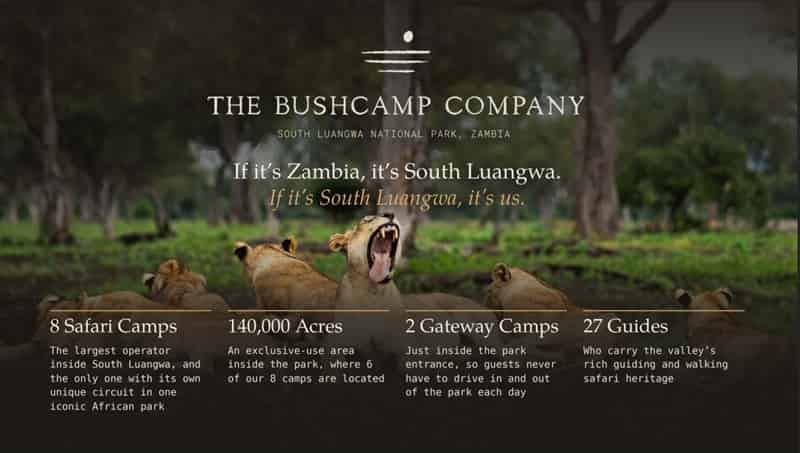
Zambia’s Bushcamp Company is turning one national park into a complete luxury safari journey, with eight properties, expert guides and no need for flights between camps.
Africa has no shortage of luxury safari lodges. The real challenge is often getting from one to the next without spending half the holiday in the air. In Zambia, The Bushcamp Company is making a strong case for staying put, at least when the place in question is South Luangwa National Park.
Its pitch is simple: eight properties within one park, six remote bush camps, 27 guides, and a 140,000-acre exclusive-use area. Guests can travel between camps by game drive or guided walk. There is no need for another internal flight once the circuit begins.
For Australian travel advisers selling a South Luangwa safari, that is more than a neat map. It offers one destination with several styles of stay, fewer transfer headaches and more time where the wildlife actually lives.
One park, eight ways to see it
Founded in 1999, The Bushcamp Company describes itself as the largest safari operator within South Luangwa. Its six remote camps sit in an exclusive-use area of about 56,700 hectares in the park’s southern sector. The two gateway properties, Mfuwe Lodge and The Villas at KuKaya, are also inside the park, near its entrance.
This is not a promise of exclusive access to all of South Luangwa. It is a circuit that links a private operating area with two established bases. That distinction matters, particularly when an agent is comparing safari products on more than a photograph of a lion.
Guests might begin at Mfuwe, move deeper into the bush and finish at a different camp. The journey is part of the experience. A drive can turn into a game-viewing session; a walk, where offered, brings the smaller details of the landscape into focus. No one needs to schedule a flight to discover the next chapter.
And there is a considerable story to tell. South Luangwa National Park is known for elephants, lions, hippos and rich birdlife. It is also a stronghold of the walking safari, a tradition linked to conservation pioneer Norman Carr in the 1950s.
An elephant at reception? Quite possibly
Mfuwe Lodge supplies the circuit with its most famous opening act. Elephants are known to pass through its reception area during their seasonal movements. Most hotels discourage unannounced visitors. Here, the visitors are rather large and have the right of way.
Set between two lagoons, the lodge offers thatched accommodation, air-conditioning, a pool and spa. It also brings serious credentials. In Travel + Leisure’s 2025 reader-voted awards, Mfuwe ranked third among hotels worldwide and second among African safari lodges. Those are 2025 results, not claims about the latest awards.
Nearby, The Villas at KuKaya take a more private route. Each villa has its own pool and outdoor shower, while bookings include a dedicated guide and safari vehicle. The product is aimed at families and groups who want control over their days without having to organise every detail themselves.
There is also the Family House on the Mfuwe Lodge grounds. Its two connecting en-suite bedrooms, private pool, garden and outdoor cooking areas offer another option for small parties. It is accommodation within the lodge grounds, not a ninth camp on the circuit.
Six bushcamps, no carbon copies
The six remote properties have distinct settings, which helps travel advisers match the right guest to the right camp.
Kuyenda, associated with veteran guide Phil Berry, has five thatched chalets facing open plains and a natural spring. Chamilandu is more dramatic: just three raised treehouse chalets look across the Luangwa River, where elephants and hippos may provide the evening entertainment.
At Chindeni, four elevated tents stand beneath ebony trees near a lagoon and the Chindeni Hills. Bilimungwe has four thatched chalets by a permanent waterhole. Wildlife often comes to drink, leaving guests with little reason to rush anywhere.
Kapamba adds riverside chalets, plunge pools and two raised star beds. Zungulila, the company’s deepest camp, puts walking safaris at the centre of the stay. Both offer the appeal of nights in the bush without turning comfort into an endurance test.
The company’s brochure also lists seven properties in Condé Nast Traveler’s 2025 Rest of Africa resort top 15. Chamilandu is ranked fourth, Chindeni sixth and Zungulila eighth. Reader polls are not a substitute for an inspection, but those results offer some comfort when selling a camp with only three rooms.
The small scale is deliberate. Some camps have only three or four chalets, so an itinerary can feel personal rather than crowded. The trade-off is limited capacity, especially during popular safari months. Early planning remains sensible.
The guides are the real luxury
Luxury is easy to photograph. Good guiding is harder to capture in a brochure, but it often decides whether a safari stays with a traveller long after the photographs have been filed away.
The company lists 27 guides across its operation. Their work spans morning and afternoon drives, optional walking safaris and night drives, when different animals become active. Sundowners provide the usual pause to admire the landscape, with a drink that is unlikely to improve anyone’s ability to identify bird calls.
A collection of optional heritage experiences adds local context. These include farm-to-table visits, a bush dinner themed around Dr Livingstone, a field-camp experience linked to Norman Carr, and visits connected to community projects. These are add-ons, not activities that every guest automatically receives.
The conservation question
A safari operator working inside a national park must offer more than attractive rooms and strong sightings. The Bushcamp Company says its community and conservation work supports clean-water projects, school meals, education and partners involved in anti-poaching efforts.
Those programmes deserve attention, but so does clear reporting. They are initiatives described by the operator, not independently audited outcomes in its trade overview. Travel advisers can ask how guest contributions are calculated and which projects receive support. Responsible tourism should withstand good questions.
When to go, and what to check
The two gateway properties operate year-round. The six remote camps run seasonal schedules, generally from May or June until 1 November, depending on the camp. This makes the circuit especially relevant to dry-season safari planning, while Mfuwe and KuKaya provide options outside those dates.
Mfuwe Airport is the usual arrival point. The company lists about 40 minutes by road to the gateway properties and longer transfers to remote camps. Travellers can reach Mfuwe on scheduled services from Lusaka, subject to airline timetables.
The trade brochure includes indicative dollar prices, but does not give a clear charging basis for every quoted figure. Australian agents should confirm the currency, per-person or per-villa terms, park fees, inclusions and current season rates before publishing a package price. The company has separate 2026 and 2027 rate information for the trade.
The real prize is not another pin on an African safari map. It is more time in one remarkable place. The company’s brochure declares: “If it’s Zambia, it’s South Luangwa. If it’s South Luangwa, it’s us.” An ambitious claim, certainly. But with eight camps and no need for flights between them, it has built a persuasive case.
By: Alison Jenkins – © 2026.
Read Time: 6 minutes.
Author Bio:
 Alison Jenkins has lived most of her working life in the slipstream of aviation, where timetables matter, and people matter more. In airline sales, she built a reputation the old-fashioned way: by knowing her clients, her routes, and never missing the human detail.
Quick with a smile, quicker with a solution, she made deals with warmth and kept her edge intact.
Trade shows, FAM’s, airport lounges and hotel lobbies became her second address. And somewhere along the way, notebook in hand, she began writing the journeys rather than selling them. Her reports grew lively, observant, full of the small truths only travellers notice.
That was the moment it dawned on her: she wasn’t simply travelling. She belonged in its stories.