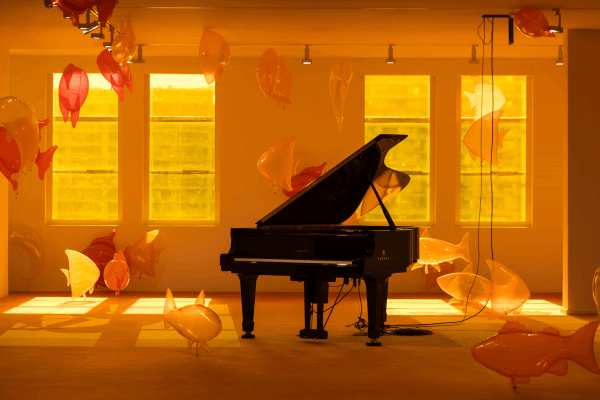
Philippe Parreno: 5 Moons opens this Saturday at the Museum of Contemporary Art Australia (MCA Australia). It is the first major exhibition in Australia by the celebrated French artist. Part of the Sydney International Art Series 2026–27, it runs for five months, from 21 November 2026 to 26 April 2027.
Parreno takes the exhibition itself as his medium and places its construction at the heart of the work. 5 Moons is conceived not as a setting but as a milieu: an active fabric spread across all three floors of the MCA, in which everything acts on everything else. Film, sculpture, sound and light, drawn from a career of more than three decades, respond to one another – and to events unfolding live on the other side of the world. There is no single starting point and no hierarchy: simple local rules give rise to patterns no one can fully predict. Parreno builds the conditions for a life, then lets that life unfold without him.
From the Tabernas Desert to Warrane/Sydney Harbour
At the centre of the exhibition is 5 Moons, a new film co-produced with MCA Australia. It sets the compositional score for the entire exhibition. The film was shot at El Almendral, an abandoned almond farm on the edge of the Tabernas Desert in southern Spain – a landscape long used by European westerns as a stand-in for the American West.
At the heart of the farm stands a meteorological tower. Together with a network of sensors and microphones spread across the land and into the soil, it turns the farm into an observatory. Day and night, it records wind, light, heat, humidity, rain and the faint vibrations of the ground.
These readings travel live to Sydney. When a gust crosses the hills, an animal passes or the air turns humid, the observatory sends cues that change the light, sound and atmosphere across the exhibition in real time. The images were filmed in Spain and are fixed; the conditions in which they appear are set by the desert’s present. For five months and five lunar cycles, an almond farm in Almería becomes a landscape on the shores of Warrane/Sydney Harbour.
In their words
‘Tabernas comes to Sydney not as a film set, but as a climatic condition – a migration of light, sand, heat and silence,’ said Philippe Parreno. ‘What is filmed there – the dry hills, the mineral folds, the traces of abandoned westerns, the scorched grasses, the shadeless roads – is deposited here, as if the desert had changed hemispheres. It is not a representation of the desert, but its relocation: an almond orchard in Almería becomes a landscape in Sydney. The film pours into the city like a hot wind from another time.’
Suzanne Cotter, Director, MCA Australia and exhibition curator, said: ‘Philippe Parreno has fundamentally changed the way we think about art. Rather than presenting artworks as static objects, he creates living environments where sound, light, architecture, moving image and people become part of a changing experience in time. We are delighted to present his first major Australian exhibition at MCA Australia and to share such a significant work by this visionary artist with audiences as part of the Sydney International Art Series.’
Across the Museum
Among the more recent works on view is Otherwhence (Ineluctable Modality of the Visible), shown in the MCA’s Lecture Theatre. The film turns the camera on a cuttlefish and exposes us to its gaze and attention. Constantly changing colour and shape, the creature never stops looking back at us.
The exhibition extends across the Macgregor Gallery on Level 1, the Lecture Theatre on Level 2 and the International Galleries on Level 3. Other non-gallery spaces across the Museum are activated at specific times. It was produced largely on site by lighting, sound and computer engineers from Parreno’s studio in Paris, working alongside the MCA exhibition team.