Wilderness Serra Cafema, set on the banks of the perennial Kunene River, where it forms Namibia’s border with Angola, will reopen on 01 December following a careful rebuild.
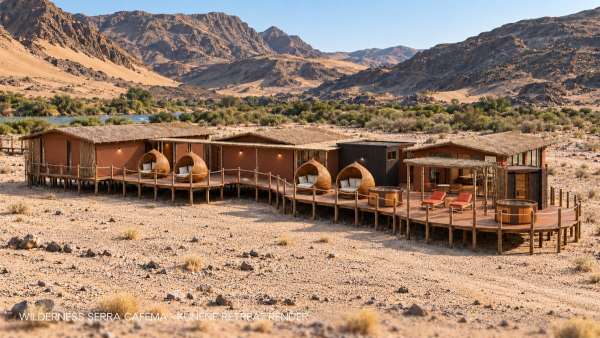
The fire damaged parts of the camp, but rather than reinvent Serra Cafema, the rebuild was designed to preserve the spirit and sense of place that have long defined it, while making even more of its sublime riverside setting. The new main area of the camp is a single, long structure designed to maximise frontage onto the Kunene River, with the boat ramp set off-centre so nothing interrupts the view. Built from wood, canvas, glass and aluminium, it brings the landscape inside, while interiors by Artichoke take their colours from the river, mountains and dunes. Where the original camp was pared back, the new space feels warmer and more layered, with hanging lights, a lounge lined with books and a variety of spaces for guests to settle into. At its heart, a central island bar is flanked by the restaurant on one side and two lounges on the other, separated by a large two-way fireplace. The fire circle remains at the centre of the main deck.
The palette also draws on the Himba, one of Namibia’s last semi-nomadic peoples, who number roughly 50,000 across northern Namibia and Angola. Himba life centres on their cattle and on a holy fire, around which families commune with their ancestors. Himba women are known for otjize, a mix of crushed red ochre and fat used to cleanse, moisturise and beautify the skin, and its rich ochre tones are echoed throughout the camp.
Of the camp’s eight suites – seven twins and one family suite – four have been rebuilt, keeping their much-loved original lines, but now with slightly larger bathrooms. Each rebuilt suite opens onto a small private deck, with a larger main deck in front of an outdoor sala, where oversized Himba- and Kunene-inspired portraits now hang alongside a minibar and coffee station. In the four original suites, the minibar and coffee station will also move out to the sala, and all eight suites will have air conditioning.
Introducing the Kunene Retreat
The most notable addition is the Kunene Retreat, the camp’s first dedicated wellness space, created around four ideas: recovery, movement, treatment and quiet reflection. It features two treatment rooms, a sauna, a gym and two hot and cold plunge pools known as Ami Pods. The retreat has been designed to frame the elements that define Serra Cafema, using shade, privacy and orientation to make the landscape part of the experience, with the Himba colour palette tying it to the rest of the camp. In a place defined by opposites – water and desert, softness and harshness, movement and stillness – a retreat built around contrast feels entirely at home.
‘Serra Cafema has always been a place that asks you to slow down and pay attention,’ says Alex Henderson, Managing Director of Wilderness Namibia. ‘The fire was a difficult moment, but it gave us the chance to rebuild with care, keeping everything our guests and our Himba partners love about the camp, and adding the Kunene Retreat as a space to absorb this remarkable landscape a little more deeply.’
Life where none should exist
Without the Kunene River, there is no Serra Cafema. Flowing from the Angolan highlands to the Atlantic, the river is the only permanent source of water in this corner of the Namib, and a ribbon of reeds and ana trees cuts through an otherwise stark landscape of mountains, dunes and gravel plains. Nile crocodiles bask on its banks, while kingfishers, herons and bee-eaters thrive in the riverine vegetation. Beyond the river, desert-adapted oryx, springbok and Hartmann’s mountain zebra survive on very little, and some of the most remarkable residents are the smallest, from tiny desert chameleons to endemic lizards. Here, adaptation rather than abundance defines the wildlife experience.
Experiences are designed to reveal every side of this landscape: nature drives across the desert plains and mountain valleys, guided walks to uncover tracks, plants and reptiles, the camp’s signature dune-sensitive quad biking, and, when water levels permit, boating on the Kunene. Guests can also respectfully visit a neighbouring Himba village, guided by a translator who shares the community’s history and customs. As families move seasonally with their herds, building small temporary villages when they’re in the area, visits depend on the community being nearby.A partnership that endures
Serra Cafema lies within the 291,500-hectare Marienfluss Conservancy, which stretches from the Hartmann’s Mountains to the Kunene River. Wilderness has partnered with the conservancy since 2003, leasing the camp from it and creating long-term conservation and economic benefits for the community. Around 70% of the camp’s staff are Himba. Beyond guest experiences, this support includes skills development, Children in the Wilderness programmes, a fully equipped mobile medical clinic serving the village of Otjinungua, whose residents previously had no access to nearby healthcare, and, most recently, a solar-powered pumping system that draws water from the Kunene River for nearby communities, so families no longer have to collect it from the crocodile-inhabited riverbanks.
‘What hasn’t changed is what matters most,’ adds Alex. ‘Every stay at Serra Cafema helps protect one of Southern Africa’s last truly remote desert river wildernesses, and the culture that is so closely tied to it. We look forward to welcoming guests back to the camp, both those who have known it for years and those discovering this remarkable corner of Namibia for the first time.’